
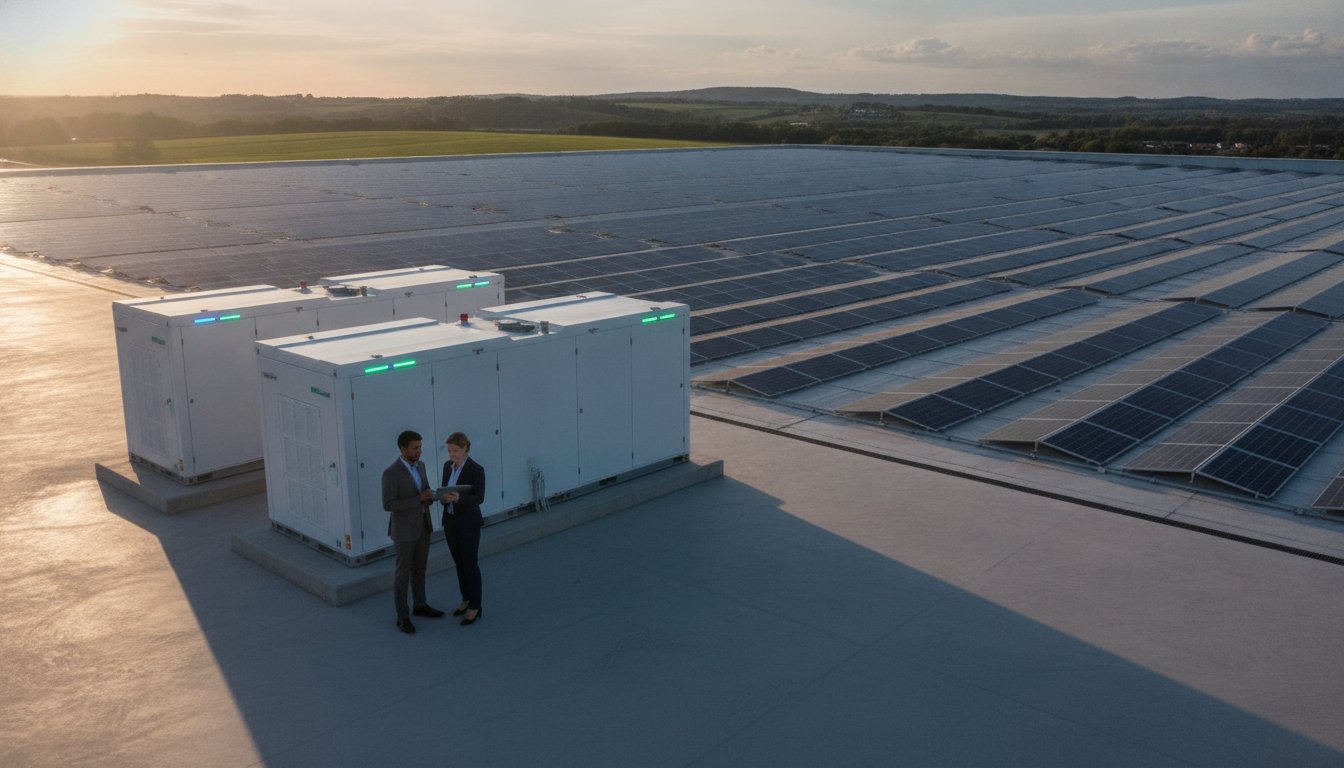
With Transmission Network Use of System (TNUoS) charges forecasted to increase by as much as 120% in 2026, the financial burden of grid dependency has reached a critical threshold for British industry. Investing in industrial battery storage is no longer merely an environmental consideration; it is a strategic necessity for maintaining operational stability whilst energy prices for large users remain significantly higher than the European median. You likely recognise that volatile markets and tightening Net Zero deadlines require a more robust approach to energy management than traditional procurement can offer.
This guide provides the technical and strategic clarity needed to navigate these complexities. It outlines how your organisation can secure genuine energy independence for businesses UK, mitigate peak demand charges, and future-proof operations against a rapidly decarbonising grid. We will examine the essential role of feasibility studies in system sizing, the implications of the Clean Power 2030 Action Plan, and the specific fiscal incentives, such as the Annual Investment Allowance, that support your transition to a resilient energy model.
Key Takeaways
- Understand the evolution of BESS from passive backup units to sophisticated active energy management assets that provide long-term operational resilience.
- Explore the technical synergies between solar PV and industrial battery storage, specifically how AC and DC coupling optimises on-site generation.
- Identify how to mitigate rising TNUoS and DUoS charges through strategic peak shaving and load shifting techniques.
- Learn why utilizing half-hourly data (HH data) within a professional feasibility framework is essential for accurate system sizing and ROI projections.
- Discover the strategic value of a full-turnkey approach, covering everything from initial grid connection management to ongoing operation and maintenance.
What is Industrial Battery Storage? Defining the BESS Ecosystem
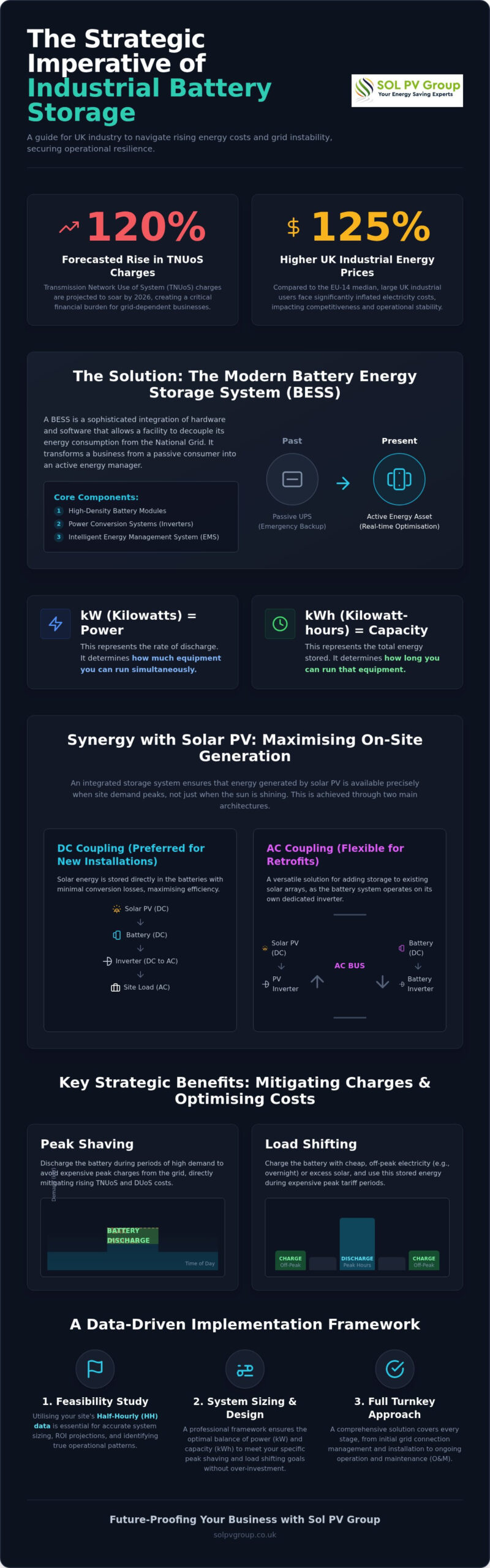
In its most fundamental form, industrial battery storage represents a large-scale energy reservoir designed to capture electricity for use during periods of high demand or grid instability. A Battery Energy Storage System (BESS) is a sophisticated integration of hardware and software. It consists of high-density battery modules, power conversion systems (inverters), and an intelligent Energy Management System (EMS). Together, these components allow a facility to decouple its energy consumption from the immediate supply of the National Grid.
Historically, many UK businesses viewed batteries as simple uninterruptible power supplies (UPS) meant only for emergency backup. That perspective has changed. Modern systems function as active energy management assets that optimise consumption patterns in real time. They don’t just sit idle; they constantly monitor grid pricing and site demand to ensure the most cost-effective power source is utilised at any given moment. For UK businesses, 2026 is a pivotal year for adoption. With TNUoS charges set to increase by up to 120% and the Clean Power 2030 targets accelerating, the transition from passive consumer to active energy manager is now a requirement for financial resilience.
The Role of BESS in the Modern UK Energy Landscape
The UK grid is undergoing a massive transformation. As coal and gas are replaced by intermittent wind and solar, the grid experiences greater frequency fluctuations. Industrial sites are filling this gap. By adopting “prosumer” status, factories aren’t just consuming power; they’re providing the flexibility the National Grid requires to remain stable. This shift directly counters the volatility of UK energy prices. Large industrial users paid an average of 25.33p per kWh in the first half of 2025, a figure that remains 125% above the EU-14 median. An integrated storage system provides a buffer against these extreme market conditions.
Key Terminology: kW vs kWh for Business Leaders
Understanding the distinction between power and capacity is critical for system sizing and accurate ROI projections. kW (Kilowatts) represents the rate of discharge; it determines how much equipment you can run simultaneously. kWh (Kilowatt-hours) represents the total energy stored; it determines how long you can run that equipment. At an industrial scale, BESS capacity typically ranges from several hundred kilowatt-hours to multiple megawatt-hours, specifically engineered to support heavy manufacturing loads or high-volume logistics hubs. Selecting the wrong ratio between these two metrics can lead to stranded assets or insufficient peak shaving capabilities.
The Technology: How Commercial Energy Storage Integrates with Solar
The technical synergy between commercial solar PV installation UK systems and battery assets is a cornerstone of modern industrial efficiency. Whilst solar arrays generate direct current (DC) electricity during daylight hours, an integrated storage system ensures this energy is available precisely when site demand peaks. This relationship is managed through two primary architectural approaches: AC coupling and DC coupling. In an industrial context, DC coupling is often preferred for new installations because it allows solar energy to be stored directly in the batteries with minimal conversion losses. Conversely, AC coupling provides a flexible solution for retrofitting storage to existing solar arrays, as the battery system operates on its own dedicated inverter.
Effective energy management relies on sophisticated Energy Management System (EMS) software. This software acts as the brain of the facility, prioritising solar self-consumption over expensive grid imports. It doesn’t just store power; it intelligently predicts load requirements and weather patterns to determine the optimal time to charge or discharge. The UK Battery Strategy highlights the importance of such high-specification infrastructure for national resilience. For businesses, this means investing in Tier 1 hardware that’s engineered for longevity. Industrial environments are often harsh, requiring components that can withstand temperature fluctuations and high-cycle demands without significant performance degradation.
Maximising Solar ROI with Storage
Without industrial battery storage, businesses often find themselves “spilling” excess solar energy back to the grid. In 2026, Smart Export Guarantee (SEG) rates remain as low as 3p per kWh, whilst commercial purchase rates are significantly higher. Storage allows you to bypass the export limitations frequently imposed by District Network Operators (DNOs), ensuring every kilowatt-hour generated on-site is used to offset your own operational costs. Understanding the solar payback period commercial organisations can realistically achieve is essential when building the financial case for combining solar PV with battery storage. For those in heavy industry, our Battery Storage for Factories insights detail how this resilience protects sensitive machinery from grid-based voltage drops.
Battery Chemistries: Why Lithium-Ion Dominates Industrial Applications
Lithium Iron Phosphate (LFP) has emerged as the industry standard for commercial applications, largely due to its superior safety profile and extended cycle life compared to Nickel Manganese Cobalt (NMC) alternatives. LFP cells offer greater thermal stability, which is a critical factor when managing the large energy volumes typical of industrial battery storage. Most modern Tier 1 systems are designed for a lifespan of 10 to 15 years, provided they’re supported by robust thermal management systems. These cooling mechanisms prevent the internal heat buildup that accelerates cell degradation, ensuring the system maintains its capacity through thousands of charge-discharge cycles. A coordinated approach ensures that your infrastructure remains scalable as your energy requirements evolve. You might find it useful to explore our turnkey battery storage solutions to see how these systems integrate with your current site layout.
Strategic Benefits: Peak Shaving, Load Shifting, and Revenue
The financial justification for industrial battery storage has shifted from simple cost avoidance to a multi-layered revenue strategy. For most UK businesses, the primary driver is the mitigation of non-commodity costs, which now constitute a significant portion of the total electricity bill. By utilising stored energy during peak periods, an organisation can effectively “shave” its maximum demand profile. This is particularly critical in 2026 as TNUoS charges are forecasted to rise by up to 120%. A well-timed discharge from your battery system ensures that your site’s recorded peak remains low, directly reducing the standing charges and levies applied by the National Grid.
Equally important is the practice of load shifting. This involves purchasing electricity from the grid during off-peak hours when prices are at their lowest; often overnight; and storing it for use during the expensive daytime windows. With commercial rates for large industrial users averaging 25.33p per kWh in the first half of 2025, the arbitrage opportunity is substantial. Beyond these daily savings, the system provides an instantaneous buffer against power instability. For facilities with sensitive electronics or continuous production lines, the ability of an industrial battery to take over the load within milliseconds prevents the catastrophic financial losses associated with unplanned downtime. Organisations seeking a broader strategic context for these decisions can benefit from reviewing the latest energy independence for businesses UK strategic trend analysis, which examines how rising non-commodity costs are reshaping operational priorities across British industry.
Revenue Generation via Grid Services
Your energy assets can also function as a proactive source of income through grid balancing services. Programmes such as Dynamic Containment allow businesses to get paid for helping the National Grid maintain frequency stability. Because managing these rapid market fluctuations requires specialised software and constant monitoring, most firms work with third-party aggregators. These partners bundle the capacity of multiple business batteries to participate in the Capacity Market or frequency response auctions. This creates a secondary revenue stream that significantly shortens the payback period of the initial capital investment.
Sector-Specific Applications: Logistics and Manufacturing
The strategic value of storage varies across different industrial landscapes. In the transport and logistics sector, firms are increasingly using batteries to manage the high-demand spikes caused by rapid EV fleet charging. Without on-site storage, the grid connection required to charge a full fleet of electric HGVs would often necessitate a prohibitively expensive substation upgrade. In manufacturing, the focus is often on protecting high-demand machinery and ensuring that voltage sags don’t trigger equipment resets. Our case studies demonstrate how UK manufacturers have successfully integrated these systems to stabilise their operational costs whilst meeting stringent carbon reduction targets. This tailored approach ensures that the technology addresses the specific pain points of your industry rather than offering a generic solution.
Planning and Implementation: The Feasibility Framework
The successful implementation of industrial battery storage requires a methodical, highly structured approach that mirrors a professional project management lifecycle. This isn’t a “plug-and-play” technology; it’s a strategic infrastructure upgrade that must be integrated with your existing electrical distribution. The process begins with a formal G99 application to your local Distribution Network Operator (DNO). This step is critical to ensure the local grid can accommodate the specific charge and discharge rates of your system. Without this approval, even the most advanced hardware cannot be legally connected to the network.
Whilst technical specifications are vital, the foundation of a high-performing system is data. Accurate modelling relies on at least 12 months of half-hourly (HH) data. This granular information allows engineers to identify the precise timing of your site’s peak demand and the periods of lowest consumption. By mapping this data against your solar yield and current tariff structures, we can simulate how a battery will behave in real-world conditions. Containerised battery solutions typically require formal planning permission. These units are significant physical assets, often housed in 20ft or 40ft steel containers, and local authorities will assess their placement regarding site boundaries and access for maintenance. To ensure your project meets all highways and access requirements, you can visit ML Traffic Engineers UK for specialist transport planning support.
The Importance of a Feasibility Study
Attempting to use “off-the-shelf” sizing for an industrial facility almost always results in a sub-optimal ROI. A bespoke feasibility study is essential to ensure the system is neither under-sized, which misses peak shaving opportunities, nor over-sized, which leads to unnecessary capital expenditure. A professional study evaluates your current load profiles whilst accounting for future expansion plans, such as the integration of EV charging hubs or additional manufacturing capacity. To begin this technical assessment, you can book a free solar and battery strategy session with our specialist team.
Safety, Fire Suppression, and Compliance
Safety and corporate compliance are paramount when housing large-scale energy assets. Industrial BESS units must adhere to stringent international standards, including IEC 62619, which governs the safety of secondary lithium cells and batteries. Modern systems incorporate integrated fire suppression technology, utilising clean agents like FM-200 or Novec 1230. These systems are designed to detect and neutralise thermal events at the rack level before they can impact the wider facility. From an insurance perspective, documenting these safety features is a prerequisite for coverage. Insurers in 2026 require evidence of robust thermal management and automated shutdown protocols to mitigate the perceived risks of large-scale lithium-ion installations. For a detailed overview of how to evaluate and specify compliant systems, including the new Chapter 57 of the BS 7671 wiring regulations mandatory from October 2026, our commercial battery storage UK investment and specification guide provides a comprehensive framework for procurement and compliance planning.
Future-Proofing Your Business with Sol PV Group
Sol PV Group operates as a seasoned expert within the industrial landscape, providing end-to-end turnkey solutions for battery storage. We understand that high-level decision-makers require more than just hardware; they require a partner who manages the entire project lifecycle with meticulous care. By maintaining a single point of contact from the initial feasibility study through to final commissioning, we eliminate the friction and technical gaps often found in fragmented delivery models. This integrated approach ensures that every component of your industrial battery storage system is optimised for your site’s specific load profile and long-term commercial objectives.
Securing a return on investment requires more than a successful installation. It demands rigorous ongoing asset protection. Our Operation and Maintenance (O&M) packages are designed to safeguard the longevity of your battery cells and power conversion systems. Through proactive performance monitoring, our engineers identify and resolve technical anomalies before they impact your site’s availability. This commitment to transparency and operational excellence guarantees the uptime necessary to meet your financial targets and carbon reduction commitments.
Integrating EV Charging and Solar Carports
As businesses transition their fleets to electric vehicles, the demand on the local grid increases significantly. Industrial battery storage acts as the central intelligence for sites incorporating solar carports. It manages the high-power requirements of rapid EV charging by buffering the load, allowing you to deploy extensive charging infrastructure without the need for a prohibitively expensive substation upgrade. This holistic strategy transforms your parking areas into active energy generation and storage hubs, supporting your corporate decarbonisation goals whilst providing a reliable service to employees and visitors.
Next Steps: Securing Your Energy Strategy
The path toward energy resilience begins with a detailed technical consultation. Our process is methodical and data-driven, starting with the collection of your site’s energy data to build a precise financial model. From the initial enquiry, most industrial systems move from design to a fully operational state within a structured timeline that respects your operational requirements. If you’re ready to secure your business against grid volatility, we invite you to request your free solar and battery strategy review today. Our team will provide the clarity and technical roadmap needed to transform your energy profile into a competitive advantage.
Securing Your Corporate Energy Resilience
The transition toward industrial battery storage represents a fundamental shift in how UK businesses manage their operational overheads. By moving beyond passive consumption and embracing active energy management, your organisation can effectively neutralise the impact of rising grid charges and volatile market rates. We’ve explored how the integration of BESS with solar infrastructure and EV charging hubs creates a cohesive energy ecosystem that supports both financial stability and carbon reduction targets.
Sol PV Group provides the technical expertise and national coverage required to deliver these complex, large-scale projects. Our full-turnkey solution handles everything from initial feasibility studies using your half-hourly data to long-term operation and maintenance. As specialists in the manufacturing and logistics sectors, we ensure your system is engineered for the high-demand environments typical of British industry. Taking the first step towards energy independence is a strategic decision that will define your competitive standing for years to come. Book your free commercial solar and battery strategy session to begin your technical assessment. We look forward to supporting your business growth through precision-engineered energy solutions.
Frequently Asked Questions
How long does an industrial battery storage system typically last?
Most Tier 1 systems are designed to operate for 10 to 15 years before significant capacity degradation occurs. This lifespan is measured in charge-discharge cycles rather than years alone. Utilising Lithium Iron Phosphate (LFP) chemistry ensures greater thermal stability and longevity, whilst professional operation and maintenance packages help preserve the health of the cells through thousands of cycles.
Can my business get paid for storing energy and selling it back to the grid?
Yes, your organisation can generate revenue by participating in grid balancing services such as Dynamic Containment or the Capacity Market. By working with an aggregator, your industrial battery storage asset can respond to frequency fluctuations in the National Grid. These programmes pay businesses for their flexibility, providing a secondary income stream that complements the savings made through reduced grid consumption.
What is the difference between peak shaving and load shifting?
Peak shaving focuses on reducing your site’s maximum demand during expensive periods to lower TNUoS and DUoS charges. Load shifting involves purchasing energy when it’s cheapest, typically overnight, and storing it for use during high-tariff daytime windows. Whilst peak shaving targets specific grid levies, load shifting is a broader strategy used for energy arbitrage and cost stabilisation.
Do I need planning permission for a large industrial battery installation?
Formal planning permission is generally required for containerised systems, as they’re considered significant physical structures. Local authorities evaluate these applications based on site placement, safety protocols, and noise levels from cooling fans. Smaller internal installations may sometimes fall under permitted development, but it’s essential to consult with a specialist during the feasibility stage to ensure all regulatory requirements are met.
How much space is required for a commercial battery energy storage system?
Space requirements vary based on capacity, but a typical 1MW system is often housed within a 20ft or 40ft steel shipping container. You must also account for mandatory clearance zones required for thermal management, maintenance access, and fire safety equipment. A professional site survey identifies the most efficient placement to minimise cabling distances whilst adhering to all safety distances from existing buildings.
Can an industrial battery provide power during a total grid blackout?
Yes, provided the system is specifically engineered with “island mode” or backup functionality. This setup requires specialised inverters and switchgear that can safely disconnect your facility from the National Grid during a failure. This ensures your critical production lines or sensitive electronics remain operational, protecting your business from the significant financial losses associated with unplanned downtime.
Is lithium-ion the only technology used for industrial energy storage?
Whilst lithium-ion, specifically Lithium Iron Phosphate, is the current industry standard for industrial battery storage, other technologies like flow batteries do exist. However, LFP remains the preferred choice for most UK commercial applications in 2026 due to its high energy density, proven safety record, and declining capital costs. It offers the most reliable balance of performance and ROI for standard industrial load profiles.
What is the typical ROI period for a UK industrial battery project?
Most UK businesses see a full return on investment within 5 to 8 years. This timeline depends on your current energy tariff, the volume of on-site solar generation, and your participation in grid services. For a detailed breakdown of how to calculate your projected returns, our guide on the solar payback period for commercial PV projects in 2026 provides a comprehensive framework for board-level financial planning. Utilising the Annual Investment Allowance (AIA) can also provide significant tax relief in the first year, effectively reducing the net cost of the project and accelerating your path to profitability.