
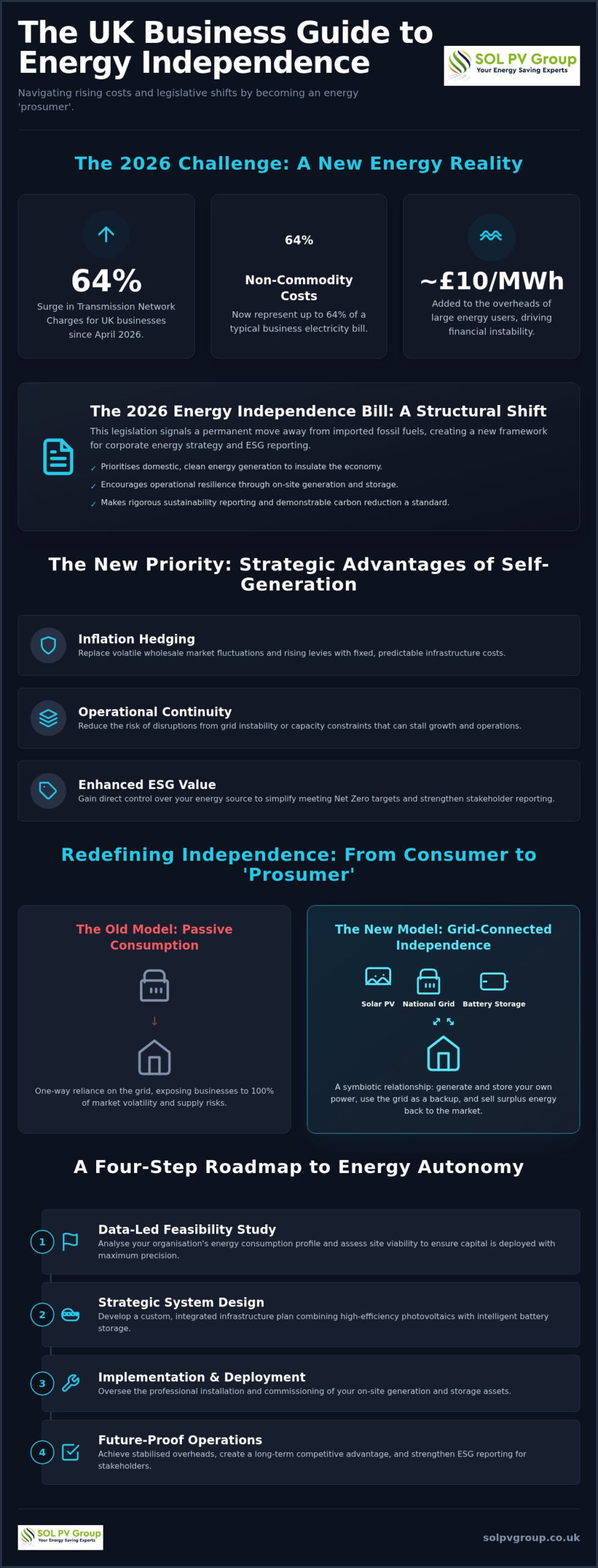
Did you know that as of April 2026, transmission network charges for UK businesses have surged by 64%, adding roughly £10 per MWh to the overheads of large energy users? This sharp rise in non-commodity costs, which now account for up to 64% of a typical bill, has transformed energy independence for businesses UK from a sustainability goal into a critical operational requirement. You likely feel the pressure of these escalating costs and the volatility of the international gas market, whilst simultaneously facing the urgent need to meet Net Zero 2030 mandates.
It’s a complex environment where grid capacity constraints can often stall your growth plans. This analysis will show you how to navigate these legislative shifts and leverage technological advancements to secure your energy future. We’ll examine the strategic integration of commercial solar PV and battery storage to eliminate price volatility, whilst highlighting why a comprehensive solar strategy is now the essential first step for navigating the latest energy regulations. You’ll discover how to achieve predictable overheads and demonstrable carbon reduction for your ESG reporting.
Key Takeaways
- Understand the strategic implications of the 2026 Energy Independence Bill and why it represents a permanent structural shift in the UK’s approach to corporate energy procurement.
- Learn how to distinguish between basic grid connectivity and genuine energy independence for businesses UK through the integration of on-site generation and intelligent storage.
- Discover why integrated systems, combining high-efficiency photovoltaics with battery storage, provide greater operational resilience than standalone renewable installations.
- Identify the critical stages of a successful transition to autonomy, starting with data-led feasibility studies to ensure capital is deployed with maximum precision.
- Explore how custom renewable infrastructure creates a long-term competitive advantage by stabilising overheads and strengthening ESG reporting for high-level stakeholders.
The Shift Towards UK Energy Independence: Navigating the 2026 Landscape
The UK energy landscape in 2026 is defined by a fundamental pivot in how corporations view power. It’s no longer just a utility cost to be managed; it’s a strategic asset to be controlled. This evolution is driven by a stark reality: the era of stable grid power at predictable prices has ended. As of April 2026, Transmission Network Use of System (TNUoS) charges surged by approximately 64%, rising from £15.70/MWh to £25.70/MWh. For high-energy users, these non-commodity costs now represent over 60% of their total electricity bill, making the pursuit of energy independence for businesses UK a financial imperative.
The 2026 Energy Independence Bill Explained
The 2026 Energy Independence Bill, a cornerstone of the recent King’s Speech, signals a permanent structural shift away from imported fossil fuels. This legislation provides the necessary framework for accelerating clean energy deployment across the UK energy policy framework. By prioritising domestic generation, the Bill aims to insulate the British economy from the volatility of international gas markets. For businesses, this means that sustainability reporting is becoming more rigorous. You aren’t just expected to reduce carbon; you’re encouraged to prove your operational resilience through self-generation and on-site storage.
Why Businesses are Prioritising Security Over Supply
Security has replaced simple supply as the primary concern for boardrooms. Passive energy consumption is now a liability in a market where the Climate Change Levy (CCL) has risen to £0.00801 per kWh for electricity. To mitigate this, forward-thinking organisations are adopting a “prosumer” model. This involves transitioning toward autonomy by integrating commercial solar PV installation into their existing infrastructure. This shift provides several critical advantages:
- Inflation Hedging: Fixed infrastructure costs replace the unpredictable nature of wholesale market fluctuations.
- Operational Continuity: On-site generation reduces the risk of disruptions caused by grid instability or capacity limitations.
- Enhanced ESG Value: Direct control over energy sources simplifies the process of meeting Net Zero 2030 targets.
Energy independence serves as a definitive hedge against market volatility. When your organisation generates its own power, you’re no longer at the mercy of wholesale price spikes or grid capacity constraints that threaten to stall expansion. Decentralised power systems offer a layer of protection that the national grid currently cannot always guarantee. This approach fosters regional economic resilience, ensuring that your facility remains operational whilst others may struggle with rising costs or supply inconsistencies. It’s about moving from a position of vulnerability to one of strategic strength.
What Does Energy Independence Mean for Modern UK Organisations?
In the current economic climate, energy independence for businesses UK represents a fundamental pivot in operational philosophy. It is no longer a peripheral sustainability initiative; it’s a core pillar of corporate resilience. For a UK business in 2026, energy independence is the strategic capability to insulate core operations from external market shocks through on-site generation and intelligent storage whilst maintaining a resilient, symbiotic connection to the national infrastructure. This definition moves beyond the binary choice of being “on” or “off” the grid. Instead, it focuses on the psychological and financial shift of viewing energy as a controlled asset rather than a volatile variable cost.
Most organisations are not seeking total off-grid operation, which can often be capital-intensive and impractical for high-load industrial sites. Instead, they’re pursuing “grid-connected independence.” This model allows a business to function as a prosumer. You generate and store what you need, use the grid as a sophisticated backup, and trade surplus power back to the market via the Smart Export Guarantee (SEG). This active participation in the energy market addresses a significant gap in traditional procurement strategies, where businesses remained passive victims of price fluctuations.
The Three Pillars of Corporate Autonomy
True autonomy is built upon three integrated technological foundations. First, generation is achieved by installing commercial solar PV systems tailored to the specific orientation and load profile of your facility. Second, storage is facilitated through industrial battery systems that decouple the timing of generation from the timing of consumption. Third, intelligent management software orchestrates these assets. This software handles load shaving and manages peak demand, ensuring your facility avoids the highest tariff periods whilst preparing for the rollout of Market-Wide Half-Hourly Settlement (MHHS).
Beyond Net Zero: The Financial Rationale
The business case for energy autonomy extends far beyond meeting carbon targets. As outlined in the business energy costs blueprint provided by the CBI, reducing exposure to non-commodity costs is essential for long-term competitiveness. By generating power on-site, you effectively bypass a significant portion of the network charges and levies that now constitute the majority of a standard energy bill. This level of fiscal control has a direct impact on business valuation and investor confidence. It demonstrates a proactive approach to risk management that secures predictable overheads for years to come. To begin assessing how these pillars apply to your specific site, you might consider a bespoke energy autonomy assessment to identify immediate savings.
Key Technological Pillars of a Self-Sufficient Energy Strategy
Achieving energy independence for businesses UK requires a transition from fragmented renewable projects to a unified energy ecosystem. Whilst standalone solar arrays provide a foundational reduction in grid reliance, they often fall short of providing total operational security. True autonomy is found in the synergy between high-efficiency generation, industrial-scale storage, and the intelligent use of existing site assets. This technical integration is a primary focus of the British Energy Security Strategy, which encourages the deployment of domestic renewables to insulate the economy from global supply shocks.
The evolution of photovoltaic technology has significantly increased the energy density available for industrial roof spaces. Modern N-type and TOPCon modules offer superior efficiency and lower degradation rates, ensuring that large-scale installations deliver consistent performance over a 25-year lifecycle. However, the hardware is only one part of the equation. The strategic value of these systems is unlocked when they are paired with infrastructure that manages the timing of energy delivery.
Solar PV and Battery Integration
Solar generation alone is often insufficient for high-demand sectors that operate outside of peak daylight hours. To bridge this gap, battery storage systems are essential. These units allow a business to capture surplus energy generated during the midday peak and deploy it during evening production shifts or periods of high grid tariffs. Many manufacturing facilities now utilise this load-shifting capability to avoid the most expensive half-hourly settlement periods. It’s a precise technical solution to the problem of intermittent generation, ensuring that your facility remains powered by its own clean energy 24/7.
This level of energy security is a game-changer for specialist industries like indoor cultivation. By sourcing reliable hydroponic supplies from Discount Hydro and powering operations through integrated renewables, businesses can maintain precise environmental controls while shielding themselves from volatile energy prices.
The Rise of Commercial Solar Carports
Many organisations overlook their most significant underutilised asset: the car park. Commercial solar carports represent a dual-use innovation that transforms parking areas into active power stations. These structures provide sheltered parking for employees and visitors whilst generating substantial amounts of renewable electricity. When integrated with EV charging infrastructure, carports create a self-sustaining ecosystem for corporate fleets. This approach maximises the available footprint of a site without requiring additional land, making it an ideal solution for logistics hubs and retail centres seeking to expand their generation capacity. It’s a logical progression for any business aiming to maximise every square metre of its estate for energy production. Alongside this physical infrastructure, ensuring digital connectivity is equally important; for example, SimOnly Club provides eSIM plans that help mobile teams and international visitors stay connected at these key business hubs.
A Roadmap to Energy Autonomy: Steps for Large-Scale Implementation
Moving from strategic intent to a physical renewable asset requires a methodical approach. It’s not a matter of simply installing hardware; it’s about engineering a system that integrates seamlessly with your existing industrial operations. To achieve genuine energy independence for businesses UK, organisations must follow a lifecycle perspective that begins with rigorous data analysis and extends into lifelong asset management. This structured transition ensures that capital is deployed with precision and that the resulting infrastructure delivers the projected financial and resilience benefits.
The complexity of the 2026 energy market means that guesswork is a significant risk. For large-scale sites, the path to autonomy involves navigating technical bottlenecks, such as grid capacity and structural limitations, whilst ensuring that the system is sized correctly for your specific load profile. A successful implementation follows a logical three-phase progression.
Phase 1: Feasibility and Demand Profiling
Before any capital is committed, you must understand your consumption patterns in granular detail. Analysing half-hourly data is the only reliable method to model peak load requirements and identify where on-site generation can have the greatest impact. This stage involves a comprehensive survey to verify roof structural integrity and orientation for maximum solar yield. We also calculate your “independence ratio,” which is the percentage of your total demand that on-site generation can realistically cover. This data-driven foundation prevents the over-sizing or under-sizing of systems, ensuring maximum efficiency from day one.
Phase 2: Design, Planning, and Grid Connection
System design must be bespoke to the operational reality of the site. For transport and logistics hubs, this often requires balancing vast rooftop solar arrays with high-capacity EV charging infrastructure for electric fleets. A critical hurdle in 2026 remains the G99 grid connection application. Navigating the requirements of the Distribution Network Operator (DNO) is a complex task that requires technical expertise to secure approval for large-scale export or storage. Professional management of these applications is essential to avoid delays that could stall your operational expansion or sustainability targets.
Phase 3: Commissioning and Asset Management
Commissioning is the final step in the transition from construction to operation. It involves rigorous testing to ensure all safety and performance standards are met before the system is energised. To protect the 25-year lifespan of these assets, professional operation and maintenance (O&M) packages are essential. Real-time monitoring software allows management-level professionals to track independence metrics and carbon reduction in real-time. This ongoing support ensures the system continues to operate at peak efficiency, providing a stable and secure energy future for the organisation. To determine the most effective roadmap for your facility, you can request a comprehensive solar strategy assessment to evaluate your site’s potential.
Future-Proofing Operations Through Custom Renewable Infrastructure
The transition to energy independence for businesses UK is no longer a speculative venture. It is a calculated response to a volatile global energy market and a domestic grid that is increasingly stretched. By internalising power generation and storage, organisations move from a state of vulnerability to one of structural stability. This strategic shift ensures that energy becomes a regulated asset rather than a fluctuating risk that threatens margins and operational growth. In an era of rapid legislative change, the ability to decouple your overheads from the wholesale market is a primary driver of long-term commercial viability.
This drive for long-term viability is often supported by robust digital systems, where SolaaS Limited provides the tailored IT and telecommunications infrastructure needed to maintain operational flexibility in a changing market.
The Strategic Advantage of Early Adoption
Securing grid capacity is a primary concern for industrial and commercial operators. As regional constraints increase due to the rapid electrification of heat and transport, the window for connecting large-scale renewable assets is narrowing. Early adopters gain a significant advantage by securing their connection agreements now, whilst also locking in long-term energy costs that are immune to wholesale market spikes. This foresight protects the bottom line and enhances brand reputation amongst stakeholders who prioritise demonstrable ESG performance. Businesses that act decisively will find themselves in a position of strength, whilst competitors remain exposed to the escalating non-commodity costs and network charges that characterise the current landscape.
This drive for electrification is not limited to industry; domestic upgrades are equally vital, with firms like WellPlumbed playing a key role in modernising residential heating systems to support the UK’s broader net-zero ambitions.
Partnering for Long-Term Success
Navigating the end-to-end complexity of commercial solar requires more than just a vendor; it requires a partner who understands the nuances of the industrial landscape. Sol PV Group provides a full-turnkey approach that manages everything from initial feasibility and DNO applications to installation and ongoing O&M. Our extensive experience in high-demand sectors ensures that technical transitions are handled with meticulous care, minimising disruption to your core operations. We prioritise a strategy-first methodology, ensuring that every kilowatt of capacity is designed to deliver maximum financial and operational value for the specific footprint of your site.
The path to a decentralised and secure energy future begins with a clear understanding of your facility’s potential. By integrating solar PV, battery storage, and EV infrastructure into a single, managed ecosystem, you can effectively eliminate price volatility and secure your operational future for the next 25 years. This is the definitive way to future-proof your organisation against the uncertainties of the next decade. To begin this transition and evaluate the specific requirements of your estate, you can Request your free solar strategy and feasibility assessment to identify the most effective route to autonomy for your business.
Securing Your Operational Resilience in a Decentralised Market
The transition towards energy independence for businesses UK represents a definitive shift from passive utility consumption to active asset management. By integrating commercial solar PV with industrial battery storage, your organisation can effectively bypass the volatility of wholesale prices and the rising burden of network charges. This strategic autonomy doesn’t just meet carbon targets; it provides a structural hedge against inflation and grid instability that protects your bottom line for the next 25 years.
Sol PV Group facilitates this evolution through full-turnkey commercial solar solutions tailored for the specific demands of the manufacturing and logistics sectors. Our expertise in specialised industrial battery storage integration ensures that your facility remains operational whilst maintaining a competitive edge in a rapidly changing legislative environment. Precision in planning and execution is the foundation of a secure energy future.
Secure your business energy future with a Free Solar Strategy. Taking control of your power generation is a significant step toward long-term stability and growth. We’re ready to help you navigate this transition with the meticulous care your operations deserve.
Frequently Asked Questions
What is the UK Energy Independence Bill and how does it affect my business?
The UK Energy Independence Bill is a legislative framework designed to accelerate the deployment of clean, domestic energy to reduce reliance on volatile international gas markets. For your organisation, this Bill signals a permanent shift in corporate procurement by introducing stricter sustainability reporting standards and incentivising on-site generation. It effectively mandates a more proactive approach to energy security to insulate the broader economy from global supply shocks.
Can a business be 100% energy independent in the UK?
Achieving 100% independence is technically possible but often commercially impractical for high-load industrial facilities. Most organisations pursue a “grid-connected independence” model instead. This approach allows you to generate and store the majority of your power whilst maintaining a grid link for backup and trading surplus electricity through the Smart Export Guarantee. It provides the best balance of security and financial flexibility.
How long does it take to achieve ROI on a commercial solar and battery system?
Return on investment typically depends on your specific consumption profile and current energy tariffs. Many UK businesses see a full return within several years; a timeline often accelerated by the government’s “full expensing” capital allowance. This tax relief allows you to claim a 100% first-year deduction on qualifying plant and machinery, including solar panels and battery storage, significantly improving the initial financial viability of the project. For a detailed breakdown of projected returns and how to build a board-level financial case, our guide to the solar payback period for commercial PV installations in 2026 provides a comprehensive framework for calculating your specific ROI.
What are the main barriers to energy independence for UK manufacturing firms?
Grid capacity constraints and DNO application complexities are the primary barriers facing manufacturing firms today. Many sites also struggle with the structural integrity of older roof spaces or the high initial capital requirement for integrated systems. Overcoming these hurdles requires a professional feasibility study to identify technical solutions, such as commercial solar carports, which bypass roof limitations whilst delivering the necessary generation capacity for heavy machinery.
Does energy independence require a business to go completely off-grid?
Energy independence doesn’t require your business to disconnect from the national grid entirely. In fact, staying connected is a strategic advantage for energy independence for businesses UK. It allows your facility to operate as a prosumer, using the grid as a sophisticated safety net whilst selling excess power back to suppliers. This hybrid model ensures 24/7 operational continuity without the extreme costs of total off-grid infrastructure.
How does battery storage improve a business’s energy independence ratio?
Battery storage improves your independence ratio by decoupling the timing of energy generation from the timing of consumption. Without storage, any solar power generated during midday that isn’t used immediately is exported. By capturing this surplus—potentially using modular units from advanced manufacturers like greenSANE—you can power evening production shifts or avoid expensive peak grid tariffs. This technical integration ensures that a higher percentage of your total energy demand is met by your own clean generation.
Are there government grants available for business energy independence in 2026?
Support in 2026 is primarily delivered through targeted relief schemes and tax incentives rather than direct universal grants. Eligible energy-intensive industries can access the British Industry Supercharger (BIS) for up to 90% relief on network charges. Additionally, the Industrial Energy Transformation Fund (IETF) provides grants for specific decarbonisation projects. Most businesses benefit most from “full expensing,” which provides immediate tax relief on the total cost of renewable infrastructure.
What is the role of a feasibility study in achieving energy autonomy?
A feasibility study serves as the data-led foundation for your entire transition toward energy independence for businesses UK. It involves a granular analysis of your half-hourly settlement data to ensure the proposed system is sized accurately for your load requirements. This stage identifies potential technical bottlenecks, such as grid connection limits or roof orientation, before any capital is committed. It’s the essential first step to ensure long-term asset performance. Understanding the commercial solar payback period at this stage is equally critical, as it allows stakeholders to validate the financial assumptions underpinning the entire project before capital is deployed.