
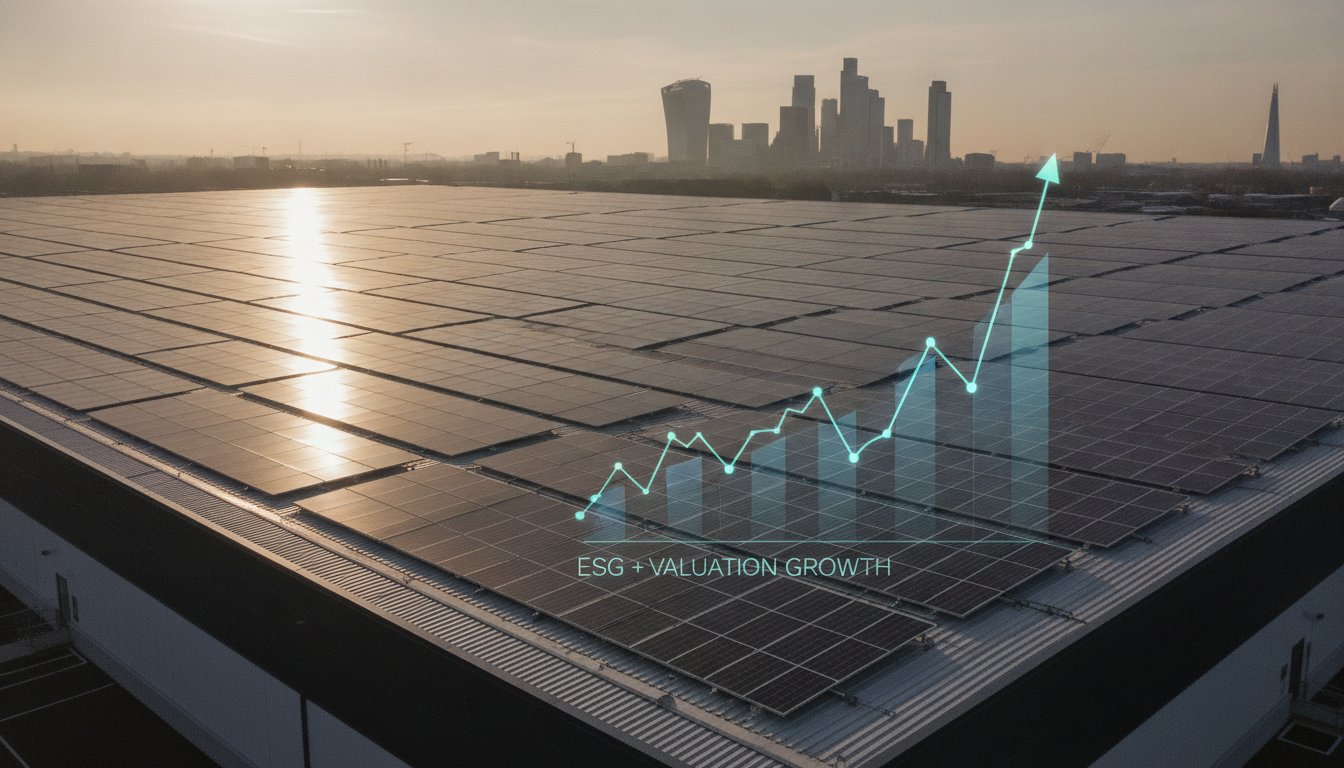
Why are forward-thinking UK directors now treating solar PV as a strategic financial instrument rather than a simple utility upgrade? In a landscape where energy price volatility directly threatens EBITDA, the impact of commercial solar on business valuation has become a critical metric for shareholders. You’ve likely recognised that traditional cost-cutting measures have reached their limit, whilst pressure from institutional investors to meet stringent ESG targets continues to intensify.
We understand the uncertainty involved in quantifying green assets during a complex business sale or property appraisal. This strategic guide provides a definitive framework for converting operational savings into tangible increases in exit multiples and property yields. We will examine how professional solar installations improve EPC ratings and de-risk your long-term expenditure, ensuring your organisation remains attractive to high-level acquirers in 2026 and beyond. By the end of this guide, you’ll possess the data-driven insights required to present solar infrastructure as a premium balance sheet asset that secures institutional confidence and long-term stability.
Key Takeaways
- Understand how converting operational energy savings into bottom-line profit directly expands your EBITDA exit multiples.
- Quantify the positive impact of commercial solar on business valuation by securing long-term energy price stability and de-risking the balance sheet.
- Discover how robust ESG credentials attract institutional investors and unlock access to preferential green finance and lower interest rates.
- Identify the relationship between solar infrastructure, improved EPC ratings, and the potential for achieving a ‘Green Rent Premium’ on commercial assets.
- Evaluate the strategic financial advantages of different funding models to ensure your solar asset is optimised for maximum valuation uplift.
The Financial Link: How Solar PV Directly Influences Business Valuation
Business valuation is fundamentally a reflection of risk and projected future earnings. By integrating solar, a company transforms a volatile liability into a predictable asset. This shift has a profound impact of commercial solar on business valuation, as it permanently lowers the cost of production or operation. Investors in 2026 don’t just view solar as an environmental choice; they see it as a strategic shield against the energy market’s inherent unpredictability.
Boosting EBITDA Through Operational Efficiency
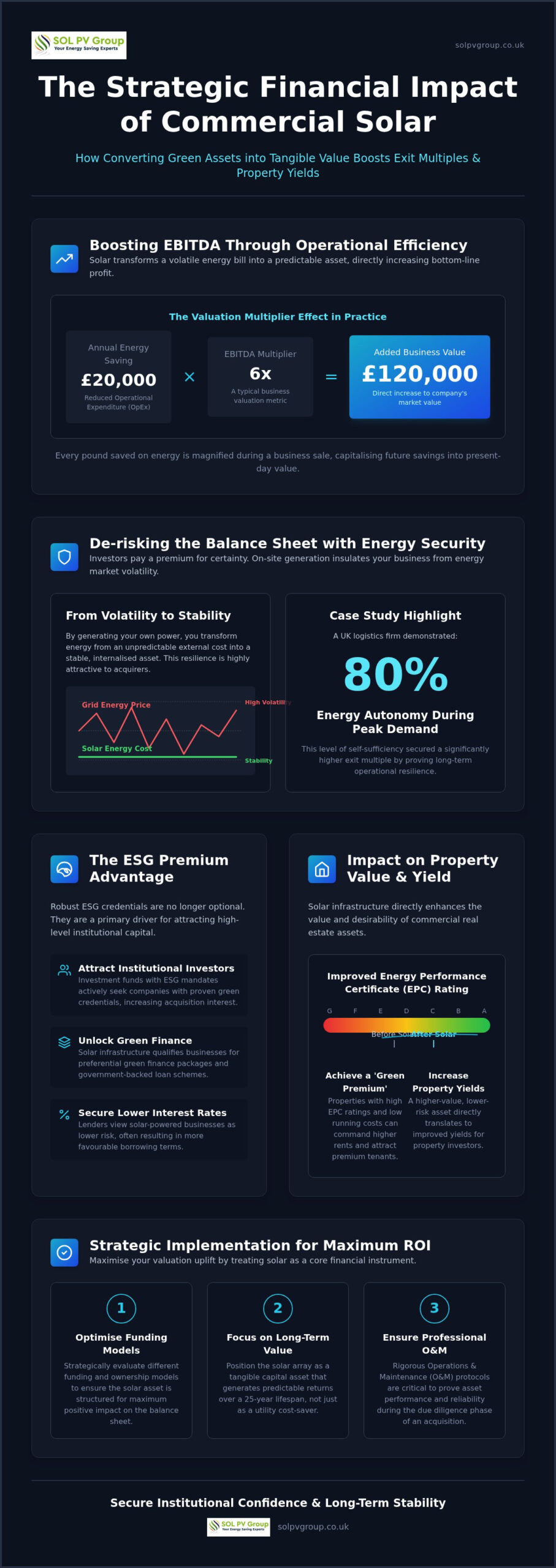
Utility bills are traditionally classified as variable Operational Expenditure (OpEx). Reducing this figure has a direct, pound-for-pound impact on net income. Because business valuations are often calculated as a multiple of EBITDA (Earnings Before Interest, Taxes, Depreciation, and Amortisation), every pound saved is magnified during a sale. For instance, a manufacturing facility that achieves a £20,000 reduction in annual energy costs doesn’t just gain £20,000 in cash flow. If that firm is valued at a 6x multiplier, the solar installation has effectively added £120,000 to the company’s market value. In 2026, the EBITDA multiplier for solar assets represents a capitalised value of future energy savings that buyers are increasingly willing to pay a premium for. This financial clarity is underpinned by the reliability of modern photovoltaic (PV) technology, which provides consistent yields over a 25-year lifespan.
Solar as a Tangible Capital Asset
Moving energy costs from a variable expense to a fixed, owned asset changes the complexion of the balance sheet. Whilst traditional machinery depreciates, a solar array continues to generate value by offsetting market-rate electricity purchases. When assessing the overall impact of commercial solar on business valuation, acquirers prioritise assets that demonstrate long-term operational resilience. To maintain this book value, rigorous solar PV operation and maintenance UK protocols are essential. Professional O&M ensures that the hardware performs at peak efficiency, which is a critical detail during the due diligence phase of a business acquisition. Turnkey installations also reduce friction for potential buyers; they’re acquiring a proven, managed system rather than a technical liability. This transition from buying energy to owning the means of production creates a more robust, self-sufficient enterprise that commands higher institutional confidence.
De-risking the Balance Sheet: Energy Security as a Valuation Multiplier
Business valuation isn’t solely a reflection of current profit; it’s a measure of future certainty. The impact of commercial solar on business valuation is often viewed through the lens of cost reduction, yet the most significant uplift frequently comes from risk mitigation. In a global economy prone to geopolitical shocks and energy market instability, institutional investors prioritise firms that have decoupled their growth from the volatility of the national grid. By generating power onsite, a business effectively immunises its balance sheet against external price spikes that would otherwise erode margins and threaten long-term viability.
Consider the transport and logistics sector, where high-volume cold storage facilities face immense pressure from fluctuating utility rates. A UK-based logistics firm recently secured a higher exit multiple by demonstrating 80% energy autonomy during peak demand periods. This level of self-sufficiency transformed their energy bill from an uncontrollable variable into a predictable, internalised cost. Buyers don’t just see panels; they see a business that has secured its operational future for the next 25 years.
Mitigating Future Energy Volatility
The transition from “just-in-time” energy procurement to energy self-sufficiency is a hallmark of resilient 2026 business models. Relying on the grid during peak hours exposes a company to significant price premiums and potential supply constraints. Integrating industrial battery storage allows a firm to capture excess solar generation and deploy it when grid prices are at their highest. This technical capability provides a robust hedge against inflation, ensuring that financial forecasting for manufacturing and industrial entities remains accurate and stable regardless of wider market conditions.
Long-term Cost Certainty for Prospective Buyers
Acquirers pay a premium for businesses with predictable overheads. When two companies with identical revenues are compared, the one with “locked-in” energy costs for the next two decades will always command a higher valuation. This certainty allows management to bid more aggressively on long-term contracts, knowing their production costs won’t be derailed by a sudden hike in electricity prices. While some academic research has explored the impact on nearby property values in residential settings, the industrial consensus is clear: energy independence is a massive value driver. If you’re looking to understand how these dynamics apply to your specific site, requesting a bespoke energy strategy can clarify your potential valuation uplift.
The ESG Premium: Attracting Institutional Investors and Green Finance
By 2026, Environmental, Social, and Governance (ESG) criteria have transitioned from elective corporate reporting to fundamental drivers of enterprise value. Institutional investors, particularly private equity firms and pension funds, now apply rigorous carbon-intensity filters to their acquisition targets. The impact of commercial solar on business valuation is significantly amplified in this context; a robust solar infrastructure serves as a verifiable indicator of a firm’s commitment to decarbonisation. When a business demonstrates a clear path to Net Zero through onsite generation, it reduces the perceived regulatory and reputational risk for potential acquirers, often resulting in a premium on the final sale price.
Lowering the Cost of Capital
A high ESG score directly influences a company’s risk profile in the eyes of modern lenders. Financial institutions have increasingly pivoted towards “Green Finance” models, offering preferential interest rates and more flexible terms to businesses with sustainable operations. Installing solar PV is a primary method for companies to qualify for these incentives. By reducing the carbon footprint of their core operations, firms can secure lower-cost debt, which improves cash flow and increases the overall capital available for growth. This visible commitment to corporate responsibility reassures stakeholders that the business is prepared for a low-carbon economy, effectively lowering the long-term cost of capital.
Satisfying Supply Chain Sustainability Requirements
The manufacturing sector faces unique pressures as Tier 1 suppliers are now audited based on their Scope 2 emissions. Global corporations are increasingly mandating that their partners adopt renewable energy to remain within the supply chain. Businesses that fail to meet these standards risk losing high-value, long-term contracts. Conversely, those that leverage energy independence for businesses UK as a core strategy position themselves as “preferred green partners.” This status is a powerful valuation driver. It secures future revenue streams and proves that the company is deeply integrated into the sustainable supply chains of the future. In a competitive market, the ability to guarantee low-carbon production is no longer just an advantage; it’s a prerequisite for institutional confidence and a higher market valuation. For organisations seeking a structured roadmap, decarbonising business energy supply through a phased, strategic approach is the most effective way to satisfy these mandates whilst protecting margins.
Property Value and Yield: The Impact on Commercial Real Estate Assets
While the operational savings discussed earlier bolster a firm’s internal finances, the physical real estate often dictates the ceiling of an enterprise’s worth. The impact of commercial solar on business valuation is perhaps most visible in the appreciation of freehold assets and the preservation of property liquidity. In the UK, a warehouse or factory isn’t merely a shell for production; it’s a financial asset whose yield is increasingly tied to its energy profile. Solar-equipped sites command a significant market advantage over traditional, energy-inefficient properties that face mounting regulatory pressure.
Enhancing EPC Ratings and Compliance
Adhering to the UK’s evolving Minimum Energy Efficiency Standards (MEES) is no longer a peripheral concern for landlords. With projected requirements for commercial rentals to reach an EPC rating of ‘B’ by 2030, many older buildings risk becoming “stranded assets” that cannot be legally leased. Proactive solar installation is a primary lever for jumping multiple EPC bands, ensuring the property remains compliant and marketable. Beyond the roof, commercial solar carports offer a dual-purpose solution that adds significant value to car park infrastructure whilst improving the overall energy rating of the site. These installations signal to prospective buyers that the property is fully future-proofed against the 2027-2030 regulatory shifts.
Attracting High-Quality Tenants
The “Green Rent Premium” is a documented trend where tenants are willing to pay more for premises that offer lower total occupancy costs. Blue-chip companies, particularly in the transport and logistics sector, now prioritise solar-ready buildings to satisfy their own corporate decarbonisation mandates. By providing onsite generation, landlords can offer lower service charges and protection against grid price spikes, which significantly reduces tenant churn. This stability increases the security of the rental income stream, which in turn compresses yields and raises the capital value of the building. To understand how your specific property portfolio can benefit from these dynamics, book a comprehensive commercial solar feasibility assessment to identify your potential valuation uplift.
Quantifying the Impact: Strategic Implementation for Maximum ROI
Achieving a significant uplift in enterprise value requires more than just hardware installation. It necessitates a rigorous alignment of technical execution with fiscal objectives. To truly realise the positive impact of commercial solar on business valuation, directors must decide which financial model best serves their long-term exit strategy. Whilst a Capital Expenditure (CapEx) approach allows for full asset ownership and depreciation benefits, a solar PPA for businesses UK can provide immediate operational savings without the initial capital outlay. This choice often depends on whether the goal is to enhance the balance sheet’s asset base or to maximise immediate cash flow and EBITDA multiples. Beyond the immediate fiscal gains, the long-term impact of commercial solar on business valuation is secured through technical rigour and professional oversight.
Sol PV Group’s turnkey methodology focuses on creating a high-yield, low-maintenance asset that stands up to the technical scrutiny of a buyer’s due diligence team. By providing a seamless transition from initial design to ongoing support, we ensure that the solar infrastructure remains a core value driver throughout its operational lifecycle. This end-to-end capability reduces friction during a business sale, as every aspect of the energy generation is already optimised and documented.
The Feasibility Study: Your Valuation Roadmap
A successful solar project begins with a comprehensive audit of the physical and electrical infrastructure. This involves a detailed analysis of roof structural capacity and grid connection constraints to ensure the system delivers maximum energy yield. Accurately projecting the solar payback period commercial entities can expect is essential for justifying the investment to stakeholders and lenders alike. A professional feasibility study serves as a vital risk-reduction tool, providing investors with the technical certainty required to assign a premium to the asset during a valuation audit.
Partnering for Long-term Asset Protection
The green premium is only preserved if the asset remains in peak condition. Implementing robust solar PV operation and maintenance UK contracts is vital for maintaining the performance levels that justify a higher exit multiple. Prospective buyers will look for a clear, documented history of energy generation and system health to verify the projected savings. By maintaining meticulous records and ensuring hardware longevity, you provide the evidence needed to secure institutional confidence. Ready to increase your business valuation? Request your free solar strategy today.
Securing Your Organisation’s Financial Future in 2026
The transition to renewable energy is no longer a peripheral environmental goal; it’s a core pillar of corporate fiscal strategy. By converting variable operational expenses into a fixed, owned asset, you directly enhance your EBITDA multiples and insulate your firm from market volatility. The impact of commercial solar on business valuation extends from the balance sheet to the physical property, where improved EPC ratings and ESG credentials secure institutional interest and premium rental yields.
As full-turnkey commercial solar specialists with extensive experience in the manufacturing and logistics sectors, Sol PV Group provides the technical precision required to protect your asset’s value. Our UK-wide national coverage ensures that your transition is handled with meticulous care from initial feasibility to long-term maintenance. Investing in solar today is a commitment to the enduring stability and marketability of your business. Begin your journey to a higher business valuation with a free solar strategy and ensure your organisation is positioned as a leader in the low-carbon economy.
Frequently Asked Questions
How much does commercial solar increase business valuation in the UK?
Commercial solar increases valuation by the capitalised value of the annual energy savings it generates. If a logistics facility reduces its annual utility spend by £30,000, that saving is added directly to EBITDA. When a valuation multiple of 6x or 7x is applied, the enterprise value increases by over £180,000. The exact uplift depends on the specific sector multiples and the system’s efficiency.
Is it better to buy solar panels or use a PPA for business valuation?
Buying solar panels through CapEx is generally better for asset-heavy valuations as it adds a tangible asset to the balance sheet. Conversely, a PPA is ideal for firms that want to boost EBITDA without taking on debt or spending capital. The choice depends on whether the prospective buyer values physical asset ownership or a lean, high-margin operational structure.
Does solar PV improve the EPC rating of a commercial building?
Solar PV is a primary driver for improving a commercial building’s EPC rating. By generating renewable energy onsite, a property can often move up several bands, which is essential for complying with the UK’s 2027 and 2030 MEES regulations. A higher EPC rating protects the property’s market value and ensures it remains attractive to blue-chip tenants.
How do institutional investors view commercial solar assets in 2026?
Institutional investors in 2026 view commercial solar as a critical indicator of operational resilience and ESG compliance. Many pension funds and private equity firms now have strict mandates that penalise carbon-intensive assets. Onsite solar generation provides the verifiable data needed to satisfy these mandates, making the business a more attractive and lower-risk target for high-level acquisition.
What is the impact of solar on EBITDA multiples during a business sale?
Solar improves EBITDA multiples by permanently lowering the cost of production and de-risking future earnings. When the impact of commercial solar on business valuation is calculated, buyers often apply a premium multiple to businesses with “locked-in” energy costs. This stability allows for more aggressive bidding on long-term contracts, which further reinforces the company’s market position and overall worth.
Can commercial solar panels be considered a “stranded asset”?
Commercial solar panels are not considered stranded assets; they are the primary tool used to prevent properties from becoming stranded. As UK building regulations become more stringent, properties without renewable infrastructure risk becoming legally un-leasable or unsellable. Solar ensures that a building remains a viable, income-generating asset that meets the highest modern energy standards.
How does battery storage influence the valuation of a solar-ready site?
Battery storage significantly increases site valuation by enabling energy price arbitrage and enhancing self-sufficiency. It allows a business to store solar energy and deploy it during peak grid hours when electricity is most expensive. For manufacturing and logistics sites, this level of energy autonomy is a major selling point that justifies a higher property yield and sale price.
What documentation is needed to prove solar ROI during business due diligence?
To prove ROI during due diligence, you must provide energy generation logs, O&M maintenance records, and the original feasibility study. These documents allow a buyer’s audit team to verify the impact of commercial solar on business valuation with technical certainty. Clear data-led evidence ensures that the operational savings are fully capitalised into the final purchase price of the business.