
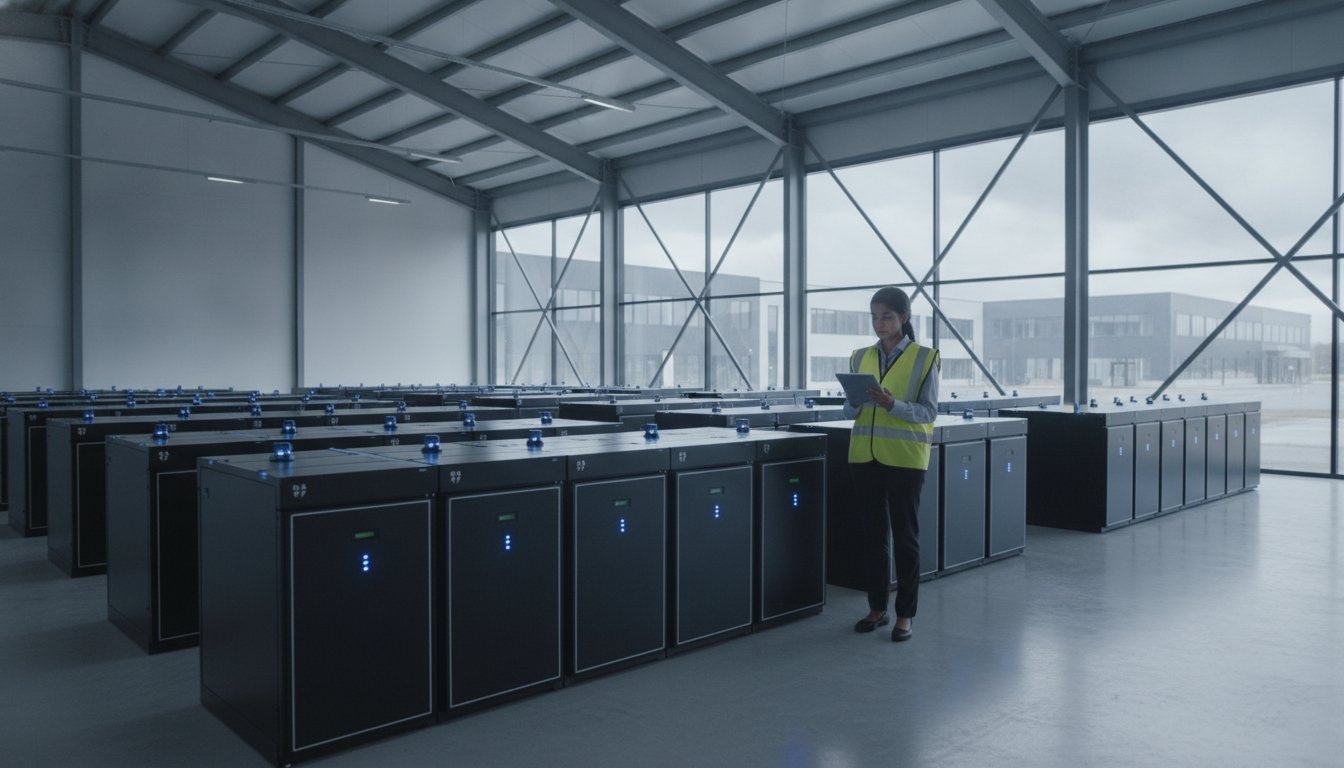
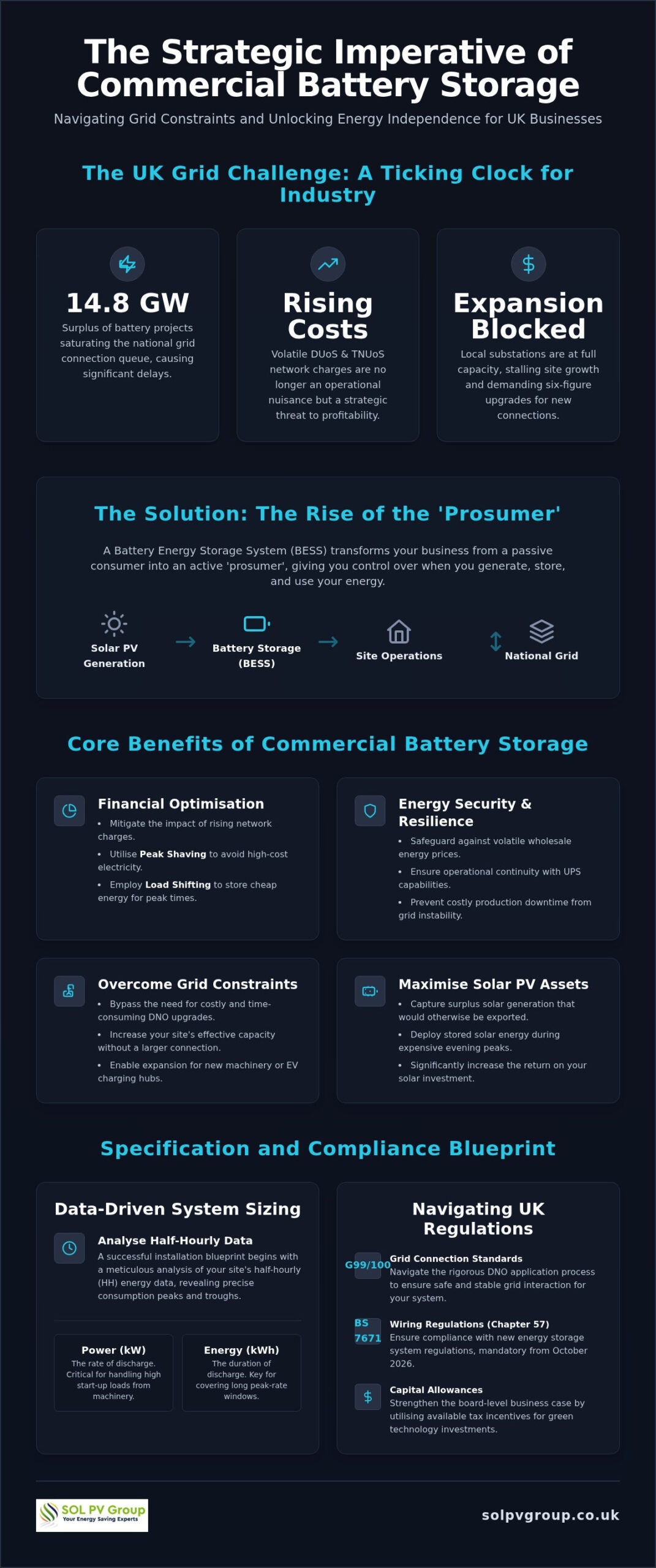
The assumption that grid capacity will expand to meet your site’s growth is a gamble that most UK businesses can no longer afford to take. With a 14.8 GW surplus of battery projects currently saturating the connection queue, securing your energy future requires immediate, evidence-based action. Implementing commercial battery storage UK systems has transitioned from a sustainability goal to a core requirement for industrial resilience. You likely already recognise that rising DUoS and TNUoS charges are no longer just operational nuisances; they’re strategic threats to your bottom line.
We understand that the technical transition to high-capacity storage feels complex, particularly when integrating with existing solar PV assets. This guide provides a comprehensive framework to help you evaluate and specify the right system for your operations. You’ll learn how to navigate the new Chapter 57 of the BS 7671 wiring regulations mandatory from October 2026 and how to utilise capital allowances to strengthen your board-level business case. We’ll outline the exact steps to achieve energy independence and mitigate peak-time costs through a structured, professional approach to energy management.
Key Takeaways
- Identify why energy resilience is now a strategic priority and how commercial battery storage UK systems safeguard against market volatility.
- Learn to interpret half-hourly data to specify the optimal power and energy capacity for your specific industrial requirements.
- Uncover financial optimisation techniques, including peak shaving and load shifting, to mitigate the impact of rising network charges.
- Navigate the rigorous DNO application process and ensure compliance with essential G99 and G100 grid connection standards.
- Understand the value of a comprehensive turnkey solution that manages every stage of the project lifecycle from feasibility to final commissioning.
The Strategic Role of Commercial Battery Storage for UK Businesses
In the current UK energy market, a battery energy storage system (BESS) is no longer an optional “green” addition but a fundamental component of industrial infrastructure. By 2026, the definition of a BESS has evolved into a sophisticated management tool that balances site load, manages solar generation, and interacts with the national grid. UK businesses are rapidly prioritising energy resilience to insulate themselves from volatile wholesale prices and the increasing complexity of the national distribution network.
This shift represents a move from being a passive consumer to an active “prosumer.” Organisations now generate their own power via solar PV and use commercial battery storage UK systems to dictate exactly when they draw from or export to the grid. This level of control is essential for maintaining a competitive edge in energy-intensive sectors.
To better understand how these assets integrate into commercial land and infrastructure, watch this helpful video:
Integrating battery storage with commercial solar PV creates a powerful synergy. Solar generation often peaks when site demand is low, leading to wasted export potential. A BESS captures this surplus energy, allowing it to be deployed during expensive evening peaks or periods of low generation. This process maximises the return on investment for solar assets whilst significantly reducing reliance on external energy suppliers.
Mitigating Grid Constraints and Capacity Issues
Grid capacity constraints often stall site expansion plans for manufacturing and logistics firms. If a local substation is at its limit, a DNO may demand six-figure upgrades before allowing additional load. Commercial battery storage UK installations provide a strategic workaround. By discharging stored energy during peak operational hours, businesses can increase their site’s effective capacity without relying on a larger grid connection. This “buffer” allows for new machinery or EV charging hubs to be installed on sites that would otherwise be restricted by infrastructure limitations. It effectively bypasses the need for costly and time-consuming grid reinforcement projects.
Energy Security and Operational Continuity
For industrial sectors, even a momentary brownout can cause significant financial loss through equipment damage or production downtime. Modern industrial BESS units offer uninterruptible power supply (UPS) capabilities that provide a seamless transition during grid instability. This level of security ensures that critical operations remain functional regardless of external factors. Reliable energy storage acts as a final line of defence for sensitive manufacturing processes and high-demand data environments. You can see how various organisations have implemented these systems to protect their operations by reviewing the Sol PV Group Case Studies.
Key Specification Criteria: Sizing and Capacity Analysis
Specifying a commercial battery storage UK system requires a meticulous analysis of site-specific electrical data rather than simply selecting a pre-configured unit. The blueprint for any successful installation is your half-hourly (HH) data. This granular information reveals the precise peaks and troughs of your energy consumption, allowing engineers to determine the exact requirements for your facility. Without this data, businesses risk installing systems that are either insufficient for peak demand or unnecessarily large, which negatively impacts the return on investment.
A critical technical distinction in the specification process is the ratio between Power (kW) and Energy (kWh). Power represents the rate at which the battery can discharge, whilst Energy dictates how long that discharge can be sustained. For industrial applications, a high power-to-energy ratio is often necessary to handle heavy machinery start-up loads. Conversely, sites focused on load shifting may prioritises total energy capacity to cover longer peak-rate windows. Most modern commercial installations favour Lithium Iron Phosphate (LFP) chemistry due to its superior safety profile and ability to withstand thousands of charge cycles without significant degradation. This technology aligns with the UK’s official battery strategy, which emphasises the development of secure and sustainable supply chains for stationary storage.
Understanding Your Load Profile
Your load profile is the most important factor in preventing over-spending. You must distinguish between your base load, the minimum power required to keep the site operational, and your peak load, which occurs during high-intensity production periods. Industrial machinery often creates “inrush currents” that demand a massive surge of power for a few seconds. If your battery system isn’t specified to handle these start-up currents, it won’t provide the resilience you require. Adopting a load-first approach ensures that capital expenditure is precisely aligned with operational needs, preventing the financial burden of over-specification. To ensure your specification is data-driven, you might consider a bespoke energy strategy review.
Technical Standards and Safety Requirements
Commercial-grade systems must adhere to rigorous UK fire safety and thermal management standards. This includes integrated cooling systems that prevent thermal runaway and sophisticated battery management systems (BMS) that monitor each individual cell. We recommend specifying Tier 1 components from established manufacturers to ensure long-term reliability and warranty support. Furthermore, the physical location of the system dictates the required IP (Ingress Protection) rating. Outdoor containers require high IP ratings to withstand the UK climate, whilst indoor installations must focus on adequate ventilation and floor loading capacity. Future-proofing your investment through modular designs allows for scalable energy growth, enabling you to add more capacity as your site’s demand increases.
Financial Optimisation: Peak Shaving and Revenue Streams
Investing in commercial battery storage UK systems provides two distinct financial levers: immediate cost avoidance and active revenue generation. The most significant saving for industrial sites often comes from peak shaving. By discharging stored power during “Red” DUoS periods, typically between 16:00 and 19:00, businesses can avoid the highest tariff brackets. This strategy also helps in reducing TNUoS charges, which are calculated based on demand during the three highest national peaks. It’s a precise method of shielding your operational budget from the most expensive windows of the day.
Beyond avoiding charges, load shifting allows you to capitalise on price volatility. You can charge your BESS during off-peak windows when rates are lowest and deploy that energy when grid prices spike. This flexibility is supported by UK Parliament research on BESS, which highlights how these systems are essential for managing the intermittent nature of renewable energy whilst providing grid stability. Sophisticated operators can also participate in grid balancing services such as Dynamic Containment or the Capacity Market. These services pay you to help the National Grid maintain frequency levels. When combined with Commercial Solar PV Installations, these revenue streams transform an energy system from a cost centre into a strategic financial asset.
The Economics of Solar and Storage Integration
Storing surplus daytime generation is the most effective way to reduce solar export waste. Instead of exporting excess energy at low SEG rates, which as of July 2026 range from approximately 4p to 12p/kWh, you can store it for use when prices are significantly higher. This integration drastically shortens the Solar Payback Period for Commercial PV by increasing self-consumption rates. Many industrial sites see their self-consumption jump from 40% to over 80% following the installation of a correctly sized battery, ensuring that every kilowatt generated on-site delivers maximum value.
Incentives and Funding Models
Financial planning for the 2026/27 fiscal cycle should leverage current capital allowances to maximise the business case. You can claim a 100% Annual Investment Allowance (AIA) on the first £1 million of qualifying expenditure and a 50% First-Year Allowance (FYA) on the remaining balance. For organisations preferring to preserve capital, Power Purchase Agreements (PPAs) and funded storage models offer a route to implementation with zero upfront cost. These models allow you to benefit from reduced energy bills whilst the provider manages the asset’s performance and maintenance. This approach ensures that technical transitions don’t compromise your liquidity or operational focus.
Navigating UK Grid Constraints and Connection Agreements
Securing a viable grid connection is currently the most significant bottleneck for commercial battery storage UK projects. The assumption that your local network can automatically accommodate a high-capacity BESS is a risk that can derail industrial expansion plans. Every installation must adhere to Energy Networks Association (ENA) standards, specifically G99 for the connection of generation equipment and G100 for technical export limitation. These aren’t merely administrative hurdles; they’re the technical frameworks that ensure your system interacts safely with the national infrastructure without causing voltage instability.
Smart control systems are now essential for managing these agreements. If your District Network Operator (DNO) imposes export limits, an intelligent controller will dynamically throttle your battery discharge to stay within your agreed capacity. This prevents “tripping” the connection whilst ensuring you maximise the use of generated solar power on-site. Sol PV Group provides a full-turnkey approach to this challenge, managing the entire DNO liaison process from the initial G99 application through to final witness testing and commissioning.
The DNO Application Process
The landscape for grid applications has shifted significantly in 2026. Following reforms by the National Energy System Operator (NESO), the “first-come, first-served” queue has been replaced by a “ready-to-connect” model to address the massive oversubscription of battery projects. Final offers for projects connecting up to 2030 were issued by mid-2026, meaning new applicants must demonstrate high levels of site readiness. Comprehensive feasibility studies must precede any hardware procurement. These studies identify the risk of “curtailment,” where the DNO may temporarily restrict your export, allowing you to design a system that remains financially viable under those constraints.
Integration with Site Infrastructure
Site readiness extends beyond the grid connection to your physical electrical architecture. You must assess whether your existing switchgear and transformer capacity can handle the bi-directional power flows inherent in battery charging and discharging. Footprint requirements also vary; containerised outdoor storage requires a reinforced concrete plinth and specific clearance for thermal management, whilst indoor modular systems need climate-controlled environments with high floor-loading tolerances. This infrastructure must be perfectly synchronised with your EV Charging Infrastructure. Batteries act as a critical buffer, providing the high-current bursts required for rapid charging without exceeding your site’s total import capacity. To begin your site-readiness assessment, you can request a bespoke grid feasibility review.
Implementing a Turnkey Solution with Sol PV Group
Deploying commercial battery storage UK infrastructure is a sophisticated engineering undertaking that requires more than just hardware procurement. A successful project depends on the seamless integration of feasibility analysis, grid negotiation, and precision installation. Sol PV Group provides a comprehensive end-to-end service, ensuring that every stage of the project lifecycle is handled with professional diligence. This turnkey approach eliminates the operational risks of managing disparate contractors and ensures that the final system is perfectly synchronised with your site’s unique electrical architecture.
Operational excellence doesn’t end at commissioning. Long-term performance is secured through bespoke Solar PV Operation and Maintenance packages tailored for industrial-scale storage. Our team utilises advanced remote performance monitoring to track system health and efficiency in real-time. This preventative care model identifies potential anomalies before they escalate into operational downtime, ensuring your investment continues to deliver maximum energy resilience for its entire service life.
Sector-Specific Expertise
Energy profiles vary significantly across different industrial landscapes, and a one-size-fits-all approach often leads to inefficiency. For Manufacturing facilities, our designs prioritise high discharge rates to support heavy machinery start-up currents and protect against grid instability. In the transport and logistics sector, we focus on the synergy between storage and EV hubs to manage the high-current bursts required for rapid charging. Educational institutions often require systems that prioritise load shifting to align with specific term-time consumption patterns. This deep understanding of sector-specific requirements makes Sol PV Group a trusted advisor for high-level decision-makers across the UK.
The Path to Energy Independence
Securing your organisation’s energy future is a methodical process that begins with accurate data. To start your commercial storage journey, we recommend following this strategic checklist:
- Consolidate 12 months of half-hourly energy data to establish your baseline load profile.
- Identify any planned site expansions or upcoming EV charging requirements.
- Locate your current grid connection agreements and any existing G99 or G100 documentation.
- Request a comprehensive site feasibility study to evaluate physical footprint and grid capacity.
Taking these steps ensures that your transition to an active prosumer model is evidence-based and financially sound. By partnering with an expert who understands the complexities of the 2026 UK energy landscape, you can protect your operations from market volatility and infrastructure constraints. The next step in securing your organisation’s energy future is to engage with our engineering team for a detailed site assessment.
Securing Your Site’s Energy Resilience
The implementation of commercial battery storage UK systems is a strategic necessity for businesses aiming to decouple their growth from grid limitations. Successful deployment relies on three pillars: rigorous data analysis for optimal sizing, expert navigation of DNO connection standards, and a robust financial strategy focused on peak shaving. These systems don’t just reduce costs; they provide the operational security required to expand manufacturing lines or EV charging hubs without expensive infrastructure upgrades.
Sol PV Group acts as your strategic partner throughout this lifecycle. We provide a full-turnkey design and installation service, drawing on our specialist experience in the manufacturing and logistics sectors to deliver high-performance assets. Our commitment to longevity is reflected in our comprehensive O&M support packages, which ensure your system remains a reliable financial asset. You can protect your organisation from market volatility by taking a proactive approach to energy management now.
Begin your transition today. Contact Sol PV Group for a Commercial Battery Storage Feasibility Study and secure your organisation’s energy future.
Frequently Asked Questions
What is the typical lifespan of a commercial battery storage system in the UK?
A commercial battery storage system typically offers a functional lifespan of 10 to 15 years, depending on the battery chemistry and usage patterns. Lithium Iron Phosphate (LFP) units often deliver between 3,000 and 6,000 full charge cycles before capacity degrades significantly. Longevity is further protected through professional operation and maintenance packages, which monitor thermal management and depth of discharge to ensure the asset continues to perform within its warranted parameters throughout its operational life.
Do I need planning permission for an outdoor containerised battery system?
Planning permission is usually required for outdoor containerised battery systems, as they’re considered permanent structures that alter the site’s appearance. Whilst some smaller installations may fall under permitted development rights in specific industrial zones, most local authorities require a formal application. This process often includes assessments for noise levels from cooling fans and fire safety access. We recommend consulting with a professional installer to manage the technical documentation required for these planning submissions before procurement begins.
Can battery storage help my business if we don’t have solar panels?
Your business can benefit significantly from commercial battery storage UK installations even without on-site solar generation. These systems enable energy arbitrage, where you charge the batteries during low-cost, off-peak windows and discharge them during expensive peak periods. This strategy reduces your reliance on the grid when tariffs are at their highest. Additionally, standalone storage allows participation in grid balancing services, creating a new revenue stream whilst providing essential backup power for critical site operations.
How much space is required for an industrial-scale battery installation?
The physical footprint of an industrial-scale installation depends on the capacity and the choice between indoor or outdoor housing. A typical containerised system for a large facility often utilises standard 10ft or 20ft ISO shipping containers. For smaller sites, modular indoor racks may only require a few square metres in a dedicated plant room. Crucially, you must also allow for adequate clearance around the units to satisfy fire safety regulations and ensure efficient thermal management for the system.
What is the difference between peak shaving and load shifting?
Peak shaving focuses on reducing your site’s maximum demand during the most expensive DUoS and TNUoS “Red” periods to avoid high tariff charges. Load shifting is a broader strategy where you move your total energy consumption from high-cost peak hours to cheaper off-peak windows. Whilst both methods aim to reduce energy expenditure, peak shaving is specifically designed to manage demand spikes, whereas load shifting optimises your overall daily tariff profile to lower the unit cost of electricity.
How does a G99 application differ from a standard grid connection?
A G99 application is a technical requirement for any generation or storage equipment exceeding 16A per phase, whereas a standard connection only covers energy import. This process is more rigorous and involves a detailed study by the District Network Operator (DNO) to ensure your system doesn’t negatively affect the local grid’s stability. Unlike standard connections, G99 often requires formal witness testing by a DNO engineer before the system can be fully commissioned and operational on your site.
Are there any UK government grants available for commercial battery storage in 2026?
As of August 2026, there aren’t direct government grants for commercial battery storage UK projects, but significant tax incentives exist through capital allowances. Businesses can utilise the Annual Investment Allowance (AIA) to claim 100% tax relief on the first £1 million of qualifying expenditure. Additionally, a 50% First-Year Allowance (FYA) applies to the remaining balance. These mechanisms provide a substantial reduction in the effective cost of the installation, supporting the evidence-based case for board approval.
Can battery storage enable high-powered EV charging on a constrained site?
Battery storage is an excellent solution for implementing high-powered EV charging on sites with grid capacity constraints. The battery acts as an energy buffer, charging slowly from the grid during low-demand periods and discharging rapidly to support ultra-fast chargers when needed. This approach allows you to provide high-current bursts to multiple vehicles simultaneously without exceeding your site’s agreed import limit, effectively bypassing the need for expensive and time-consuming grid reinforcement or substation upgrades for your facility.