
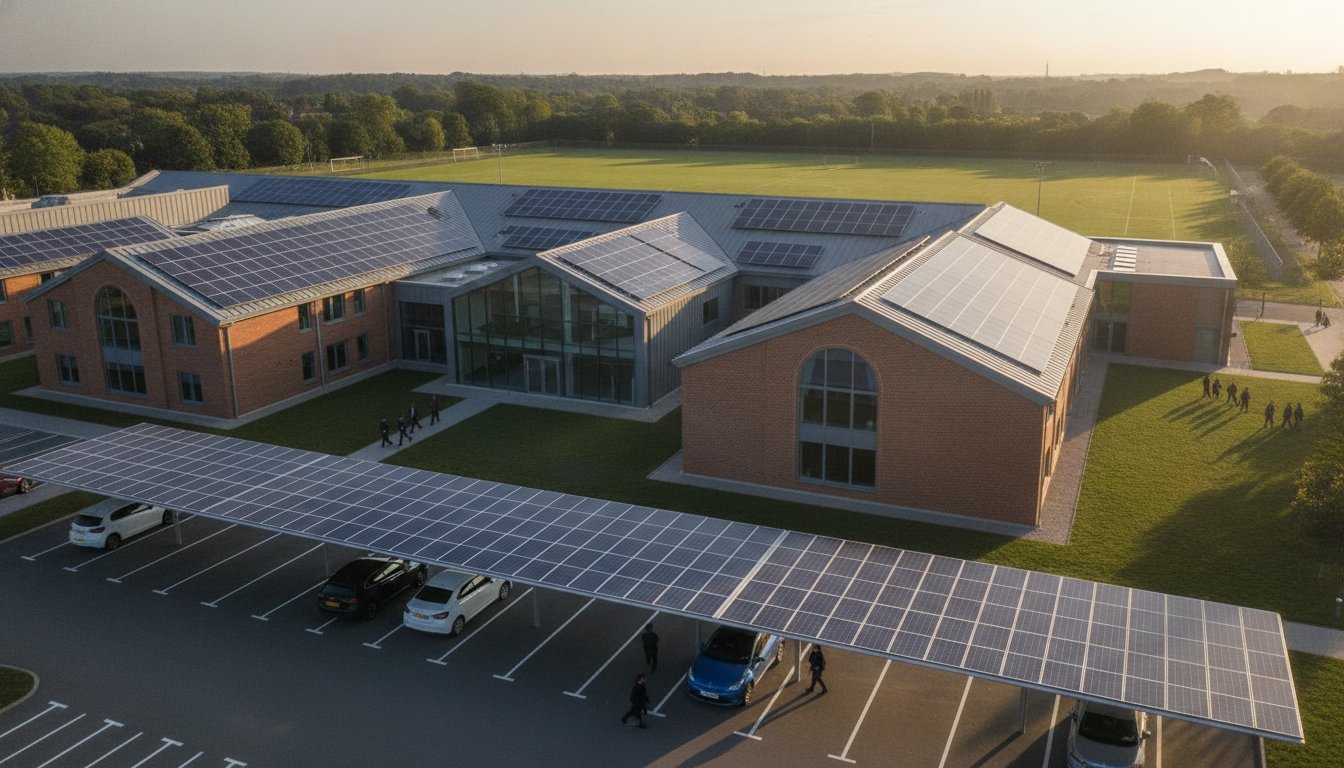
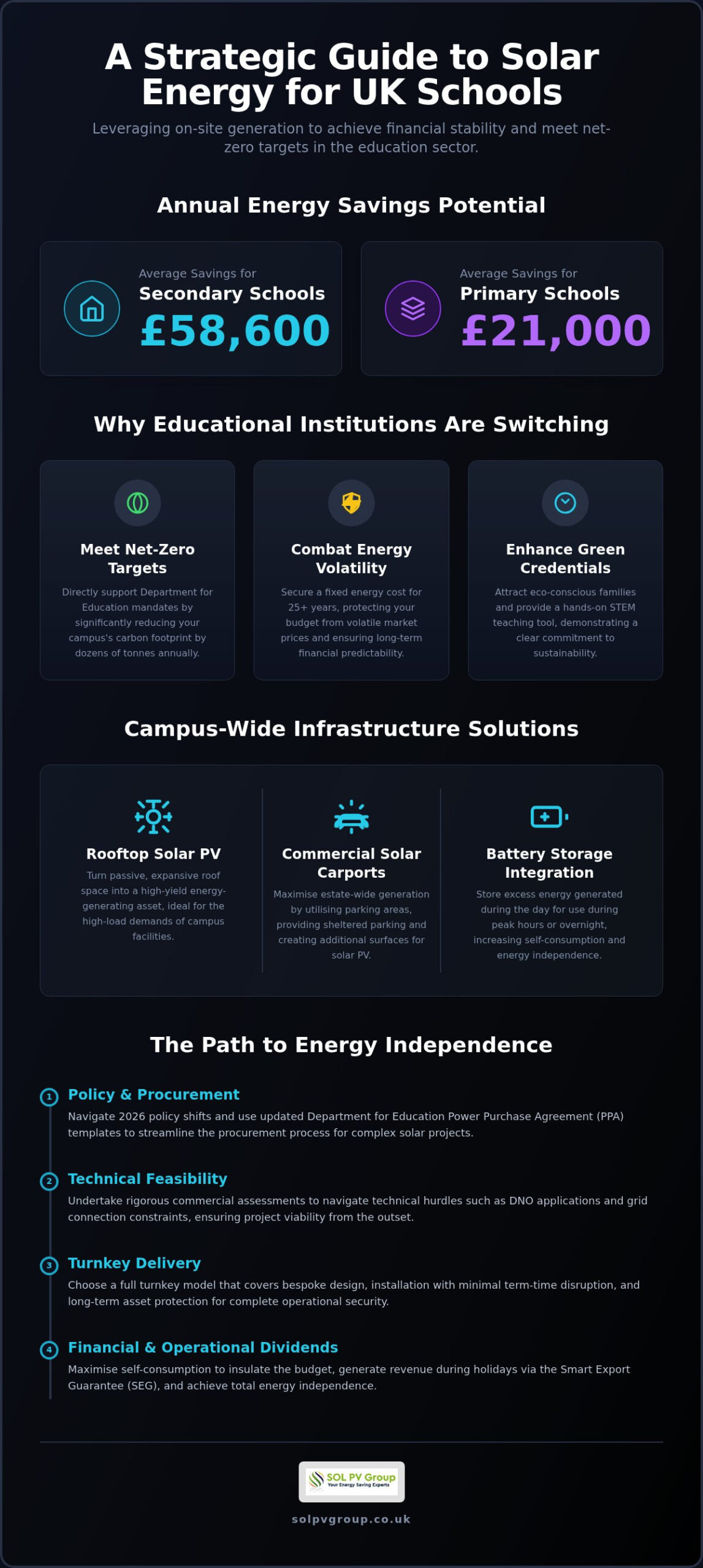
Did you know that UK secondary schools are now saving an average of £58,600 annually by integrating solar PV systems and LED upgrades? With primary schools seeing savings of approximately £21,000, the financial argument for solar energy for the education sector has never been more compelling. We understand that bursars and estate managers face a difficult balancing act. You’re tasked with meeting ambitious Department for Education sustainability targets whilst managing tight budgets amidst volatile energy prices. It’s a complex challenge that requires a structured, long-term approach to energy security and operational stability.
This strategic 2026 guide provides a roadmap for educational institutions to leverage solar PV, battery storage, and commercial carports to achieve net-zero targets. You’ll discover how the latest Great British Energy Solar Partnership and the updated Department for Education PPA templates offer new avenues for deployment. We’ll explore how modern, turnkey installations are designed to minimise term-time disruption, ensuring your transition to renewable energy is handled with meticulous care. This overview covers everything from feasibility to long-term asset protection, helping your school achieve energy independence and enhanced green credentials to attract eco-conscious families.
Key Takeaways
- Understand how 2026 policy shifts and updated DfE PPA templates have streamlined the procurement process for complex educational solar projects.
- Evaluate the financial dividends of high self-consumption and the unique value of using solar energy for the education sector as a hands-on STEM teaching tool.
- Explore campus-wide infrastructure configurations, including the integration of battery storage and commercial solar carports to maximise estate-wide energy generation.
- Learn to navigate technical hurdles such as DNO applications and grid connection constraints through rigorous commercial feasibility assessments.
- Recognise the operational security provided by a full-turnkey delivery model that encompasses everything from bespoke design to long-term asset protection.
The Current Landscape of Solar Energy for the Education Sector
In 2026, the adoption of solar energy for education sector institutions has transitioned from a sustainability aspiration to a core operational requirement. Solar photovoltaic (PV) systems for schools and universities are bespoke installations designed to convert sunlight into electricity, specifically engineered to handle the high-load demands of modern campus facilities. As Solar power in the United Kingdom continues to expand, educational estates represent a critical frontier for national capacity. These buildings are uniquely positioned for solar integration because their peak energy usage aligns perfectly with daylight hours, whilst their expansive roof areas provide the necessary footprint for high-yield generation.
The shift towards on-site generation is driven by the Department for Education (DfE) sustainability strategy, which demands a robust response to the climate emergency. Schools aren’t just installing panels for optics; they’re doing it to secure their financial future. By generating power where it’s consumed, institutions bypass the inefficiencies and costs associated with grid reliance, turning passive roof space into a high-performing financial asset.
To better understand how these systems function in a real-world educational setting, watch this helpful video:
Meeting Net Zero Targets in Schools and Universities
Carbon reduction mandates are no longer voluntary for the public sector. The DfE has set clear expectations for schools and colleges to reach net-zero, making solar PV the primary tool for decarbonising the estate. Unlike other green technologies that require deep structural changes, solar offers a visible and measurable impact on a school’s carbon footprint. A mid-sized secondary school that implements a standard solar installation can expect to reduce its annual carbon emissions by several dozen tonnes, directly supporting the Department for Education’s target for a net-zero estate. This makes it the cornerstone of any commercial solar strategy.
Combatting Energy Volatility with On-Site Generation
Educational operational budgets have been historically vulnerable to the extreme fluctuations of the global energy market. These price spikes often force difficult decisions between utility payments and educational resources. On-site generation provides a definitive solution by offering fixed-cost energy for the lifespan of the system, which is typically 25 years or more. This level of predictability is invaluable for Multi-Academy Trusts (MATs) that manage multiple sites. It allows for accurate long-term budget forecasting and protects the trust against future market volatility. By stabilising one of their largest overheads, MATs can redirect vital funds back into the classroom where they matter most.
Financial and Operational Dividends: Why Education Providers are Switching
The financial incentives driving the adoption of solar energy for education sector estates have never been more quantifiable. Recent data indicates that secondary schools can achieve annual savings of approximately £58,600, whilst primary schools can reduce overheads by roughly £21,000. These substantial figures are supported by the government solar drive for schools, an initiative projected to save the sector over £220 million over the lifetime of installed assets. By focusing on high self-consumption, schools ensure that the majority of generated power is used immediately, effectively insulating the budget from external market shocks.
Revenue generation during holiday periods is an often overlooked operational dividend. Through the Smart Export Guarantee (SEG), schools can monetise surplus energy generated during the 13 weeks of the year when the campus is largely vacant. This surplus coincides with peak summer generation, creating a valuable secondary income stream. It’s a pragmatic way to ensure that the solar asset remains productive even when students aren’t on-site.
Calculating ROI and Long-Term Payback
Determining the solar payback period commercial institutions can expect involves assessing system size against specific consumption patterns. In 2026, advancements in PV cell efficiency have significantly compressed these timelines. While orientation and roof pitch remain influential, the increased power density of modern modules allows for greater generation from limited roof space. This technical progression ensures a more rapid return on investment, particularly for Multi-Academy Trusts looking to scale solar across multiple sites. A sensible first step involves reviewing your current energy profile to determine the optimal system configuration.
Educational Benefits and Student Engagement
Infrastructure serves a dual purpose when it doubles as an educational resource. The “Living Laboratory” concept allows schools to integrate real-time generation data into STEM subjects, providing students with tangible examples of renewable physics and environmental science. This hands-on engagement helps inspire the next generation of engineers and sustainability leaders. Beyond the classroom, a visible solar array acts as a powerful statement of institutional values. It signals a commitment to environmental stewardship that resonates deeply with eco-conscious parents and students, helping to differentiate the school in an increasingly competitive landscape. Successfully deploying solar energy for education sector facilities proves that sustainability and financial prudence can work in tandem.
Infrastructure Options: Rooftops, Carports, and Battery Storage
Educational institutions possess diverse estates that require a multifaceted approach to energy generation. Rooftop solar PV remains the foundational element, utilising the extensive surface area of primary and secondary buildings. It’s an efficient way to turn passive assets into active power plants, a strategy already adopted by 245 schools and colleges across the UK. However, a comprehensive strategy for solar energy for education sector sites now extends to ground-level infrastructure. This approach ensures that every available square metre of the campus contributes to decarbonisation and cost-reduction goals.
Solar Carports for Higher Education Campuses
For university campuses and large colleges with extensive parking facilities, commercial solar carports represent a significant opportunity. These structures provide a dual benefit by generating renewable power whilst offering sheltered parking for staff, students, and visitors. They don’t just produce energy; they also improve the aesthetic appeal of modern estates and demonstrate a visible commitment to innovation. Carports are particularly effective when combined with EV charging infrastructure, providing essential services for the growing number of electric vehicle users amongst faculty and students.
Implementing these large-scale projects requires a clear understanding of UK school solar funding and costs. Procurement for carports often involves different governance and planning considerations than standard rooftop arrays. It’s vital to assess site potential through a structured feasibility study to ensure the infrastructure aligns with the institution’s long-term master plan.
The Role of Battery Storage in Educational Settings
Energy demand in schools is rarely linear, often peaking during morning registration and lunch periods. Industrial battery storage allows institutions to capture solar energy generated during peak sunlight and deploy it when it’s needed most. This is particularly vital for maintaining the resilience of critical IT infrastructure and research labs during periods of grid instability. By discharging stored energy when the school’s morning demand peaks, batteries perform load shaving to prevent expensive breaches of agreed capacity limits.
Integrating storage ensures that solar energy for education sector projects provides maximum value throughout the year. It allows schools to bridge the gap between generation and consumption, reducing the need to purchase expensive peak-time electricity from the grid. This level of energy independence is a cornerstone of operational excellence, allowing bursars to manage energy profiles with precision and corporate reliability.
Navigating Procurement, Planning, and Feasibility
Securing solar energy for education sector estates requires a meticulous approach to both technical feasibility and legal compliance. In January 2026, the Department for Education (DfE) provided much-needed clarity by officially lifting the temporary pause on solar Power Purchase Agreements (PPAs). This decision, coupled with the mandatory PPA and land lease templates introduced in July 2026, has standardised the procurement process for academy trusts and local authority schools alike. Whether you’re opting for a capital purchase or a funded model, the procurement phase must be data-driven to ensure long-term value for money and total transparency.
The Feasibility Study: Assessing Your Estate
A comprehensive commercial solar feasibility study is the first critical milestone in any project. We don’t just look at available roof space; we conduct a rigorous structural survey to confirm that older educational buildings can safely support the additional load of a modern PV system. Shading analysis is equally vital, as we use orientation optimisation to mitigate the impact of surrounding campus architecture or mature trees. Finally, we evaluate your existing electrical infrastructure to ensure it’s compatible with high-capacity generation and potential battery storage integration.
Managing the Distribution Network Operator (DNO) application is another complex layer of the process. Grid connection constraints can often dictate the maximum system size, so it’s essential to secure these permissions before committing to a final design. Whilst many rooftop projects fall under Permitted Development, larger installations or those on listed buildings require careful coordination with local planning authorities. This ensures all building regulations are met with the precision required for public sector assets.
Installation Logistics and Term-Time Planning
Minimising disruption to the learning environment is a non-negotiable requirement for educational providers. We organise installation schedules with meticulous care, often prioritising heavy lifting and high-noise activities during half-terms or summer breaks. Successfully transitioning to solar energy for education sector projects requires a partner who treats Health and Safety as a core operational pillar rather than a checkbox. This involves strict segregation of work zones and enhanced DBS clearances for all on-site personnel to maintain a secure environment.
Moving from a strategic vision to a commissioned system requires a partner who understands the unique pressures of the school calendar and the necessity of operational excellence. To ensure your estate’s transition is handled with professional integrity and technical thoroughness, you can request a bespoke solar strategy for your school to begin the formal assessment process.
The Sol PV Group Approach: Turnkey Solar Solutions for Education
Delivering successful solar energy for education sector projects requires more than just technical proficiency; it demands a deep understanding of the unique operational constraints within schools and universities. Sol PV Group provides a full-turnkey service that manages every phase of the project lifecycle. We handle the initial feasibility assessments, bespoke system design, complex grid connection negotiations, and final commissioning. This end-to-end management allows educational leaders to focus on their primary mission whilst we ensure their transition to renewable energy is handled with meticulous care and professional integrity.
Every educational estate possesses a distinct energy profile. Our engineers don’t rely on generic templates. Instead, we develop bespoke designs that account for specific consumption patterns, roof orientations, and campus-wide infrastructure goals. By reviewing our educational case studies, estate managers can see how this tailored approach translates into measurable performance and long-term financial stability. It’s this commitment to precision that differentiates a standard installation from a high-performing strategic asset.
Comprehensive Operation and Maintenance (O&M)
The value of a solar installation is protected through rigorous, ongoing support. Our solar PV operation and maintenance UK packages are designed to maximise system uptime and ensure the longevity of the hardware. We utilise advanced remote monitoring technology to detect performance fluctuations in real-time, allowing for rapid intervention before generation is significantly impacted. This proactive stance includes:
- Scheduled preventative maintenance visits to verify safety and efficiency standards.
- Detailed performance reporting to track financial returns against initial projections.
- Rapid reactive repairs to address component failures and maintain total system resilience.
Why Choose Sol PV Group for Your Educational Estate?
Our expertise isn’t limited to a single niche. We’ve established a reputation for excellence across high-demand environments, including the complex manufacturing sector. This cross-industry experience allows us to bring a level of technical thoroughness and corporate reliability that’s often missing in the residential-focused market. We provide national UK coverage, which is particularly beneficial for Multi-Academy Trusts (MATs) managing multi-site portfolios. Our approach is grounded in transparency and straightforward communication, ensuring that high-level decision-makers are fully informed at every stage of the technical transition. By choosing a partner with a proven track record in the solar energy for education sector, you’re investing in a relationship built on professional integrity and operational excellence.
Securing the Future of UK Educational Estates
Adopting a strategic approach to solar energy for education sector institutions is no longer just a sustainability goal; it’s a vital step toward long-term financial resilience. By integrating rooftop PV with modern battery storage and commercial carports, schools can effectively insulate their budgets from the volatility of the energy market. Transitioning to on-site generation allows bursars and estate managers to redirect significant operational savings toward primary educational objectives whilst simultaneously meeting Department for Education carbon mandates.
Success in these complex energy projects relies on a partner who offers total transparency and technical thoroughness. Sol PV Group is a team of accredited commercial solar installers with national UK coverage, specialising in complex turnkey energy projects for both public and private sectors. We manage the entire lifecycle from feasibility and DNO applications to final commissioning and ongoing maintenance. This ensures your institution achieves energy independence without compromising the daily learning environment. Contact Sol PV Group today for a comprehensive solar feasibility study for your educational institution. We’re ready to help you build a more sustainable and secure future for your students.
Frequently Asked Questions
Are there specific grants available for solar energy for the education sector in 2026?
The Great British Energy Solar Partnership currently provides up to £40 million in government backing to support an additional 100 schools with solar installations. Furthermore, a pilot programme involving 150 schools and colleges is testing private sector investment models that require no upfront capital. These initiatives are designed to make solar energy for education sector projects accessible to every school in England, with a national rollout ambition set for the 2027 to 2028 period.
How long does it take to install solar panels on a typical school building?
Most rooftop solar installations on standard school buildings are completed within two to four weeks, depending on the system’s complexity and total capacity. Larger campus projects involving solar carports or extensive battery storage may require additional time for groundworks and electrical integration. We prioritise scheduling high-impact activities during holiday periods; this ensures the learning environment remains undisturbed whilst we maintain a strict health and safety perimeter throughout the project lifecycle.
Can solar panels be installed on older school roofs or listed buildings?
Solar panels can be installed on older structures, provided a rigorous structural feasibility study confirms the roof’s load-bearing capacity and integrity. Listed buildings require specialised planning permissions and coordination with local heritage authorities to ensure the installation respects the building’s historic character. We utilise bespoke mounting systems designed to distribute weight evenly. If rooftop space is unsuitable, ground-mounted arrays or commercial carports often provide a viable alternative for maintaining energy independence on historic estates.
What happens to the solar energy generated during school holidays?
Surplus energy generated during the 13 weeks of school holidays is typically exported back to the National Grid. Under the Smart Export Guarantee (SEG), your institution receives payments for this exported power, effectively turning the campus into a revenue-generating asset during vacant periods. This is a crucial component of the financial model for solar energy for education sector investments, as it ensures that peak summer generation coincides with maximum financial returns through surplus export credits.
How much can a school realistically save on its energy bills with solar PV?
Secondary schools that integrate solar PV alongside LED lighting upgrades are currently saving an average of £58,600 annually on electricity costs. Primary schools typically see annual reductions of approximately £21,000. These figures represent a significant decrease in overheads, with the sector projected to save £220 million over the lifetime of these systems. Real-world savings depend on your specific energy profile, self-consumption rates, and the total capacity of the installed solar array on your campus.
Is battery storage necessary for a school solar installation?
Whilst not strictly mandatory, industrial battery storage is highly recommended for schools with high morning or evening energy demands. Storing excess generation allows you to perform load shaving, which reduces reliance on the grid during expensive peak-pricing periods. It also provides essential energy resilience for critical IT infrastructure and research laboratories. For most modern educational estates, the combination of PV and storage offers the most robust protection against market volatility and potential grid instability.
How do we manage the maintenance of solar panels on a high school roof?
Maintenance is managed through structured Operation and Maintenance (O&M) packages that include both remote monitoring and scheduled physical inspections. Our technology tracks performance in real-time to identify performance drops or technical faults immediately. Preventative visits ensure that all safety and efficiency standards are met, whilst reactive repairs address any component issues to maximise system uptime. This comprehensive approach ensures the longevity of your solar asset without requiring day-to-day involvement from your site teams.
Can solar carports be integrated with existing EV charging points on campus?
Solar carports are specifically designed to integrate seamlessly with EV charging infrastructure on school and university campuses. These structures capture solar energy to power on-site chargers directly, providing a sustainable and cost-effective way for staff and visitors to charge their electric vehicles. This integration supports your institution’s broader decarbonisation strategy and enhances your green credentials. It’s an efficient use of car park space that adds functional value whilst contributing directly to your net-zero targets.