
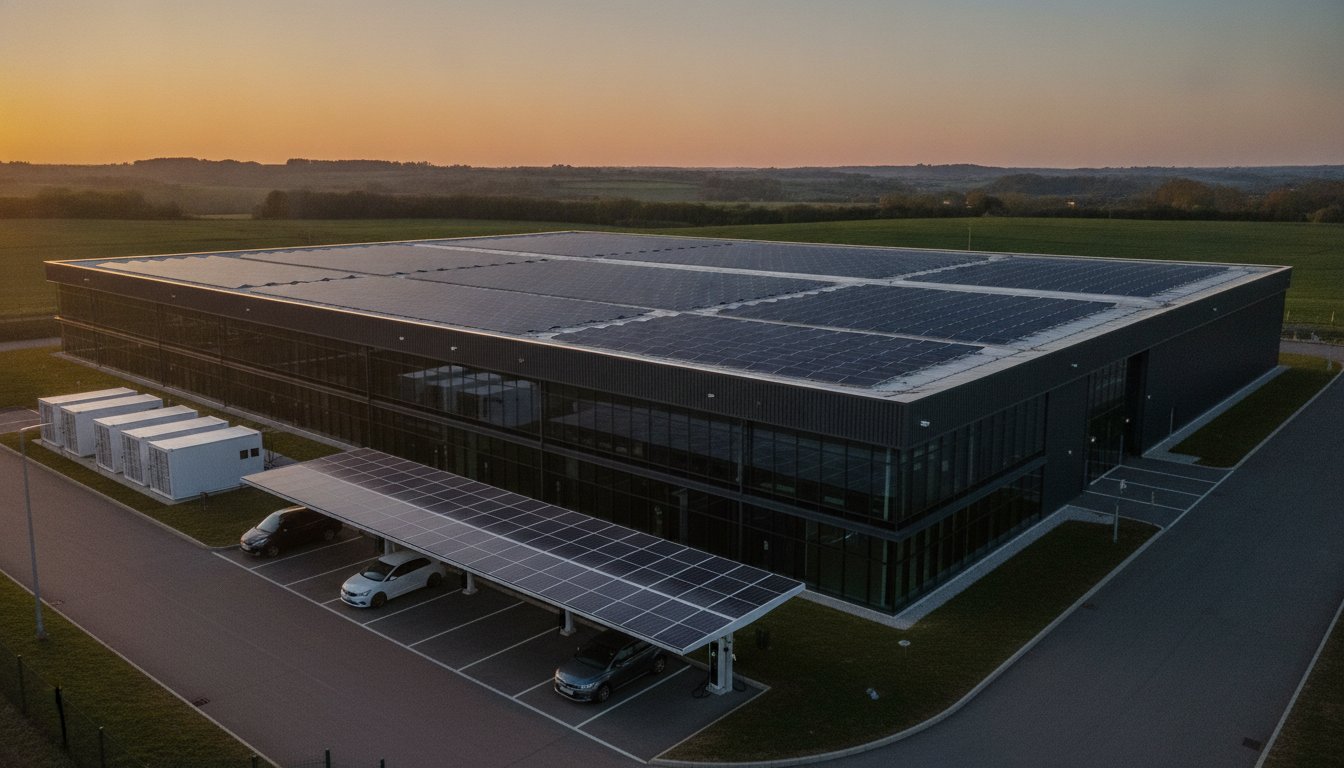
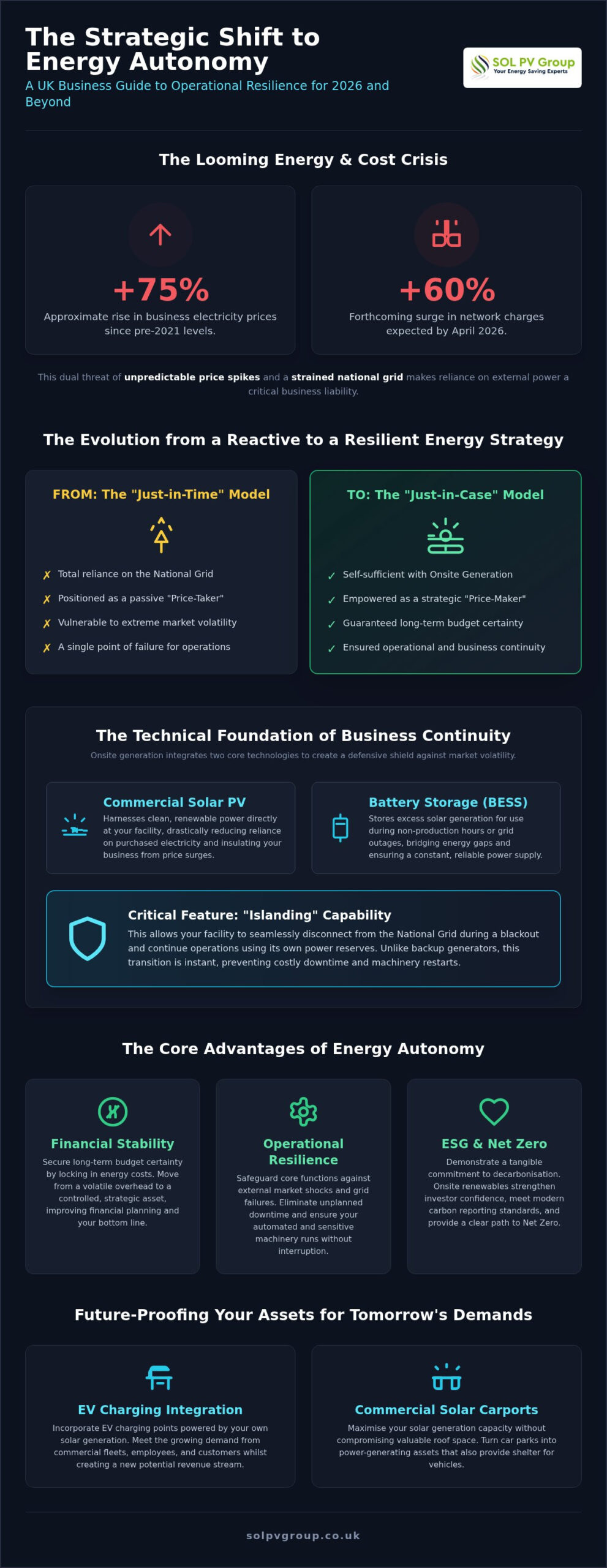
With business electricity prices now approximately 75% higher than they were before 2021 and April 2026 bringing a 60% surge in network charges, the financial burden of traditional energy procurement has reached a critical threshold. Industrial and commercial leaders across the UK are facing a dual crisis of unpredictable price spikes and a grid that’s increasingly strained by the demands of the digital economy. You likely recognise that relying solely on external power supplies is no longer a viable strategy for long-term stability. True operational resilience through onsite generation has transitioned from a sustainability ambition to a fundamental requirement for business continuity.
This guide explores how integrating commercial solar PV and battery storage systems creates a defensive shield against market volatility. By decentralising your power supply, you can secure energy price certainty for your budgeting whilst ensuring uninterrupted uptime during grid outages. We’ll examine the strategic framework for 2026, covering everything from navigating the latest Ofgem grid connection reforms to achieving your Net Zero targets through robust, physical asset management. It’s a comprehensive approach designed to turn energy from a volatile overhead into a controlled, strategic asset.
Key Takeaways
- Recognise the strategic shift from “just-in-time” energy procurement to a “just-in-case” model that safeguards core functions against external market shocks.
- Learn how to establish operational resilience through onsite generation by combining commercial solar PV with battery storage to bridge generation gaps.
- Gain financial stability by moving from a grid-dependent “price-taker” position to a “price-maker” status, ensuring long-term budgeting certainty.
- Understand the technical requirements for deployment, from conducting comprehensive feasibility studies to managing complex G99 grid connection protocols.
- Future-proof your infrastructure by integrating EV charging points and commercial solar carports to maximise generation without compromising existing roof space.
The Evolution of Operational Resilience in the UK Energy Landscape
In the 2026 UK landscape, operational resilience is the capacity of an organisation to maintain essential functions during external energy shocks. Historically, businesses relied on a “just-in-time” model where the National Grid provided power on demand. However, with “tight margin” events becoming more frequent as the grid manages the transition to intermittent renewables, this reliance has become a liability. For UK manufacturing, where automated lines require constant, high-quality power, traditional grid dependency is now viewed as a single point of failure that can halt production in seconds.
This shift in risk profile has prompted a move towards “just-in-case” energy strategies. Integrating distributed generation technologies allows firms to insulate themselves from systemic instability. Achieving true operational resilience through onsite generation means your facility is no longer a passive recipient of power but an active, autonomous participant in its own energy security. It’s about moving beyond simple backup power to a system that provides continuous, reliable throughput.
To better understand how these principles apply to modern corporate strategy, watch this helpful overview:
Why Business Continuity Now Depends on Energy Autonomy
Resilience is often measured by the ability to avoid, cope with, and recover from disruption. Energy volatility directly impacts the “cope” phase; if the power fails, the ability to recover is delayed by the time taken to restart sensitive machinery. In automated logistics centres, where every minute of downtime translates to thousands of pounds in lost throughput, energy autonomy is essential. Whilst some explore “energy-as-a-service” models, owning onsite assets provides the highest level of control and long-term financial certainty, ensuring your facility remains operational when others are forced to pause.
Regulatory Pressures and ESG Resilience
Modern carbon reporting and sustainability audits are no longer optional. In 2026, operational stability is inextricably linked to investor confidence. Stakeholders now look for evidence that a business can sustain itself through climate-related grid instability. Implementing onsite renewables is a visible commitment to decarbonising business energy supply whilst simultaneously hardening the organisation against price volatility. This dual benefit ensures that your ESG strategy supports your bottom line, providing a clear path to Net Zero that doesn’t compromise on your ability to deliver services.
Onsite Generation: The Technical Foundation of Business Continuity
Building a robust framework for energy security requires a shift from passive consumption to active infrastructure management. The technical foundation of this transition rests on the integration of power generation and intelligent storage. By deploying high-quality components designed for industrial scale, organisations can ensure asset longevity and consistent performance. This physical layer is what actually delivers operational resilience through onsite generation, providing a tangible buffer against the instability of the external grid. It’s a move that transforms energy from an unpredictable expense into a manageable internal utility.
A critical feature of modern systems is “islanding” capability. This allows a facility to disconnect from the National Grid during a blackout and continue operations using its own power reserves. Whilst traditional backup generators often suffer from lag or fuel supply issues, a synchronised solar and battery array offers a seamless transition. Adhering to Ofgem regulations for on-site generation ensures that these systems are both compliant and safe for grid-parallel operation. This technical compliance is the first step in securing long-term operational uptime.
Solar PV: Harvesting Reliable, Low-Cost Energy
A commercial solar PV installation serves as the primary engine for energy harvest. For sectors like manufacturing, where energy intensity is high, rooftop solar provides a predictable energy floor that offsets volatile wholesale costs. Modern modules are engineered for durability, often forming the core of 25-year resilience plans. These assets deliver a level of price certainty that traditional energy contracts simply can’t match, turning underutilised roof space into a high-yield power plant. It’s a straightforward way to lock in costs whilst reducing environmental impact.
Battery Storage: The Operational Safety Net
Whilst solar provides the harvest, industrial battery storage systems provide the control. The transition from basic Uninterruptible Power Supplies (UPS) to full-scale Battery Energy Storage Systems (BESS) allows businesses to manage peak demand and engage in load shedding more effectively. Industrial battery storage acts as the critical balancer for onsite solar intermittency. This safety net ensures that excess energy captured during the day is available during peak evening periods or when the grid is under stress. To determine how these technologies can be integrated into your specific facility, you may wish to explore a bespoke solar strategy for your site.
Mitigating Volatility: Grid Reliance vs Onsite Energy Autonomy
In 2026, the financial risk of 100% grid dependency is no longer a theoretical concern; it’s a measurable threat to corporate stability. Businesses relying solely on the National Grid remain “price-takers,” leaving them vulnerable to every fluctuation in the wholesale market. This exposure is particularly acute during geopolitical energy shocks, which can cause unit rates to surge without warning. By contrast, achieving operational resilience through onsite generation transforms a firm into a “price-maker.” You effectively control your energy costs for the next two decades, creating a robust physical hedge against external volatility that traditional financial instruments cannot match.
A critical metric for evaluating this transition is “avoided cost.” Rather than simply looking at traditional payback periods, finance directors now measure the total expenditure avoided during market spikes. If grid prices jump whilst your onsite production remains constant, the value of your asset increases in real-time. This approach treats energy as a controlled, internal utility rather than a variable overhead. It provides the security needed for long-term strategic planning and ensures that your energy strategy is a source of competitive advantage rather than a liability.
Protecting Bottom-Line Margins from Energy Spikes
Maintaining healthy margins requires absolute cost predictability. Whilst wholesale markets remain erratic, the levelised cost of energy (LCOE) from solar provides a fixed, transparent baseline. To understand the initial capital requirements for such a transition, you can review the commercial solar panel cost per kWp to establish a budgeting context. This investment secures price certainty for 20 years or more, shielding your bottom line from the inflationary pressures that often cripple grid-reliant competitors. It’s a definitive move from variable uncertainty to fixed-asset reliability.
Reducing the Load on a Strained National Grid
Energy autonomy also offers a “good citizen” benefit by reducing local grid congestion. As large retail and wholesale centres transition to distributed energy networks, they alleviate the strain on aging infrastructure. This proactive behaviour can actually lead to faster grid connection approvals for future site expansions, as the local network operator sees a reduced demand profile. When you generate and consume your own power, you’re not just protecting your own operations; you’re contributing to a more stable and resilient national network. This systemic contribution often eases the path for further infrastructure development.
Strategic Implementation: From Feasibility to Grid Synchronisation
Transitioning from grid dependency to energy autonomy requires a methodical, project-managed approach to ensure technical integrity and financial performance. Strategic implementation isn’t merely about hardware installation; it’s a multi-stage lifecycle that begins with data and ends with ongoing asset optimisation. This structured path is the only way to guarantee operational resilience through onsite generation whilst maintaining the safety standards required for industrial environments.
- Step 1: Conduct a comprehensive commercial solar feasibility study to assess roof health and load profiles.
- Step 2: Navigate the G99 grid connection application process with a specialist partner.
- Step 3: Design a bespoke system that balances solar yield with battery discharge rates.
- Step 4: Execute a phased installation to minimise operational disruption whilst on-site.
- Step 5: Establish an O&M contract for ongoing performance monitoring.
The Critical Role of the Feasibility Study
Historical billing data forms the bedrock of a successful resilience strategy. By analysing half-hourly data, we can identify the exact “sweet spot” where capital expenditure meets maximum operational protection. Structural surveys are equally vital, ensuring that rooftop assets remain secure for their entire 25-year lifespan. This data-driven approach allows for an accurate projection of the solar payback period commercial, ensuring that the project aligns with your organisation’s broader financial objectives and long-term budgeting needs.
Managing Grid Connections and DNO Negotiations
The complexity of DNO (District Network Operator) applications remains a primary hurdle for UK businesses. Securing grid capacity requires meticulous technical documentation and proactive negotiation to avoid the extensive delays currently affecting the UK energy market. Our turnkey approach manages these technical hurdles from inception to synchronisation, providing a single point of accountability. This ensures your project moves from the planning stage to active generation without the friction typically associated with large-scale infrastructure changes, ultimately securing operational resilience through onsite generation.
To begin securing your organisation’s energy future, you can request a comprehensive feasibility assessment to evaluate your site’s potential and load requirements.
Future-Proofing Assets: The Long-Term Value of Onsite Power
As we look toward 2030, the definition of a high-value commercial asset has fundamentally changed. Property attractiveness is now dictated by energy autonomy and the maturity of onsite utility infrastructure. Investors and stakeholders increasingly view decentralised power as a prerequisite for risk mitigation. Establishing operational resilience through onsite generation doesn’t just protect today’s margins; it enhances the long-term valuation of the business by removing the liability of a volatile, carbon-intensive energy supply. It’s a strategic roadmap that ensures your organisation remains competitive in a landscape where energy security is the primary currency.
For sites where roof space is at a premium, commercial solar carports offer a dual-purpose solution. They transform existing parking areas into high-capacity generation zones without requiring structural modifications to the primary building. This additional capacity is vital for businesses scaling their operations or transitioning to fully electrified transport fleets. By utilising every available square metre of your estate, you create a diversified energy portfolio that’s less susceptible to local grid constraints or the connection delays currently affecting the UK market.
Synergising Solar, Storage, and EV Fleets
The integration of EV charging infrastructure into the energy loop is a critical step for modern transport and logistics hubs. By linking onsite generation with fleet charging, organisations ensure their vehicles remain operational even during grid failures. Intelligent systems optimise charging schedules to utilise excess solar generation during peak daylight hours, reducing the need to draw expensive power from the grid. This creates a local microgrid that supports both the facility and the fleet, ensuring seamless delivery schedules whilst insulating the business from rising network charges. It’s a closed-loop system where energy is produced, stored, and consumed within your own operational boundary.
Continuous Performance: The Role of O&M
A resilience strategy is only as effective as the monitoring behind it. Performance monitoring acts as the heartbeat of the system, identifying potential inefficiencies before they lead to downtime. Transitioning from reactive to preventative maintenance ensures that your assets are ready to perform when the grid is at its most vulnerable. It’s a commitment to longevity that ensures your infrastructure remains a reliable pillar of your business continuity plan for decades. You can view our case studies to see how these integrated systems are delivering measurable security and operational resilience through onsite generation to organisations across the UK.
Securing Your Organisation’s Energy Future
Transitioning from a “price-taker” to a “price-maker” is the most effective way to shield your bottom line from the volatility of the 2026 energy market. By integrating commercial solar PV with industrial battery storage, you establish a physical buffer that ensures business continuity even during periods of grid instability or price surges. This strategic shift protects your margins whilst providing the predictable energy floor required for long-term budgeting and growth.
Achieving operational resilience through onsite generation is no longer a luxury for the ESG-conscious; it’s a fundamental requirement for any high-demand industrial or commercial operation. As specialists in the manufacturing and logistics sectors, Sol PV Group provides a full-turnkey service across the UK. We handle everything from complex grid connection management to ongoing performance monitoring, ensuring your assets deliver maximum value for their 25-year lifespan.
To begin your transition toward energy autonomy, secure your business continuity with a Sol PV Group feasibility study. Taking control of your power supply today creates a secure foundation for your organisation that remains stable for decades to come.
Frequently Asked Questions
What is operational resilience in the context of energy generation?
Operational resilience is the capacity of an organisation to protect its core functions against external energy shocks and grid instability. In the 2026 UK landscape, this means having the physical infrastructure to avoid, cope with, and recover from power disruptions without halting production. It represents a shift from passive energy consumption to active asset management. By decentralising power, businesses ensure that their critical operations remain stable regardless of volatility in the national energy market.
How does onsite solar PV improve a business’s operational resilience?
Onsite solar PV provides a predictable and controllable energy floor that shields a business from wholesale price spikes. By generating power at the point of use, you reduce dependency on a strained National Grid and eliminate the risks associated with aging transmission infrastructure. Achieving operational resilience through onsite generation allows for more accurate long-term budgeting. It transforms roof space into a productive asset that delivers consistent, low-cost electricity for 25 years or more.
Can a business run entirely off-grid using onsite generation?
Whilst it’s technically possible to operate entirely off-grid, most UK businesses find a grid-parallel hybrid approach more efficient. This setup provides the security of onsite power whilst retaining the grid as a secondary backup or a route for exporting excess energy. True resilience is found in diversity; having multiple power sources ensures continuity even during maintenance or seasonal variations. A well-designed system balances onsite solar and battery storage to maximise autonomy without the risks of total isolation.
Is battery storage essential for achieving operational resilience?
Battery storage is considered a critical component for comprehensive resilience because it bridges the gap during non-generation hours. Without a Battery Energy Storage System (BESS), your facility remains vulnerable to evening grid failures and solar intermittency. Storage enables “islanding” capability, allowing your business to disconnect and run independently during a blackout. It also allows for sophisticated load management, ensuring that stored energy is prioritised for your most critical automated systems when demand peaks.
How long does it take to implement an onsite generation strategy in the UK?
Implementing a robust energy strategy typically requires six to twelve months. This timeframe includes the essential feasibility studies and structural surveys required for industrial sites. A significant portion of this period is dedicated to the G99 grid connection process with the local District Network Operator. Since June 2026, new requirements for project maturity have prioritised viable applications, making expert management of the documentation process more critical than ever to avoid lengthy project delays.
What are the regulatory requirements for onsite commercial solar in 2026?
Regulatory compliance in 2026 involves G99 grid connection standards and the latest Ofgem guidelines for demand connections. Since June 2026, projects above 5MVA must demonstrate enhanced project maturity to secure a place in the queue. Businesses must also consider the Electricity Generator Levy, which is currently set at 55% for certain renewable profits. Navigating these fiscal and technical requirements ensures your installation remains both compliant and financially viable within the UK’s evolving energy framework.
How does onsite generation impact a company’s carbon footprint and ESG score?
Onsite generation directly reduces Scope 2 emissions by replacing carbon-intensive grid power with renewable energy produced at the point of use. This reduction is a vital component of carbon reporting and significantly improves a company’s ESG score. Beyond environmental metrics, it demonstrates a commitment to operational stability, which is a key factor for investor confidence in 2026. Hardening your infrastructure against energy volatility provides a visible indicator of a well-managed and future-proofed organisation.
What happens to my onsite generation during a National Grid power cut?
Standard solar installations are designed to shut down during a power cut for safety reasons, preventing electricity from being fed back into a faulty grid. However, systems equipped with advanced battery storage and “islanding” technology can automatically disconnect from the grid and continue powering your facility. This ensures that your critical operations remain live whilst the surrounding area is in darkness. It’s this specific capability that defines true operational resilience through onsite generation in a modern commercial context.