

What if the primary risk to your organisation isn’t the capital expenditure of a solar transition, but the strategic paralysis of remaining tethered to an increasingly volatile energy market? It’s understandable why many executives hesitate; quantifying long-term ROI amidst price fluctuations and potential grid connection delays is a complex task. You likely recognise that a solar project is no longer just an environmental initiative, it’s a vital de-risking exercise for your operational margins. Understanding how to get board approval for a solar project requires more than just technical data; it demands a narrative that aligns perfectly with your existing financial and ESG KPIs.
This guide provides the strategic framework you need to secure executive buy-in and move from feasibility to commissioning with confidence. We’ll master the financial and operational arguments that resonate in the boardroom, ensuring your pitch addresses scepticism head-on. You’ll gain a clear understanding of various funding models, including the differences between upfront CAPEX and Power Purchase Agreements (PPAs). By the end, you’ll have a comprehensive roadmap to lead your organisation through a successful energy transition, backed by the authority of a seasoned industrial partner.
Key Takeaways
- Understand why commercial solar has transitioned from a sustainability initiative to a strategic de-risking tool in the current UK energy market.
- Discover how to get board approval for a solar project by structuring your proposal around three critical pillars: financial resilience, operational stability, and ESG compliance.
- Evaluate the merits of self-funded CAPEX versus fully-funded Solar PPA models to effectively address boardroom objections regarding upfront capital expenditure.
- Learn the step-by-step roadmap from conducting a site-specific feasibility study to aligning your energy goals with the company’s long-term decarbonisation strategy.
- Identify how a turnkey partner can mitigate technical risks and manage grid connection complexities, ensuring a seamless transition for your executive team.
The 2026 Business Case: Why Solar is a Strategic Necessity
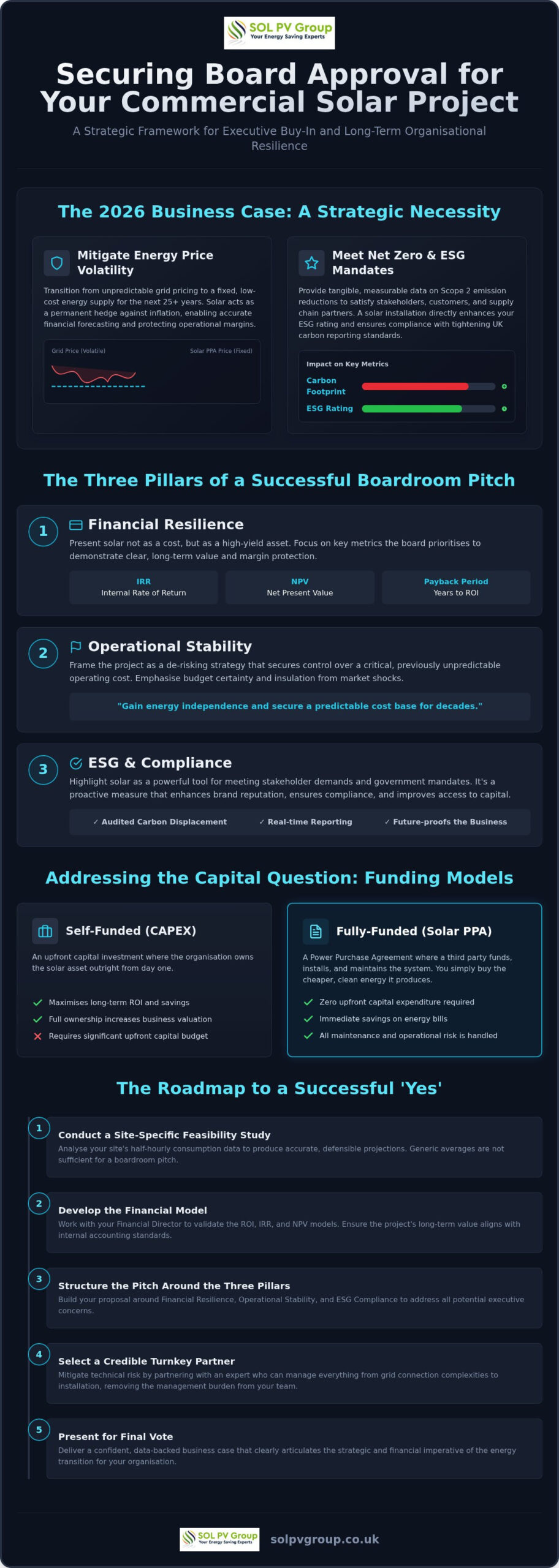
The UK energy market is currently defined by a fundamental shift in how corporations view power. For years, on-site generation was considered a “green perk” or a secondary sustainability goal. In 2026, this has evolved into a core operational requirement. Boards must recognise that “doing nothing” is no longer a neutral stance; it’s a financial risk that exposes the organisation to unhedged wholesale market fluctuations. For sectors like manufacturing and logistics, where margins are thin, energy cost certainty is the difference between growth and stagnation.
Understanding how to get board approval for a solar project requires shifting the conversation from “environmental benefit” to “strategic de-risking”. You aren’t just buying panels; you’re securing a fixed-cost energy supply for the next 25 years. This transition is part of the wider commercialization of renewable energy, where solar has become a standard asset class for prudent financial planning. It’s about taking control of a critical input cost that was previously entirely outside of your influence.
Mitigating Energy Price Volatility
Relying solely on the grid is an invitation for inflation to erode your bottom line. Solar PV provides long-term predictability that traditional procurement simply cannot match. It acts as a permanent hedge against future price spikes, allowing finance directors to forecast operational costs with much higher accuracy. For a deeper look at these trends, consult our Energy Independence for Businesses UK guide. This level of predictability is vital for protecting margins amongst fluctuating wholesale prices, providing a stable foundation for long-term investment decisions.
Meeting 2026 Net Zero and ESG Mandates
The pressure to decarbonise is no longer just coming from government policy; it’s coming from your customers and supply chain partners. Stakeholders now demand granular data on Scope 2 emission reductions as a condition of doing business. Solar PV provides a tangible, measurable solution that delivers real-time reporting for annual disclosures. In 2026, a company’s ESG rating is directly enhanced by solar installations as they provide audited evidence of carbon displacement and a commitment to long-term resource efficiency. It’s a proactive step that ensures your organisation remains compliant as UK carbon reporting standards tighten, protecting your brand reputation and access to capital.
The Three Pillars of a Successful Boardroom Pitch
Securing executive buy-in depends on presenting a case that transcends simple utility savings. To understand how to get board approval for a solar project, you must structure your proposal around three distinct pillars: Financial, Operational, and Environmental. While the first two focus on fiscal health and resilience, the third addresses the growing pressure from stakeholders to meet decarbonisation targets. The foundation of this pitch shouldn’t rely on generic industry averages. Instead, it requires specific, half-hourly consumption data from your own site. Using accurate lead-in data ensures your projections are defensible under scrutiny and provides the precision directors expect.
Involving your Financial Director (FD) at the earliest stage is essential for success. They’ll help validate the ROI model and ensure the internal accounting matches the project’s long-term value. Partnering with a credible technical expert like Sol PV Group provides the granular feasibility data boards trust, effectively removing the technical headache from the decision-making process. By presenting a turnkey solution, you mitigate fears regarding internal resource drain and project management complexities.
The Financial Pillar: ROI and Payback Periods
Boards prioritise metrics like Internal Rate of Return (IRR) and Net Present Value (NPV). A well-structured pitch demonstrates how solar isn’t just a cost, but a yield-generating asset that protects future margins. You should consult our guide on the Solar Payback Period for Commercial PV to refine your financial projections. Beyond immediate savings, consider the impact of commercial solar on business valuation. By improving EBITDA and future-proofing energy costs, solar enhances the overall attractiveness of the enterprise to investors and potential buyers.
The Operational Pillar: Resilience and Battery Integration
Operational continuity is a primary board concern in an era of grid instability. Integrating battery storage provides a critical layer of security and allows for peak shaving, which further reduces expensive standing charges. While boards may worry about grid connection delays, a professional partner handles the entire G99 application process to ensure compliance. For organisations with limited roof space, solar carports offer a way to maximise existing estate assets whilst providing essential EV charging infrastructure. When discussing funding risk, a Solar Power Purchase Agreement can be an effective way to secure renewable energy without the initial capital burden. If you’re ready to build your business case, you can request a bespoke solar strategy to get started.
Funding the Project: CAPEX vs. Solar PPA
The financial structure of a renewable energy transition is often the most scrutinised element of any boardroom proposal. When addressing how to get board approval for a solar project, the conversation usually centres on whether to utilise existing cash reserves or opt for a third-party funding model. It’s a strategic choice. Both pathways offer distinct advantages depending on the organisation’s current cash flow priorities and long-term fiscal strategy. By presenting both options, you demonstrate a sophisticated understanding of the company’s capital allocation needs, effectively removing the “high cost” objection from the debate.
For UK businesses, the tax landscape remains a significant driver for investment. Capital Allowances can provide substantial relief, allowing companies to write off the cost of the installation against taxable profits. This fiscal incentive, combined with the broader commercial solar market trends showing a steady decline in hardware costs, makes the business case for solar more compelling than ever before. Decisions should be based on a clear framework that balances the desire for asset ownership against the need for capital preservation.
CAPEX: Maximising Long-Term Savings
A self-funded CAPEX model is typically the preferred route for organisations with strong balance sheets looking to maximise their Internal Rate of Return. By owning the asset outright, the company captures 100% of the energy savings and any available export tariffs. To provide the board with an accurate budget, it’s vital to reference the current commercial solar panel cost per kWp. This ownership model grants the board total control over the system’s design, operation, and ongoing maintenance. It ensures the asset is managed in precise alignment with internal technical standards and long-term facility plans.
Solar PPA: Zero Capital, Immediate Savings
If capital preservation is the priority, a Solar Power Purchase Agreement (PPA) offers a fully funded alternative. In this scenario, a third party pays for the installation and maintenance, whilst the organisation buys the generated electricity at a rate significantly lower than grid prices. This “off-balance-sheet” solution is particularly attractive for manufacturing and logistics firms that wish to reserve capital for core business operations. Whilst boards sometimes express concern regarding the 10-to-25-year contract lengths, the long-term price certainty often outweighs the commitment risk. It provides a stable, predictable energy cost that grid-reliant competitors simply cannot match.
The Approval Roadmap: From Feasibility to Final Vote
The transition from a conceptual business case to a live installation requires a disciplined project management lifecycle. When determining how to get board approval for a solar project, your internal roadmap must be as robust as the technical system itself. Directors require a logical progression that addresses site-specific constraints before they commit to a final resolution. This process typically follows five critical steps designed to build confidence at every level of the organisation:
- Conduct a Commercial Solar Feasibility Study to establish baseline data.
- Align the project with the company’s 2026-2030 decarbonisation strategy to ensure long-term relevance.
- Select a turnkey partner capable of providing fixed-price proposals and performance guarantees.
- Present a comprehensive Risk Mitigation plan covering operation, insurance, and performance monitoring.
- Secure the formal board resolution and initiate the DNO application.
The Role of the Feasibility Study
A roof structural survey is a non-negotiable requirement for board approval. Directors need absolute assurance that the existing infrastructure can support the additional load for the next 25 years. This study should also include yield projections derived from local UK weather data rather than generic national averages. To build confidence amongst stakeholders, use case studies from similar industrial or commercial sites to prove the concept’s viability in a real-world context. This data-driven approach transforms a technical proposal into a credible business proposition that stands up to intense financial scrutiny.
De-Risking the Decision with O&M
Ongoing performance is often a point of boardroom scepticism. You must demonstrate that the asset will be protected through a structured Solar PV Operation & Maintenance package. This ensures that system downtime is minimised and that long-term performance degradation is managed within expected parameters. Remote monitoring plays a vital role here; it provides the board with quarterly ROI reports that validate the original investment case. By addressing maintenance early, you remove the fear of “hidden costs” that can often stall an approval. It’s about providing the security that the transition will be handled with meticulous care over its entire lifespan.
Once the board is satisfied with the risk mitigation and feasibility data, the final resolution can be passed. This triggers the formal DNO application, which is the first step in the physical transition to a cleaner energy profile. To ensure your proposal is board-ready from the start, request a bespoke solar strategy and secure the data you need to move forward.
Partnering with Sol PV Group for Board-Ready Solutions
Sol PV Group understands that the final hurdle in any energy transition is the boardroom vote. We position ourselves as a strategic advisor rather than just a vendor, providing the precise data and technical assurance that directors require. Our expertise is deeply integrated into the UK’s manufacturing and logistics sectors, where we understand the specific operational pressures and estate constraints of large-scale industrial facilities. By providing board-ready documentation, we simplify the process of how to get board approval for a solar project, ensuring your proposal is grounded in commercial reality.
Turnkey Delivery: Removing the Technical Burden
A primary concern for many boards is the internal resource required to manage a complex infrastructure project. Our full-turnkey service is designed to mitigate this fear by handling every technical detail on your behalf. We manage the entire grid connection process, including complex G99 applications, and secure all necessary planning permissions. This design-led approach ensures that solar arrays are optimised for even the most challenging industrial roof profiles, maximising energy generation whilst maintaining structural integrity. Beyond the installation, our comprehensive operation and maintenance packages offer the long-term security boards need to realise the full value of their investment over its 25-year lifespan.
Next Steps for Your Board Pitch
The journey towards energy independence begins with accurate information. To start building your business case, the first action point is to gather 12 months of half-hourly consumption data. This allows us to create a bespoke profile of your energy usage and project exactly how much a solar installation will save your organisation. We also offer a preliminary consultation to define which funding model, whether CAPEX or a Solar PPA, aligns best with your company’s current financial objectives. This ensures that when you finally present your case, it’s a fully de-risked strategy that prioritises both fiscal responsibility and operational excellence. It’s about making the decision as straightforward as possible for your executive team.
Securing executive buy-in is a methodical process that requires a partner who values professional integrity and precision. If you’re ready to move from concept to reality, we invite you to take the first step in your organisation’s transition. Contact Sol PV Group for a Board-Ready Feasibility Study and gain the technical authority needed to lead your organisation’s solar transition with confidence.
Leading Your Organisation’s Energy Transition
Securing executive buy-in for renewable infrastructure is no longer a matter of environmental sentiment; it’s a rigorous exercise in fiscal responsibility and strategic de-risking. Understanding how to get board approval for a solar project depends on your ability to present a data-driven narrative that addresses volatility, resilience, and long-term asset value. By structuring your pitch around the financial and operational pillars we’ve discussed, you transform a complex technical transition into a clear roadmap for corporate growth.
Sol PV Group provides the authoritative data and end-to-end support needed to satisfy even the most sceptical directors. With a proven track record in the UK manufacturing and logistics sectors, we deliver a full-turnkey service that handles everything from grid connection management to specialist O&M protection. We’re here to ensure your transition is handled with meticulous care and professional integrity. When you’re ready to present a definitive business case to your executive team, we’re ready to provide the evidence. Request Your Board-Ready Commercial Solar Feasibility Study and begin your journey toward energy independence today.
Frequently Asked Questions
What is the average ROI for a commercial solar project in the UK in 2026?
Payback periods typically fall between 3 and 7 years for UK commercial installations. The precise ROI depends on your specific energy consumption profile and current wholesale electricity rates. By offsetting expensive grid power with on-site generation, most organisations see a significant reduction in operational expenditure. We provide detailed financial modelling as part of our feasibility study to give your board an accurate projection of long-term yields.
Does our business need planning permission for a large-scale rooftop solar installation?
Many commercial rooftop projects fall under Permitted Development rights, which removes the need for a full planning application. However, certain restrictions apply to listed buildings, conservation areas, or systems exceeding specific size thresholds. We handle the assessment of your site’s status as part of our turnkey service. If formal planning permission is required, our team manages the entire submission process to ensure your project remains compliant with local regulations.
How long does it take to get a G99 grid connection approval?
Securing a G99 grid connection approval generally takes between 45 and 65 working days, depending on your local Distribution Network Operator (DNO). This timeline is a critical factor when planning how to get board approval for a solar project, as it dictates the earliest possible commissioning date. We manage this technical application on your behalf, liaising directly with the DNO to navigate any potential grid constraints or infrastructure requirements.
Can we install solar panels if we do not own the building?
Yes, tenants can install solar through various legal frameworks such as Green Leases or Power Purchase Agreements (PPAs). These arrangements allow businesses to benefit from lower energy costs whilst the landlord sees an increase in the building’s asset value and EPC rating. We facilitate these discussions between tenants and landlords to ensure the final agreement serves the strategic interests of both parties, particularly regarding the long-term maintenance of the system.
What happens if our energy demand increases after the solar project is approved?
Solar PV systems are modular, meaning they can often be expanded to meet growing energy requirements if roof space and grid capacity allow. If your demand increases due to new machinery or fleet electrification, we can integrate battery storage or additional panels to compensate. Planning for future scalability is a core part of our initial design process, ensuring your energy infrastructure remains resilient as your operational footprint grows.
How do we account for solar energy on our corporate ESG reports?
On-site solar generation directly reduces your Scope 2 emissions by displacing electricity that would otherwise be purchased from the grid. Our monitoring systems provide real-time, audited data on carbon savings, which can be seamlessly integrated into your annual ESG disclosures. This tangible evidence of decarbonisation is increasingly vital for maintaining supply chain compliance and satisfying stakeholder demands for transparent environmental reporting in 2026.
Is a Solar PPA better than a CAPEX investment for a manufacturing firm?
The choice depends on your organisation’s capital allocation strategy. A CAPEX investment offers the highest long-term ROI and total ownership of the asset, which is often preferred by manufacturing firms with available cash reserves. Conversely, a Solar PPA requires zero upfront capital and provides immediate savings, making it ideal for businesses that wish to preserve funds for core production activities. Both models provide the long-term price certainty required for stable operational planning.
What maintenance is required to ensure the solar system meets its projected ROI?
Achieving your projected ROI requires a structured operation and maintenance programme. This includes annual electrical testing, periodic panel cleaning to maintain efficiency, and continuous remote monitoring to identify performance anomalies. Our specialist O&M packages are designed to protect your investment by ensuring the system operates at peak capacity. Proactive care minimises downtime and prevents performance degradation, providing the board with confidence in the project’s long-term financial delivery.