

A high-ranking Trustpilot score is no longer a sufficient metric for a multi-megawatt energy transition. Whilst public feedback offers a glimpse into customer service, relying solely on independent reviews of solar EPC contractors UK can lead to a dangerous conflation of domestic expertise and commercial engineering capability. You’ve likely found that the market is saturated with installers who excel at residential rooftops but lack the technical depth required for complex grid connections or industrial-scale battery storage. It’s a common frustration for directors who need to verify high-value project claims before committing to a seven-figure capital investment.
This guide provides a definitive framework for UK businesses to move beyond surface-level testimonials and interrogate the technical data that actually dictates long-term performance. We’ll examine which accreditations hold genuine weight in 2026, how to audit a contractor’s national track record, and the specific metrics that ensure your chosen system delivers a secure ROI. You’ll gain the clarity needed to filter out “solar cowboys” and identify a vetted partner capable of managing your entire energy lifecycle from feasibility to ongoing asset protection.
Key Takeaways
- Identify the critical distinctions between standard PV installers and true commercial EPC contractors to ensure your project meets industrial engineering standards.
- Learn how to filter independent reviews of solar EPC contractors UK by prioritising verified industry-body data over generic consumer feedback platforms.
- Discover the technical benchmarks, such as professional PVSyst modelling and sector-specific feasibility studies, that guarantee accurate energy yield projections.
- Master the due diligence process for verifying a contractor’s financial longevity and operational track record within high-demand sectors like manufacturing and logistics.
- Understand the strategic value of a full-turnkey delivery model in simplifying complex grid connections and integrating advanced battery storage infrastructure.
Understanding the UK Commercial Solar EPC Landscape in 2026
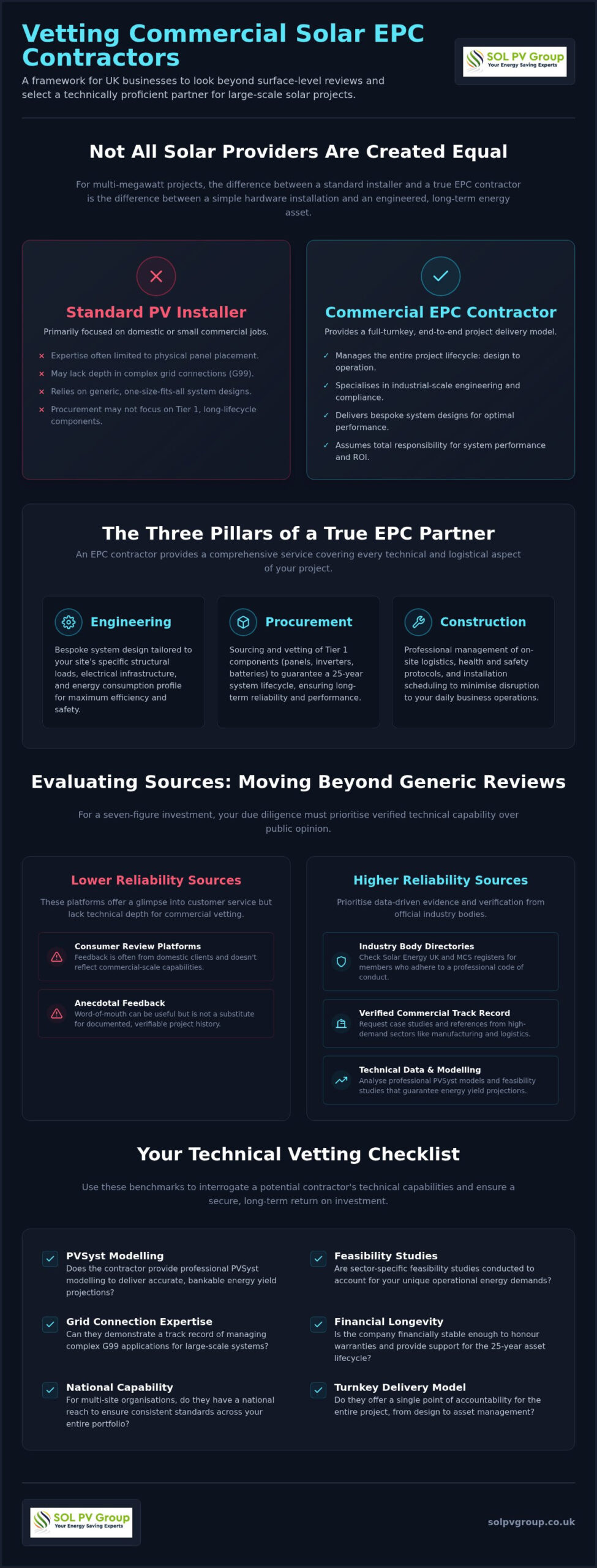
The landscape of Solar power in the United Kingdom has matured significantly. In 2026, businesses no longer view renewable energy as a bolt-on accessory but as a core infrastructure requirement for operational security. This shift has elevated the role of the EPC (Engineering, Procurement, and Construction) contractor. Unlike a standard installer who might focus purely on the physical placement of panels, an EPC partner provides a comprehensive project delivery model. They oversee the entire lifecycle, ensuring that technical designs align with financial forecasts and long-term sustainability goals.
For large-scale PV projects, the complexity of grid applications, such as G99 applications for systems over 3.68kW per phase, necessitates a level of expertise that goes beyond basic electrical work. Fragmented services often lead to communication gaps and cost overruns. In contrast, the UK market now prioritises full-turnkey solutions where a single entity assumes total responsibility for the system’s performance. When researching independent reviews of solar EPC contractors UK, it’s vital to distinguish between companies that simply mount hardware and those that engineer integrated energy solutions.
To better understand the criteria for selecting a high-quality partner, watch this helpful video:
The Difference Between an Installer and an EPC Contractor
An EPC contractor manages three distinct pillars that a simple installer often overlooks. First, the Engineering phase involves bespoke system design tailored to specific industrial roof loads and electrical infrastructure. It isn’t a generic approach; it’s a precise calculation of structural integrity and energy yield. Second, Procurement involves sourcing Tier 1 components to ensure the system’s longevity. EPCs have the technical knowledge to select hardware that withstands the 25-year lifecycle expected of commercial assets. Finally, Construction focuses on managing complex on-site logistics. Professional EPCs ensure that installation doesn’t disrupt daily business operations, coordinating meticulously with health and safety protocols.
Why National Capability Matters for UK Organisations
Consistency is paramount for organisations operating across multiple sites. A contractor with national capability ensures that every installation adheres to the same rigorous standards. This centralised approach to project management simplifies communication and provides a single point of accountability for your entire portfolio. For a deeper look at high-level strategy, consult our Commercial Solar PV Installation UK guide. Relying on independent reviews of solar EPC contractors UK that highlight national reach can help you identify partners capable of executing broad rollouts without compromising on technical precision.
Where to Find Reliable Independent Reviews for Solar Contractors
Identifying a trustworthy partner requires a move away from generic star ratings. Whilst consumer-facing platforms provide a baseline for customer service, they often fail to capture the technical nuances of a multi-megawatt installation. Relying on independent reviews of solar EPC contractors UK necessitates a tiered approach to reliability where industry-specific data takes precedence over anecdotal feedback. A business leader must prioritise organisations that are vetted by professional bodies and hold a transparent track record within the commercial sector.
The first port of call should be the member directory of Solar Energy UK. This trade association enforces a code of conduct that ensures members operate with professional integrity. Similarly, checking the Microgeneration Certification Scheme (MCS) register is essential. Although MCS is often associated with smaller systems, it remains a vital indicator of a contractor’s commitment to national standards and technical competence. When browsing online feedback, look for “red flags” such as a sudden influx of vague, five-star praise or complaints regarding residential door-to-door sales; these often signal a company that lacks the specialist focus required for high-value commercial projects.
Beyond Trustpilot: Industry-Specific Review Sources
Trade associations like the Renewable Energy Consumer Code (RECC) offer a more robust framework for verifying member conduct than standard consumer sites. For a B2B decision-maker, independent industry awards and shortlists serve as a prestigious form of peer review. Recognition at events such as Solar & Storage Live indicates that a contractor is performing at the forefront of the industry. If you use Google Business Profiles for vetting, ignore the overall score and focus on reviews from verified business accounts. Look for mentions of project management efficiency, adherence to health and safety protocols, and the ability to work within industrial environments without disrupting operations.
The Power of the Case Study as a “Professional Review”
For a CFO or Operations Director, a detailed case study is far more valuable than a simple testimonial. These documents act as professional reviews, providing objective proof of a contractor’s ability to deliver tangible results. When reviewing evidence, focus on specific metrics such as ROI data, system uptime statistics, and how the contractor navigated sector-specific challenges like limited roof capacity or complex grid constraints. You can explore our Sol PV Group Case Studies to see how these technical benchmarks are met in real-world scenarios. To see how these principles apply to your specific facility, you can request a bespoke solar strategy to evaluate your site’s potential.
Technical Vetting: Why Reviews Are Not Enough for Large-Scale Projects
Whilst independent reviews of solar EPC contractors UK provide a useful starting point for identifying potential partners, they cannot substitute for rigorous technical auditing. For projects of an industrial scale, the decision-making process must pivot from subjective feedback to objective engineering benchmarks. A comprehensive commercial solar feasibility study serves as the bedrock of any successful installation. This study ensures that the proposed system is not only physically viable but also financially sound, accounting for specific site constraints that generic reviews might overlook. It’s the only way to guarantee that the projected ROI aligns with actual site conditions.
During the design phase, it’s essential to verify that the contractor utilises professional modelling software such as PVSyst. This tool provides high-fidelity simulations of energy yield, accounting for shading, weather patterns, and component degradation with scientific precision. All designs must strictly adhere to UK building regulations for solar panels to ensure structural integrity and fire safety. Beyond the blueprints, look for contractors who maintain high-level Health and Safety accreditations, including SafeContractor, CHAS, and ISO standards. These certifications demonstrate a commitment to operational excellence and risk mitigation that a simple five-star rating cannot convey.
Grid Connection Expertise: The Ultimate Litmus Test
The true capability of an EPC contractor is often revealed during the grid connection phase. A contractor must possess a proven track record in managing applications with the relevant Distribution Network Officer (DNO). Without this expertise, businesses risk investing in “zombie projects” that are technically complete but cannot export power due to grid capacity issues. For large-scale systems, typically those over 50kW, the G99 application is a formal regulatory process used to ensure the solar installation remains compatible with the national grid’s stability requirements.
Tier 1 Component Procurement and Warranties
Technical vetting also extends to the supply chain. Reputable contractors prioritise hardware with Bloomberg New Energy Finance (BNEF) Tier 1 ratings, which indicate the financial stability and bankability of the manufacturer. You should distinguish between a product warranty, which covers physical defects, and a performance guarantee, which ensures the panels meet specific energy output targets over their 25-year lifespan. A seasoned EPC contractor manages these procurement channels directly to avoid project delays. This ensures that components arrive on site as scheduled and meet the exact specifications defined during the initial engineering phase.
How to Perform Due Diligence on a Solar EPC Partner
Selecting a partner for a multi-megawatt project isn’t about finding the lowest quote. It’s about comprehensive risk management. Whilst independent reviews of solar EPC contractors UK provide a qualitative baseline, due diligence requires a deep dive into corporate stability. This process ensures your investment is protected by a partner who possesses the financial and technical resilience to support the system for its entire 25-year lifecycle.
Step one involves a rigorous check of financial stability through Companies House. You need to verify that the contractor has the balance sheet strength to honour long-term service agreements and won’t disappear within a few years. Step two requires requesting references from businesses in similar sectors. A contractor’s performance in a domestic setting is irrelevant to a warehouse manager. Step three focuses on team structure. Evaluate whether they employ an in-house team or rely heavily on sub-contractors; in-house expertise typically ensures better quality control and accountability. Finally, step four involves reviewing their O&M (Operation and Maintenance) capabilities. A system without a robust aftercare plan is a liability, not an asset.
Sector-Specific Experience: Manufacturing and Logistics
Contractors with specialised experience in the manufacturing sector understand high-demand energy profiles. They recognise that production lines require consistent, high-load power and can design systems that optimise self-consumption. Similarly, the logistics and transport sector presents unique challenges, such as vast roof areas and complex site access. A contractor who has successfully managed these specific hurdles reduces your operational risk. They’ll ensure that the construction phase doesn’t interfere with vehicle movements or tight delivery schedules.
Assessing Financial Longevity and Insurance
Financial health is the ultimate indicator of reliability. You must check that the contractor holds appropriate levels of Professional Indemnity (PI) and Public Liability insurance for commercial sites. These protections are vital for high-value assets. A solid balance sheet also impacts the “bankability” of the project. If you’re seeking external finance or considering Power Purchase Agreements (PPAs), lenders will scrutinise the EPC contractor’s standing. A seasoned partner with a proven national track record provides the security that financial institutions require to approve funding. To begin your own vetting process with a technical baseline, you can book a free solar strategy session to evaluate your project’s commercial viability.
Sol PV Group: Delivering Turnkey Excellence Across the UK
Whilst independent reviews of solar EPC contractors UK offer a valuable external perspective, the internal reality of a successful project depends on a contractor’s ability to execute without friction. Sol PV Group operates on a full-turnkey model, assuming total accountability from the initial feasibility study through to final commissioning and ongoing maintenance. This approach eliminates the communication gaps that often plague fragmented installations, providing businesses with a streamlined path to energy independence. Our commitment to transparency ensures that every client receives clear ROI projections and technical data from day one, allowing for informed decision-making at the board level.
Our expertise extends beyond standard rooftop PV to encompass advanced battery storage systems and commercial solar carports. By integrating these technologies, we help organisations maximise their self-consumption and protect themselves against volatile energy markets. With a national reach and a dedicated O&M team, we ensure maximum system uptime and long-term asset protection for our partners across the UK.
The Turnkey Advantage for Busy Decision-Makers
The primary benefit of a turnkey partner is the significant reduction of the administrative and technical burden on your internal teams. We manage the entire project lifecycle, including the complexities of planning applications and grid permissions. This provides a single point of contact, ensuring that project timelines are met without diverting your staff from their core operational duties. This methodical process is designed to align with corporate carbon reduction strategies, helping UK businesses meet their sustainability targets through precise engineering and reliable delivery. When you filter through independent reviews of solar EPC contractors UK, the value of this end-to-end management becomes a clear differentiator for high-value industrial projects.
Securing Your Energy Future with Sol PV Group
Founded in 2017, Sol PV Group has established a proven national track record that offers the security and stability large-scale organisations require. We don’t believe in generic solutions. Our approach to bespoke design involves maximising every square metre of available rooftop or car park space to ensure the highest possible yield. By combining seasoned expertise with a commitment to professional integrity, we act as a trusted advisor rather than just a vendor. We take the time to explain the value of each stage of our process, reinforcing a sense of precision and careful planning that defines our service delivery.
Speak with a Sol PV Group consultant to start your feasibility study today.
Securing Your Industrial Energy Infrastructure
Navigating the transition to renewable energy requires a shift from consumer-level feedback to professional due diligence. Whilst independent reviews of solar EPC contractors UK serve as a useful initial filter, the success of your project rests on technical precision and financial longevity. You now have the framework to distinguish between simple installers and comprehensive EPC partners who can manage complex grid connections and industrial load profiles.
Sol PV Group brings over 7 years of national commercial experience to every project, having been founded in 2017 with a commitment to corporate transparency. We specialise in high-demand industrial sectors, providing full-turnkey project management that spans from bespoke design to ongoing O&M. By prioritising technical benchmarks like PVSyst modelling and financial audits, you ensure your organisation’s energy future is built on a foundation of operational excellence.
Begin your journey to energy independence with a bespoke Sol PV Group consultation. With the right technical partner, your organisation can achieve lasting operational resilience and long-term financial security through sustainable power.
Frequently Asked Questions
What is the difference between a solar installer and an EPC contractor?
An installer typically handles the physical mounting of panels. An EPC (Engineering, Procurement, and Construction) contractor manages the entire project lifecycle. This includes sophisticated engineering design, procurement of Tier 1 components, and construction management. EPC partners take full-turnkey responsibility, which is essential for large-scale commercial projects that require complex grid connections and structural assessments. They act as a single point of accountability for the system’s performance.
How do I check if a solar EPC contractor is reputable in the UK?
You should verify their membership in trade associations like Solar Energy UK and check the MCS register for technical competence. Investigating independent reviews of solar EPC contractors UK on B2B-focused platforms is also beneficial. Additionally, examine their national track record and financial stability via Companies House. A reputable contractor will provide transparent case studies from similar industrial sectors like manufacturing or logistics to prove their expertise.
Are Trustpilot reviews reliable for commercial solar contractors?
Trustpilot offers a baseline for customer service but often lacks the technical depth required for commercial vetting. Most reviews on such platforms come from domestic customers. For high-value industrial projects, you should prioritise sector-specific case studies and technical accreditations over simple star ratings. Qualitative feedback is useful for assessing communication, but it cannot replace a rigorous audit of a contractor’s engineering capabilities and grid connection history.
Do I need MCS accreditation for a commercial solar installation?
MCS (Microgeneration Certification Scheme) accreditation is technically required for systems up to 50kW to access certain incentives. However, even for larger commercial installations, choosing an MCS-certified contractor serves as a vital indicator of quality and adherence to UK standards. It ensures the installer follows rigorous technical and safety protocols, providing an extra layer of security for your capital investment and ensuring the installation meets national benchmarks.
What technical accreditations should a commercial solar partner hold?
A professional partner should hold Health and Safety certifications like SafeContractor or CHAS, alongside ISO 9001 or 14001 standards. They must be competent in managing G99 grid applications and adhere to BS 7671 wiring regulations. Vetting these technical credentials is more critical than reading independent reviews of solar EPC contractors UK, as they prove the contractor’s ability to operate within complex industrial environments and maintain high safety standards.
How can I verify the case studies provided by a solar contractor?
You can verify case studies by requesting direct references from the featured businesses. Ask for specific performance data, such as actual energy yield versus initial projections and system uptime statistics. A transparent contractor will facilitate conversations with past clients in similar sectors. This direct verification provides a more accurate reflection of their capability than anonymous online feedback or marketing brochures, ensuring the data provided is authentic.
What happens if my solar EPC contractor goes out of business?
If a contractor fails, you’ll likely lose access to their specific workmanship warranties. This risk highlights why checking financial stability through Companies House is a non-negotiable step in your due diligence. You should also ensure that component warranties are held directly with the manufacturer. Selecting a partner with a strong balance sheet and a proven national track record minimises the likelihood of your project being left unsupported after installation.
Why is the O&M contract as important as the initial installation reviews?
An O&M (Operation and Maintenance) contract ensures your system continues to perform at peak efficiency for its 25-year lifespan. Initial reviews only cover the construction phase, but long-term ROI depends on proactive monitoring and rapid fault resolution. Without a comprehensive O&M package, small technical issues can lead to significant revenue loss. It’s the only way to protect your asset, guarantee the projected financial returns, and ensure ongoing safety.