

Could your organisation’s expansion plans be derailed by a fixed grid connection limit that no longer serves your operational reality? For many UK industrial leaders, the ceiling on power capacity has become a significant barrier to electrification and growth. You’re likely already familiar with the financial strain of red-band DUoS charges and the volatility of industrial energy costs, all whilst attempting to maintain a clear trajectory toward Net Zero. It’s a complex balancing act that requires more than just incremental efficiency gains.
This guide provides a definitive, professional framework for mastering peak shaving with commercial battery storage to transform your energy profile from a liability into a resilient strategic asset. We’ll explore how large-scale battery systems provide the security and stability needed to bypass grid constraints and protect your bottom line against unpredictable market shifts. By examining the 2026 UK landscape, we’ll outline the technical strategies and frequency response opportunities that allow seasoned experts to deliver measurable results through integrated energy infrastructure.
Key Takeaways
- Understand how peak shaving with commercial battery storage allows organisations to bypass grid connection limits and avoid punitive red-band DUoS charges.
- Discover the financial mechanics of mitigating TNUoS costs whilst transitioning from passive backup power to active grid-edge asset management.
- Learn how to maximise self-consumption by integrating battery systems with commercial solar PV and EV charging infrastructure to create decentralised energy hubs.
- Master the essential stages of a turnkey implementation, from initial feasibility studies to the complexities of G99 grid connection applications.
- Position your facility for the 2026 energy market by leveraging battery storage as a resilience asset that protects against unpredictable industrial energy price volatility.
Understanding Peak Shaving with Commercial Battery Storage in 2026
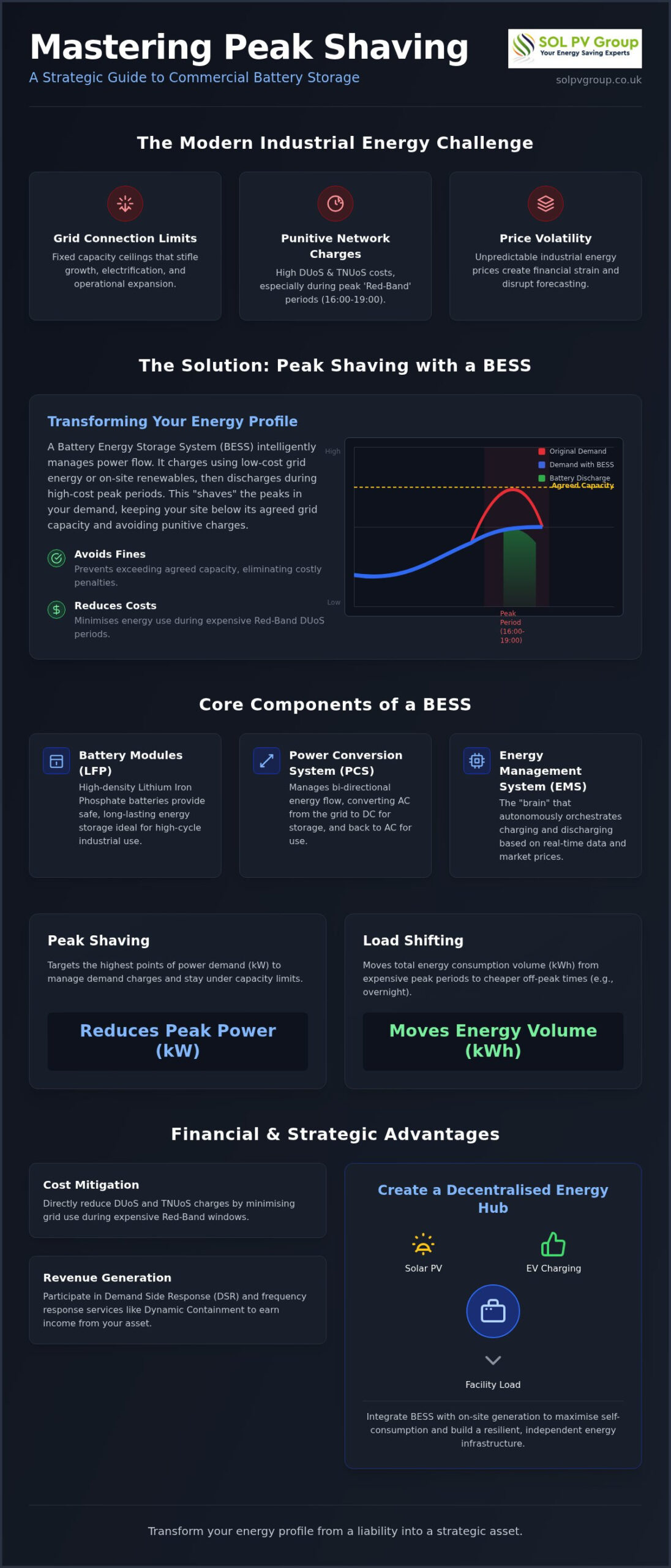
Peak shaving is the strategic reduction of grid demand during high-tariff periods. By 2026, the UK’s industrial energy landscape has shifted significantly. Businesses no longer view a battery storage system as a passive backup for power outages. Instead, it’s an active grid-edge asset that manages energy flow with precision. A modern Battery Energy Storage System (BESS) relies on three critical components: high-density battery modules for storage, a Power Conversion System (PCS) for bi-directional energy flow, and an Energy Management System (EMS) that orchestrates the entire process autonomously.
This technology is essential for UK organisations facing rigid grid capacity constraints. When a facility’s power demand approaches its permitted limit, peak shaving with commercial battery storage intervenes by discharging power locally. This prevents the site from exceeding its agreed capacity, avoiding both punitive fines and the need for costly grid reinforcement projects that often involve long lead times from District Network Operators (DNOs).
Peak Shaving vs. Load Shifting: Distinct Strategic Roles
Peak shaving specifically targets the reduction of the highest power peaks (measured in kW) to manage demand charges. Load shifting moves the total energy volume (kWh) from expensive peak windows to cheaper off-peak times, such as overnight. Both strategies work in tandem to flatten the site’s demand profile and reduce overall expenditure. The EMS prioritises these actions by analysing real-time market pricing and site-specific load data to maximise financial savings.
The Role of Lithium Iron Phosphate (LFP) in 2026
Lithium Iron Phosphate (LFP) is now the preferred chemistry for commercial installations because of its exceptional longevity and safety. Its inherent thermal stability makes it ideal for the high-cycle demands of industrial peak shaving. Maintaining battery health requires sophisticated thermal management systems that regulate internal temperatures during rapid discharge cycles. Modular, containerised units allow organisations to scale their storage capacity as their operational needs evolve, providing a future-proof energy solution for manufacturing and logistics hubs.
The Financial Mechanics: Mitigating TNUoS and DUoS Charges
Commercial energy billing in the UK relies heavily on half-hourly settlement data. This granular tracking means your organisation is charged based on when you use power, not just the total volume consumed. Distribution Use of System (DUoS) charges and Transmission Use of System (TNUoS) costs constitute a substantial portion of industrial overheads. By implementing peak shaving with commercial battery storage, businesses can effectively flatten their demand profile and reduce these specific line items by discharging stored energy when grid prices are at their highest.
Managing “Available Capacity” (kVA) is another critical financial driver for BESS adoption. If a site exceeds its agreed capacity limit, District Network Operators (DNOs) apply significant exceedance penalties. A battery system acts as a sophisticated safety buffer, capping the site’s draw from the grid to ensure it remains within contractual limits. This prevents immediate financial penalties and avoids the need for capital-intensive grid reinforcement projects that often come with multi-year lead times.
Optimising Red-Band Consumption
Red-band DUoS charges typically occur between 16:00 and 19:00 on weekdays when the distribution network is under maximum stress. These windows represent the most expensive periods for energy consumption in the UK. Battery storage for manufacturing plants allows for an automated response where the system discharges to cover the site’s load during these specific hours. This ensures the facility’s grid demand remains minimal when unit costs are at their peak, directly protecting the bottom line.
Participating in Demand Side Response (DSR)
Beyond simple cost avoidance, BESS assets create new revenue streams through Demand Side Response (DSR). National Grid provides financial incentives to businesses that reduce their demand or export power during periods of grid instability. In the 2026 market landscape, frequency response services like Dynamic Containment offer high-value returns for assets capable of sub-second responses. Aggregators play a vital role here, connecting your commercial battery storage to these national markets to ensure your asset is generating value even when not needed for site-specific peak shaving. To understand how these revenue streams could offset your initial investment, you can request a detailed energy asset appraisal.
Strategic Synergy: Integrating BESS with Commercial Solar PV
Integrating commercial solar PV with a BESS creates a closed-loop energy ecosystem that maximises the utility of every generated kilowatt-hour. Without storage, solar generation often peaks when site demand is relatively low, and it’s common for excess energy to be exported to the grid at suboptimal rates. By utilising peak shaving with commercial battery storage, businesses capture this surplus and deploy it during high-tariff windows or when solar generation drops. This ensures that on-site assets are fully utilised rather than feeding the grid for minimal return. It’s a strategic move that transforms intermittent generation into a dispatchable energy source.
Pairing industrial battery storage with solar significantly elevates self-consumption levels. A modern Energy Management System (EMS) uses “solar-first” logic to prioritise charging the battery with free on-site generation before drawing any power from the grid. This automated orchestration allows businesses to navigate the 2026 UK grid service revenue landscape with confidence. By having a guaranteed green charge source, the system can participate in high-value frequency response markets like Dynamic Regulation, which requires assets to maintain precise charge levels to balance grid frequency. This adds a layer of revenue that standalone systems might lack while ensuring the facility’s carbon footprint remains as low as possible.
Maximising ROI through Asset Integration
Standalone solar projects offer strong returns, but solar-plus-storage profiles provide greater financial stability and a more attractive long-term ROI. BESS integration improves the “bankability” of large-scale projects by reducing exposure to volatile export markets and creating a predictable cost structure for management teams. Integrated systems also future-proof businesses against the tightening export limits often imposed by DNOs. When assessing the solar payback period for commercial PV, it’s vital to include the combined value of avoided demand charges and the additional revenue generated through grid services.
ESG and Carbon Reporting Benefits
Organisations now face rigorous pressure to meet Scope 2 emissions targets and demonstrate clear progress toward Net Zero. BESS helps meet these goals by ensuring that a higher percentage of renewable energy is consumed on-site, directly reducing the carbon intensity of daily operations. Energy independence has transitioned from a secondary benefit into a core component of corporate social responsibility (CSR) mandates. For UK companies, these sustainable credentials and enhanced energy resilience assets significantly improve business valuation and appeal to institutional investors who prioritise long-term technical excellence.
Enabling Infrastructure: EV Charging and Solar Carports
The transition to electric fleets presents a unique set of challenges for the transport and logistics sector, where power demand is both high and mission-critical. Deploying a network of rapid chargers can easily overwhelm a site’s existing electrical infrastructure, leading to costly grid exceedance penalties. Peak shaving with commercial battery storage resolves this by acting as a high-capacity buffer. The system absorbs energy during periods of low activity and discharges it the moment a vehicle plugs in, preventing sudden spikes from reaching the grid. For a deeper look at the technical requirements for these systems, refer to our Commercial battery storage UK: 2026 Specification Guide.
Infrastructure such as commercial solar carports further enhances this ecosystem by turning car parks into decentralised energy hubs. These structures provide the surface area needed for significant solar generation whilst protecting the fleet and providing a direct feed to on-site battery modules. By synchronising generation, storage, and charging, organisations can decouple their transport costs from the volatility of the national grid, ensuring operational continuity even as energy prices fluctuate.
Overcoming Grid Constraints for Workplace Charging
Upgrading a local transformer to accommodate high-power charging is often a multi-year process involving significant capital expenditure. BESS provides a pragmatic alternative by delivering the necessary “burst” of power locally, bypassing the need for immediate grid reinforcement. The logic is simple yet effective: charge the battery via solar during the morning peak and discharge that energy for fleet charging in the afternoon. This approach allows for the rapid scaling of workplace EV infrastructure without the technical and financial hurdles typically associated with DNO capacity increases.
Integrated Energy Hubs for Retail and Logistics
For retail and wholesale sites, the energy demand from public rapid chargers is often erratic and difficult to forecast. An integrated energy hub allows for the autonomous management of these loads, using peak shaving with commercial battery storage to ensure that customer charging doesn’t interfere with the facility’s primary operations. Maintaining this balance requires sophisticated, unified monitoring systems that provide real-time data across all energy assets. If you’re planning to scale your on-site charging capacity, you can book a technical site assessment to identify the most efficient integration path for your facility.
Implementing BESS: From Feasibility to G99 Commissioning
Implementing a BESS requires a methodical approach that aligns technical specifications with financial objectives. A successful project moves through three primary phases: feasibility and design, regulatory approval, and physical commissioning. For manufacturing and industrial sites, this process ensures that peak shaving with commercial battery storage delivers the expected demand reduction without compromising site safety. It’s also vital to consider long-term performance through robust solar PV operation and maintenance protocols, which are equally critical for the longevity of battery assets.
The Importance of a Detailed Feasibility Study
Feasibility begins with a rigorous analysis of your facility’s half-hourly meter data. This data allows engineers to “right-size” the system, ensuring the battery has enough capacity to shave peaks without carrying unnecessary, expensive overhead. Over-sizing a battery can negatively impact the payback period by increasing the initial capital expenditure without providing a proportional increase in savings. Physical site requirements are equally important; containers need specific safety clearances, structured cooling access, and reinforced concrete foundations to support the significant weight of LFP modules. For more sector-specific insights, see our Battery Storage for Factories: 2026 Resilience Guide.
Navigating G99 Applications and Commissioning
The most complex regulatory hurdle is the G99 grid connection application. This is a mandatory technical requirement for any power-generating asset synchronising with the UK distribution network. District Network Operators (DNOs) must assess the site’s impact on the local grid before granting approval, a process that requires precise engineering diagrams and fault level calculations. Once approval is secured and the hardware is installed, the project enters the final commissioning phase.
This involves rigorous testing of the EMS logic and PCS response times to ensure the system reacts correctly to demand spikes. Partnering with a full-turnkey expert like Sol PV Group mitigates these technical risks, as we manage the entire lifecycle from the initial DNO application through to final handover and ongoing asset optimisation. This integrated approach ensures your system is compliant, safe, and ready to deliver immediate financial returns through peak shaving with commercial battery storage.
Securing Your Organisation’s Energy Future in 2026
The transition toward an electrified industrial landscape requires more than just new hardware; it demands a strategic shift in how power is managed. We’ve explored how peak shaving with commercial battery storage serves as a vital resilience asset, allowing businesses to bypass grid constraints whilst mitigating punitive DUoS and TNUoS charges. By integrating BESS with solar PV and EV infrastructure, you transform your facility into a high-performance energy hub that supports both Net Zero targets and long-term financial stability. These systems don’t just save money; they provide the operational security needed to grow in a volatile market.
Sol PV Group provides the technical expertise required to handle these complex transitions with meticulous care. Our team offers full-turnkey national delivery across the UK, managing everything from expert G99 grid connection applications to bespoke O&M packages for industrial asset protection. We’re committed to ensuring your technical standards are met with precision and transparency. Request your free commercial solar and battery strategy session today to begin your journey toward a more secure and cost-efficient energy profile. It’s time to take control of your demand curve and unlock the full potential of your site’s generation.
Frequently Asked Questions
How much space does a commercial battery storage system require for peak shaving?
A standard 1MWh system typically occupies the footprint of a 20-foot shipping container. You’ll also need to account for safety clearances of approximately 1.5 to 3 metres around the unit for ventilation and maintenance access. Smaller modular systems can be installed in dedicated plant rooms; however, large-scale industrial units are usually positioned outdoors on a reinforced concrete plinth to ensure adequate thermal management and fire safety compliance.
What is the typical lifespan of an industrial-grade BESS in the UK?
Industrial-grade LFP (Lithium Iron Phosphate) systems generally offer a design life of 10 to 15 years. This longevity is measured in cycles, with modern units typically rated for 6,000 to 8,000 cycles at 80% depth of discharge. Performance is maintained through sophisticated Energy Management Systems that prevent over-charging and deep-discharging. After this period, the batteries don’t fail instantly; they simply reach a point where capacity drops below 80% of the original rating.
Can peak shaving with battery storage provide backup power during a grid outage?
Yes, a BESS can provide backup power, but it requires specific island mode or off-grid functionality. Standard peak shaving configurations are often grid-tied and will shut down during an outage to protect engineers working on the network. If your facility requires resilience against power cuts, we must specify an uninterruptible power supply capability during the design phase. This ensures the system can disconnect from the grid and support critical loads independently.
Do I need a new grid connection to install a commercial battery storage system?
You don’t necessarily need a new connection, but you must secure a G99 approval from your District Network Operator. This application process assesses whether your existing connection can handle the bi-directional flow of energy. In many cases, peak shaving with commercial battery storage actually removes the need for a new, larger connection by capping your site’s peak draw. We manage this entire DNO application process to ensure your system complies with all local network requirements.
Is there a minimum site energy demand required for peak shaving to be viable?
There’s no strict legal minimum, but peak shaving is most viable for sites with high demand volatility or those facing capacity constraints. If your site’s peak demand regularly approaches your Available Capacity limit, the financial returns from avoiding exceedance penalties are significant. Typically, organisations with an annual energy spend exceeding £50,000 find that the combination of demand charge reduction and grid service revenue provides a compelling return on investment.
How does peak shaving help with UK corporate ESG reporting?
Peak shaving assists ESG reporting by increasing the consumption of renewable energy generated on-site. By storing excess solar power and discharging it during peak windows, you reduce your reliance on carbon-intensive grid electricity during periods of high national demand. This directly lowers your Scope 2 emissions. Additionally, demonstrating energy resilience and grid support through frequency response services enhances your corporate profile as a responsible and technologically advanced organisation.
What maintenance is required for containerised commercial battery systems?
Containerised systems require minimal manual intervention but need regular professional inspections. Maintenance focuses on the HVAC systems that regulate temperature, as keeping the LFP modules cool is vital for their lifespan. We also perform remote software monitoring and periodic physical checks on electrical connections and fire suppression systems. Our bespoke O&M packages include these services to ensure your industrial assets remain protected and operate at peak efficiency throughout their lifecycle.
Can I add more battery modules to my system if my site demand increases?
Most modern BESS designs are modular, allowing you to expand capacity as your operational requirements grow. You can add extra battery strings to existing cabinets or install additional containers in parallel. This scalability is a core benefit of peak shaving with commercial battery storage, as it allows your energy infrastructure to evolve alongside your fleet electrification or manufacturing expansion. We ensure the initial specifications are robust enough to handle future capacity increases.