

What if your organisation’s transition to an electric fleet didn’t depend on the local grid’s limited capacity or the prohibitive costs of Distribution Network Operator (DNO) upgrades? You’ve likely realised that the journey toward 2030 net-zero targets is frequently obstructed by infrastructure fees and peak-time electricity tariffs that diminish your bottom line. Adopting a strategic solar battery EV charging business model allows you to bypass these external constraints by establishing a self-sustaining energy ecosystem on your own premises.
It’s a fundamental shift from being a passive energy consumer to an active producer. By integrating commercial solar PV with sophisticated battery storage, you can capture renewable energy and deploy it precisely when your fleet requires it. This guide explores how combined installations can secure a 100% first-year deduction through Full Expensing and potentially benefit from 0% VAT. We’ll detail the technical and financial framework required to achieve true energy independence, reduce operational overheads, and deliver a demonstrable reduction in your carbon footprint through a methodical, results-oriented approach.
Key Takeaways
- Bypass prohibitive DNO upgrade costs by implementing a localised microgrid that supports rapid EV charging independently of standard grid capacity constraints.
- Optimise your solar battery EV charging business strategy by utilising load-shifting techniques to capture midday solar energy for essential overnight fleet requirements.
- Identify how combined installations qualify for 100% first-year capital allowances and 0% VAT, significantly improving the project’s return on investment.
- Learn the essential steps for sizing a Battery Energy Storage System (BESS) to ensure it aligns perfectly with your facility’s peak demand and charging cycles.
- Transition your organisation from a passive energy consumer to an active prosumer through a turnkey approach that simplifies the management of complex integrated technologies.
Solving the Grid Capacity Challenge for Commercial EV Infrastructure
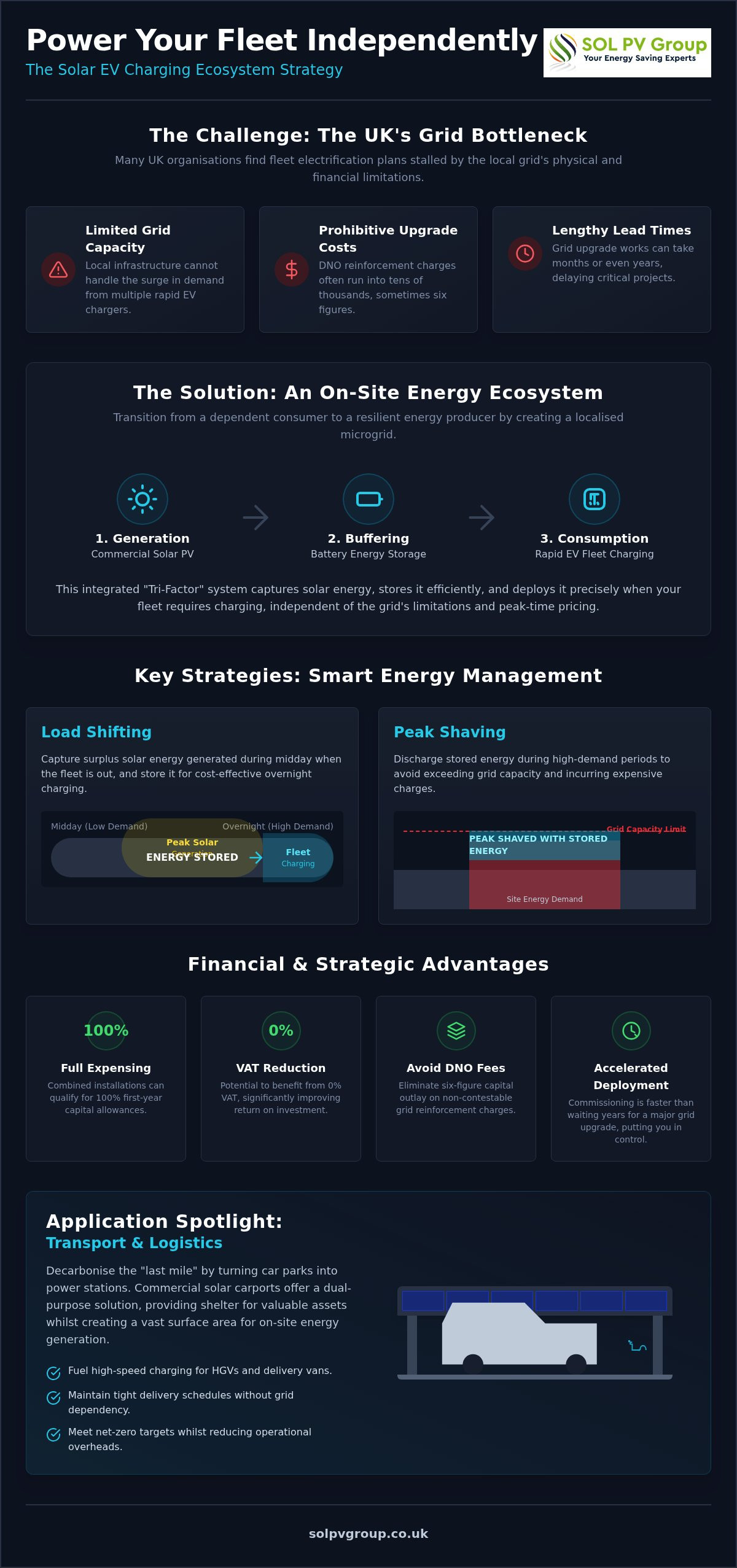
Many UK businesses face a stark reality when planning for fleet electrification: the local grid simply isn’t ready. This “Grid Bottleneck” often stops projects before they begin. A grid bottleneck in UK commercial property occurs when the existing local electrical infrastructure lacks the spare capacity to handle the surge in demand required by rapid EV charging stations. Standard business connections were rarely designed to accommodate multiple 50kW or 150kW chargers; consequently, many organisations find their electrification plans stalled by the local network’s physical limitations.
Establishing a solar battery EV charging business model allows you to transition toward a localised microgrid. It’s a strategic shift from being a dependent consumer into a resilient producer. By harnessing photovoltaic technology, your facility generates its own power, which is then managed by an on-site Battery Energy Storage System (BESS). This integrated ecosystem acts as a buffer between your demand and the grid. Instead of drawing massive spikes of power from the Distribution Network Operator (DNO) during peak charging hours, you draw from your stored reserves. Smart charging software further refines this process, dynamically balancing the site load to ensure that EV chargers never trip the main breakers or exceed your agreed supply capacity.
The Financial Impact of Grid Constraints
Relying solely on the grid for fleet charging can lead to unforeseen capital expenditure. Upgrading a local substation or installing new high-voltage cabling often costs tens of thousands of pounds; in some industrial areas, these fees can escalate into six figures. Optimising your solar battery EV charging business through on-site storage ensures that your infrastructure remains viable even as local demand increases. Key advantages include:
- Reduced Capital Outlay: Avoidance of non-contestable DNO reinforcement charges.
- Accelerated Deployment: Integrated systems can often be commissioned faster than a major grid upgrade.
- Cost Stability: Protection against fluctuating peak-time distribution and transmission charges.
Beyond the direct expense, the “time-to-power” is a critical factor. DNO works frequently involve lengthy lead times, sometimes stretching into years, whereas on-site integration places the timeline back under your control.
Decarbonising the Last Mile for Logistics
Companies within the transport and logistics sector face particularly intense pressure to meet net-zero targets whilst maintaining tight delivery schedules. These firms require high-speed charging for heavy goods vehicles and delivery vans, often during specific windows that coincide with peak grid pricing. Commercial solar carports offer a dual-purpose solution in these environments. They provide the necessary physical shelter for high-value assets whilst creating a vast surface area for energy generation, effectively turning car parks into power stations that fuel the “last mile” of the supply chain without increasing grid dependency.
The Synergy of Solar PV, Battery Storage, and EV Charging
The integration of three distinct technologies creates a closed-loop energy system that maximises operational efficiency. We define this as the “Tri-Factor”: solar PV handles generation, the battery manages buffering, and the EV infrastructure provides consumption. In a standard solar battery EV charging business model, these components work in concert to decouple your fleet’s energy needs from volatile grid pricing. This synergy ensures that the energy you produce is used on-site rather than being exported to the grid for minimal financial return.
Load shifting is perhaps the most significant advantage of this synergy. Solar arrays produce peak energy during the middle of the day, yet many commercial fleets are out on the road during these hours. Without storage, this energy is often exported for a fraction of its value. With a battery, you can capture this midday surplus and deploy it for overnight charging. Similarly, peak shaving allows the system to discharge stored solar energy during high-demand manufacturing shifts, preventing the site from exceeding its grid capacity limits when multiple types of EV charging stations are active simultaneously. This technical orchestration allows for a higher density of chargers without the need for expensive infrastructure upgrades.
How Battery Storage Optimises Solar ROI
The primary challenge for commercial sites is the temporal mismatch between generation and usage. While solar panels reach peak output between 11:00 and 14:00, your vehicles might only return for charging after 18:00. Deploying industrial battery storage effectively bridges this gap, turning intermittent generation into a reliable fuel source. Modern lithium-ion systems typically achieve a round-trip efficiency of approximately 85% to 90%, ensuring that the vast majority of your harvested solar power is successfully transferred to your vehicle fleet. This process maximises self-consumption, which can increase from 65% to over 90% when storage is correctly sized for your specific operational profile.
Smart Energy Management Systems (EMS)
An Energy Management System (EMS) acts as the central intelligence of the installation, prioritising site loads to ensure business continuity. It integrates directly with Building Management Systems (BMS) to decide whether solar power should go to the battery, the factory floor, or the charging bays. This level of control is essential for future-proofing, as it prepares the infrastructure for Vehicle-to-Building (V2B) and Vehicle-to-Grid (V2G) protocols where EV batteries can support the site during power outages. For those seeking to understand the technical feasibility of such an integration, a bespoke commercial energy audit can provide the necessary data to inform your investment strategy.
Case Study Analysis: Integrated Systems vs. Standalone EV Charging
The financial disparity between a standalone grid-reliant setup and an integrated microgrid is stark. Consider a typical UK manufacturing facility operating with a 250kW peak demand. In a standalone scenario, installing ten rapid chargers creates an immediate conflict with production energy needs. The business faces high peak-time electricity tariffs, often between 24p and 30p/kWh, and risks exceeding its agreed supply capacity. This frequently results in limited charger availability during peak shifts to avoid tripping main breakers or incurring heavy penalties from the DNO.
Contrast this with an integrated solution featuring solar PV, a 500kWh Battery Energy Storage System (BESS), and the same ten rapid chargers. This setup establishes a robust solar battery EV charging business model where on-site generation costs drop to approximately 5-8p/kWh. Over a five-year period, the operational cost savings are substantial. For instance, fueling an electric van with on-site solar instead of public rapid charging networks, which cost 60-85p/kWh in 2026, can save between £3,500 and £4,500 annually per vehicle. The integrated approach ensures your fleet remains powered without compromising manufacturing output.
Operational Efficiency in Manufacturing
Energy intensity is a defining characteristic of the manufacturing sector. Integrated systems are uniquely suited to facilities with 24/7 shift patterns because the BESS captures solar energy during the day for use by the night shift’s fleet. This ensures that carbon reduction isn’t just a daylight benefit. It provides the granular data required for ESG reporting and corporate sustainability goals, demonstrating a clear commitment to fleet decarbonisation. Such transparency is increasingly vital for tender prequalification and meeting CSRD obligations.
ROI and Payback Periods
Analysing the solar payback period commercial entities can expect reveals that combined systems often reach break-even within four to six years. This is significantly faster than standalone components because the “Combined ROI” accounts for avoided grid reinforcement and reduced peak demand charges. Strategic frameworks like the Public EV Charging Infrastructure Playbook highlight the importance of grid-friendly deployment to ensure long-term viability. Under 2026 regulations, UK companies can utilise Full Expensing to claim a 100% first-year deduction on qualifying plant and machinery. This tax incentive, combined with 0% VAT on integrated EV infrastructure, can equate to an immediate saving of up to 25% of the total project cost for profitable firms.
Strategic Implementation: Sizing, DNO Applications, and Scalability
Implementing a successful solar battery EV charging business model requires more than hardware procurement; it demands a meticulous engineering phase. We begin with a rigorous feasibility study that assesses structural roof health and existing electrical infrastructure. Understanding your current baseline is vital. We utilise data logging of site loads to identify exactly how much headroom exists within your current connection before adding EV demand. This technical scrutiny ensures that the final system is neither undersized for your fleet’s requirements nor oversized beyond your budget.
The Feasibility and Consultation Phase
Identifying the “sweet spot” between the solar array size and the Battery Energy Storage System (BESS) capacity is essential for project ROI. If the battery is too small, you’ll export valuable energy for minimal credit; if it’s too large, the capital expenditure increases without a corresponding operational benefit. Our consultation process uses predictive modelling based on your specific fleet duty cycles and manufacturing shifts. You can view sector-specific examples of these technical balances in our case studies.
DNO Strategy: Export Limitation and Import Management
Navigating the G99 and G100 application processes is often the most complex stage of a commercial project. Distribution Network Operators (DNOs) are frequently cautious about approving new high-capacity connections. However, integrated systems offer a strategic advantage during these negotiations. By using G100-compliant export limitation, we can install a larger solar array than the grid would normally allow by ensuring surplus power remains on-site. The battery effectively “masks” the peak demand of your EV chargers from the DNO, as it provides the necessary current locally rather than pulling it from the transformer. A Zero Export configuration is particularly beneficial for urban sites because it allows for rapid infrastructure deployment without triggering the need for expensive and time-consuming network reinforcement.
Planning for scalability is the final pillar of a robust strategy. We favour modular designs that allow your energy ecosystem to grow alongside your electric fleet. This approach avoids the “stranded asset” trap where initial infrastructure becomes obsolete as you add more vehicles. To begin your site assessment and navigate these technical requirements, you can request a free commercial solar strategy from our engineering team.
Future-Proofing Your Business with a Turnkey Solar Strategy
The transition from an “Energy Consumer” to an “Energy Prosumer” represents a fundamental shift in corporate asset management. Businesses no longer need to be passive recipients of grid-supplied power; instead, they can become active participants in their own energy generation and distribution. Operating a solar battery EV charging business requires a sophisticated understanding of how three distinct technologies interact. A turnkey partner is vital here, as they provide a single point of accountability from the initial feasibility study through to the final commissioning of the localised microgrid. This unified approach prevents the technical silos that often occur when separate vendors handle solar, storage, and charging components.
Longevity is a core component of this strategic framework. Solar assets are engineered for a 25-year lifespan, but achieving this requires rigorous Operation and Maintenance (O&M) packages. Regular thermal imaging, string testing, and software optimisations for the Battery Energy Storage System (BESS) ensure that the hardware performs at peak efficiency. This ongoing care is especially critical as we approach the 2030 ban on new petrol and diesel vehicles. Establishing a resilient, renewably-powered fleet infrastructure today ensures your organisation remains operational and competitive as the UK transport landscape undergoes this mandatory shift toward electrification.
The Role of Solar Carports in Corporate Estates
For organisations within the manufacturing and logistics sectors, roof space might be occupied by plant equipment or skylights. In these scenarios, commercial solar carports offer a strategic alternative by utilising existing car park acreage. These structures transform standard parking bays into high-yield energy generators, providing covered charging points that improve the employee experience. A dedicated solar carport installation provides the physical foundation for large-scale fleet electrification whilst shielding vehicles from the elements, effectively turning underutilised land into a core energy asset.
Next Steps: Developing Your Solar Strategy
Success in the 2026 energy market requires a move toward total energy independence for businesses UK. This holistic approach ensures that your solar battery EV charging business is protected from external price shocks and grid instability. The first step in this transition is a professional feasibility study, which provides the data-driven foundation for your investment. By assessing your site’s specific load profile and structural capacity, you can develop a roadmap that balances immediate cost savings with long-term carbon reduction. To begin this process and secure your organisation’s energy future, we invite you to request a free commercial solar strategy from our expert engineering team.
Securing Your Organisation’s Energy Autonomy
The transition toward an electrified fleet presents both a challenge and a significant strategic opportunity. By integrating solar PV, battery storage, and EV infrastructure, your business can effectively bypass the grid bottlenecks and prohibitive DNO upgrade costs that stall many commercial projects. This holistic approach ensures you capture renewable energy at its lowest cost whilst protecting your facility from peak-time tariff volatility. Establishing a resilient solar battery EV charging business model provides the operational stability required to meet 2030 net-zero targets without compromising production efficiency.
Sol PV Group specialises in delivering these complex, integrated systems for the manufacturing and logistics sectors through a full-turnkey design and installation process. Our 2026-ready DNO grid management expertise ensures your project moves from feasibility to commissioning with meticulous care. To understand how your site can achieve energy independence and slash operational overheads, Book your free Solar Strategy and feasibility assessment today. We look forward to partnering with you on your journey toward a self-sustaining and secure energy future.
Frequently Asked Questions
Can I install EV chargers if my business has a limited grid connection?
Yes, you can install EV chargers on sites with limited grid capacity by using battery storage to buffer the high power demand. This configuration isn’t dependent on immediate transformer upgrades; it allows you to draw power slowly from the grid and discharge it rapidly when needed. It effectively bypasses the need for expensive DNO reinforcement whilst ensuring your fleet remains operational.
How much solar PV do I need to power a fleet of 10 electric vans?
Powering 10 electric vans typically requires a solar array between 60kWp and 90kWp, depending on daily mileage and vehicle efficiency. Assuming an average of 20,000 miles per year per van, the total energy demand’s substantial. A professional feasibility study will calculate the exact kilowatt-peak requirement by analysing your specific duty cycles and local solar irradiance levels to ensure reliable year-round charging.
Does a solar battery really improve the ROI of an EV charging installation?
Battery storage significantly improves the ROI of an EV installation by increasing solar self-consumption from roughly 65% to over 90%. Storing surplus energy generated during the day for peak-rate periods avoids grid costs of up to 30p/kWh. It’s a proven financial strategy. This optimisation shortens the payback period for a solar battery EV charging business project to between four and six years.
What is the typical lifespan of a commercial solar and battery system?
You’ll expect a 25-year operational lifespan for solar PV modules, whilst commercial battery systems typically last 10 to 15 years. Modern lithium-ion batteries are rated for thousands of charge cycles before capacity begins to degrade. EV charging hardware generally requires replacement or significant refurbishment after 10 years; however, the underlying electrical infrastructure’s designed for much longer service.
Are there any UK government grants for commercial EV charging in 2026?
The Workplace Charging Scheme (WCS) remains available in 2026, providing up to 75% of installation costs capped at £500 per socket. This grant’s available for up to 40 sockets per business until 31 March 2027. Additionally, UK companies can utilise Full Expensing to claim a 100% first-year capital allowance on qualifying plant and machinery, which effectively reduces the net project cost.
How long does the DNO application process take for integrated systems?
A standard G99 DNO application for an integrated system typically takes between 45 and 65 working days for a formal response. Network reinforcement needs can extend this. We manage the complexity. Our team submits detailed technical designs early to secure capacity and ensure your solar battery EV charging business timeline remains on track.
Is a solar carport better than a rooftop installation for EV charging?
A solar carport’s often superior for sites with limited roof space or those requiring high-visibility sustainability credentials. Whilst rooftop installations are generally more cost-effective to install, carports utilise underused car park acreage and provide physical protection for vehicles. They’re an excellent solution for logistics hubs where roof structures can’t support the weight of a large-scale solar array.
What maintenance is required for an integrated solar battery EV system?
Maintenance for an integrated system involves annual electrical inspections, thermal imaging of solar strings, and routine firmware updates for the battery management software. Physical cleaning of the panels might be required depending on your local environment to maintain peak generation. Our ongoing O&M packages provide proactive monitoring to identify and resolve performance issues before they impact your fleet’s charging availability.