
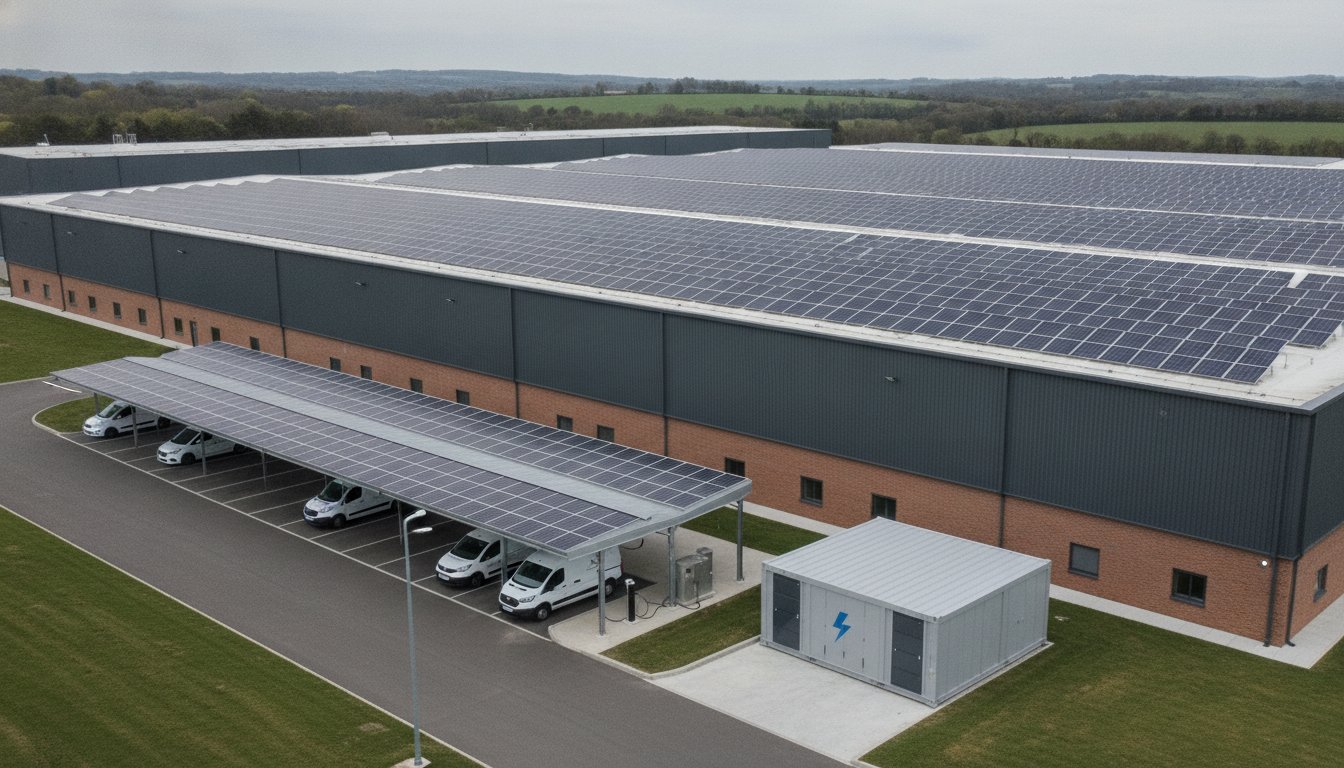
Can your organisation afford to ignore a potential 70% reduction in energy costs whilst competitors lock in predictable rates for the next two decades? For many UK manufacturing and logistics firms, the move towards on-site generation is no longer just a sustainability goal; it’s a vital strategy for long-term operational security. Successfully delivering a commercial solar PV installation UK project requires a sophisticated understanding of technical integration and the evolving 2026 regulatory landscape.
We recognise that volatile industrial energy prices and the complexities of G99 grid applications often create significant uncertainty for decision-makers. This guide provides a comprehensive framework to navigate these challenges, ensuring your transition to renewable infrastructure is handled with precision. You’ll gain a clear roadmap for achieving energy independence, utilising the latest capital allowance rules, and securing a predictable long-term levelised cost of energy whilst generating audit-ready ESG data for your stakeholders.
Key Takeaways
- Understand why on-site generation has become a critical hedge against energy market volatility and how it secures your 2026 decarbonisation targets.
- Learn how a turnkey commercial solar PV installation UK project manages the entire lifecycle; this includes everything from initial feasibility to complex G99 grid negotiations.
- Discover the advantages of integrated energy solutions that combine solar with battery storage and EV charging to maximise self-consumption and power commercial fleets.
- Evaluate the financial architecture of large-scale solar, including current ROI projections, Capital Allowance benefits, and zero-CAPEX PPA deployment options.
- Identify the essential criteria for selecting a Tier-1 partner and the necessity of dedicated O&M contracts for ensuring long-term asset uptime.
Why Commercial Solar PV is Critical Infrastructure in 2026
In 2026, a commercial solar PV installation UK project is no longer viewed as an optional environmental initiative. It’s now a strategic hedge against the persistent volatility of industrial energy prices. As the UK solar power capacity is projected to reach 20.85 GW by the end of this year, businesses are integrating generation into their core infrastructure to protect operational margins. This shift is driven by the need for energy security in a market that has faced significant instability since the closure of the UK’s last coal power station in 2024.
To better understand the scale and technical precision involved in these projects, watch this overview of the installation process:
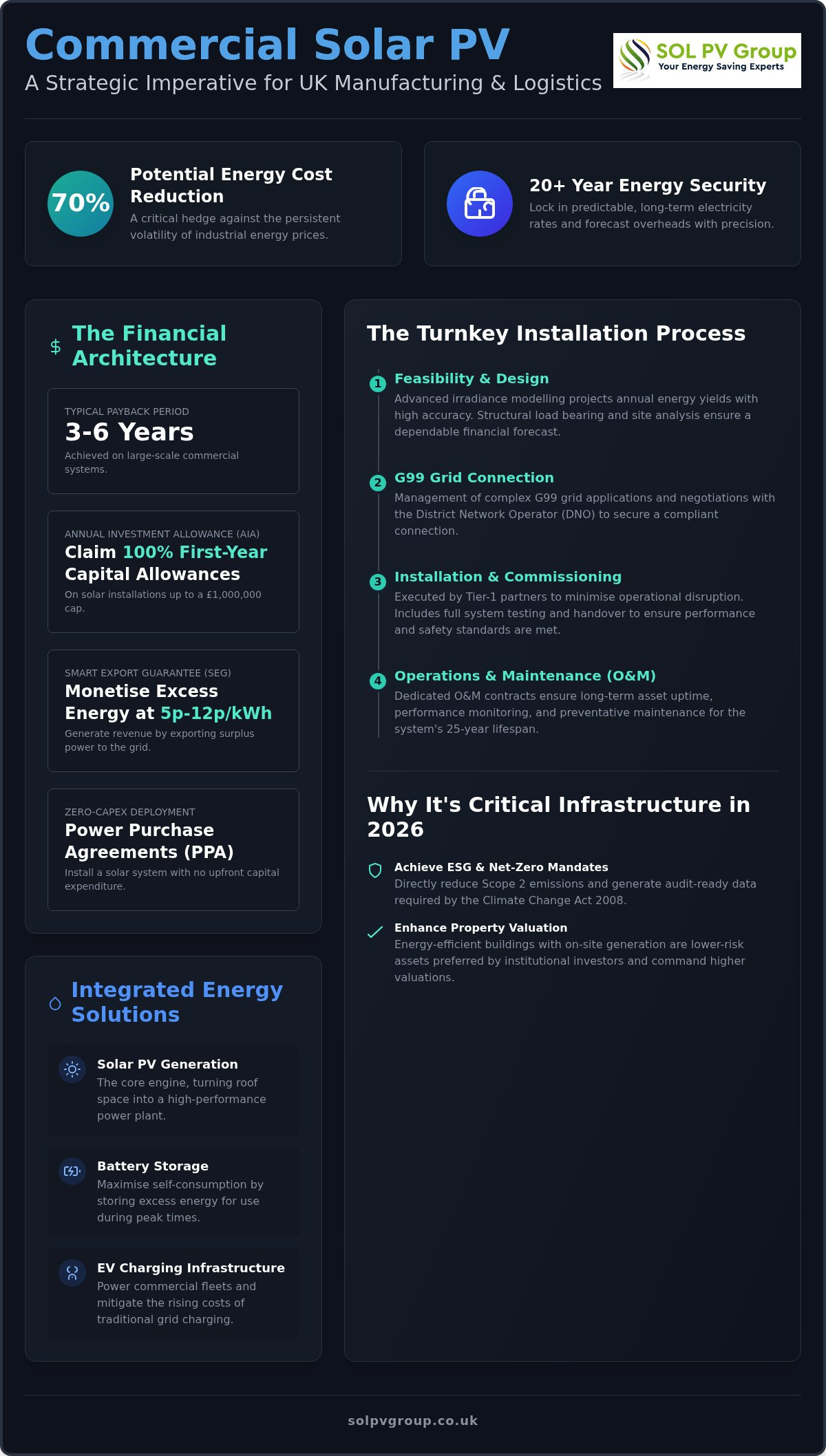
Traditional financial assessments often focus solely on simple payback periods, which typically range between three and six years for large systems. However, sophisticated firms now prioritise Levelised Cost of Energy (LCOE) analysis. This metric accounts for the total cost of the asset over its 25-year lifespan against its total energy output, providing a more accurate reflection of how a commercial solar PV installation UK delivers long-term security. By locking in a fixed cost for electricity, organisations can forecast their overheads with a level of precision that grid-reliant competitors cannot match.
Beyond energy savings, these installations significantly enhance the valuation of commercial and industrial properties. Energy-efficient buildings with high EPC ratings and on-site generation are increasingly preferred by institutional investors. These assets are seen as lower-risk investments because they’re better prepared for future regulatory shifts and offer lower operating costs for potential tenants or future owners. Organisations seeking to understand how to maximise the potential of their building envelope can find detailed strategic guidance in our dedicated resource on rooftop solar for commercial buildings, which covers everything from technical feasibility to long-term asset protection.
The 2026 Energy Landscape for UK Organisations
Manufacturing organisations face intense pressure to decarbonise whilst maintaining global competitiveness. Energy independence has transitioned from a preference to a core requirement for business continuity. Under the Climate Change Act 2008, the UK’s legally binding net-zero targets have intensified corporate reporting requirements. Large firms must now provide transparent, audit-ready data on their carbon footprint. Generating power on-site is the most direct way to reduce Scope 2 emissions and meet these stringent 2026 ESG mandates. To understand the full scope of how transmission network charges and non-commodity costs are reshaping the business case for on-site generation, our energy independence for businesses UK strategic trend analysis provides a comprehensive breakdown of the legislative and market forces driving this transition.
Solar as a Revenue-Generating Business Asset
This transition transforms energy from a recurring operational expense into a high-yield capital asset. Current tax incentives, such as the Annual Investment Allowance (AIA), allow businesses to claim 100% first-year capital allowances on solar PV installations up to a £1,000,000 cap. For a detailed breakdown of how to leverage these reliefs to their fullest extent, our guide on commercial solar capital allowances UK provides a definitive roadmap for maximising your business ROI in 2026. The Smart Export Guarantee (SEG) also enables businesses to monetise excess energy by exporting it back to the grid at rates typically between 5p and 12p/kWh. For logistics centres in 2026, on-site solar PV functions as the primary energy engine for fleet electrification, turning vast roof spaces into high-performance power plants that mitigate the rising costs of traditional grid charging.
Navigating the Turnkey Installation Process: From Feasibility to Grid Connection
Executing a large-scale solar project requires more than simply mounting panels. It’s a complex engineering undertaking that demands a methodical approach to risk management. A full-turnkey commercial solar PV installation UK strategy ensures that every technical hurdle, from structural load bearing to regulatory compliance, is managed through a single point of accountability. This integrated approach is particularly vital for industrial sectors where operational disruption must be avoided at all costs.
The Feasibility and Design Phase
Precision begins with data. We utilise advanced irradiance modelling to project annual yields with high degrees of accuracy, ensuring that financial forecasts remain dependable for FDs and stakeholders. This phase isn’t just about output; it’s about compatibility. We assess the specific roof condition and orientation of manufacturing facilities to determine the most secure mounting methods. Your system size must be customised to match the unique load profile of your business. This alignment ensures that self-consumption is maximised, which directly impacts the long-term LCOE of the asset.
Mastering the Grid Connection Lifecycle
The G99 grid application is frequently the most significant bottleneck in any project. For systems exceeding 50kW, the UK Solar Taskforce has highlighted the need for streamlined processes to unlock the untapped potential of commercial roofs. Despite these national ambitions, District Network Operators (DNOs) often impose strict export limitations or require expensive grid reinforcement before granting approval.
Navigating these negotiations is a critical path activity. A seasoned partner manages the entire G99 lifecycle, engaging with DNOs early to secure the best possible connection terms and managing any potential export constraints. They handle all planning permissions and regulatory paperwork, allowing your internal teams to focus on core operations. If you’re concerned about how local grid constraints might affect your site, you can explore our commercial solar services to understand how we mitigate these risks.
Before the system goes live, structural integrity assessments are mandatory, especially for older manufacturing plants or logistics hubs. These surveys confirm that the building can safely support the additional dead load and wind uplift of a large array. If you need to prepare your property for such installations, you can learn more about Swiss Build Ltd to see how professional construction services can support your project. Finally, professional commissioning verifies that every string, inverter, and safety switch operates within specified tolerances. For those considering a commercial solar PV installation UK, this rigorous sign-off process ensures the system is safe, efficient, and ready to generate value from day one.
Integrated Energy Solutions: Combining PV, Battery Storage, and EV Charging
Relying on solar panels alone often leads to wasted energy or missed savings during periods of low demand. To truly optimise a commercial solar PV installation UK, organisations are increasingly adopting an integrated energy hub model. This architecture combines generation with storage and transport infrastructure, creating a closed-loop system that maximises every kilowatt generated on-site. It’s a shift from simple power generation to comprehensive energy management that ensures your investment works harder for the business.
Maximising Self-Consumption with Battery Storage
Industrial battery storage is the catalyst that makes solar viable for 24/7 operations. By capturing excess generation during peak daylight hours, firms can utilise “load shifting” to power machinery during evening shifts or “peak shaving” to avoid expensive grid demand spikes. This technology provides a vital layer of business resilience. If the grid becomes unstable, a correctly configured battery system offers backup power for critical industrial processes, preventing costly downtime. Integrating storage significantly improves the ROI by ensuring that nearly 100% of generated energy is consumed behind the meter rather than exported at lower rates. For a comprehensive understanding of how industrial battery storage can protect your business from rising TNUoS charges and grid volatility in 2026, our dedicated guide provides the technical and strategic detail your organisation needs.
Solar Carports and EV Infrastructure
Corporate car parks represent vast, underutilised assets that can be transformed into high-performance power plants. Commercial solar carports provide a dual-purpose solution: they generate renewable energy whilst providing sheltered parking for employees and visitors. This infrastructure is essential for future-proofing sites against the mandatory transition to electric vehicle (EV) fleets. According to this Guide to Commercial Solar Panels, the synergy between transport and generation is a key driver for modern financial performance. Integrating workplace EV charging points directly with solar canopies allows firms to charge their fleets using zero-carbon electricity, drastically reducing fuel overheads.
The visible nature of these canopies also serves as a powerful statement of corporate intent. They provide a tangible demonstration of ESG commitment to clients and employees alike. When designed as part of a multi-technology hub, these systems ensure your facility remains operationally efficient and compliant with the evolving demands of the 2026 industrial landscape. It’s about building a site that’s self-sufficient, resilient, and ready for the next decade of transport electrification.
While infrastructure is key to ESG, the human side of business, such as corporate events and employee engagement, also requires a focus on quality. For organisations looking to inspire their teams with exceptional service, PanYella Catering serves as an excellent example of how specialist providers can deliver authentic and memorable catering experiences.
The Financial Architecture of UK Commercial Solar: ROI, PPA, and Tax Incentives
For Financial Directors, the decision to invest in a commercial solar PV installation UK project is increasingly driven by the internal rate of return (IRR) and the ability to de-risk future energy expenditure. Whilst the operational benefits are clear, the underlying financial architecture determines the ultimate success of the asset. Achieving a robust return requires a balance between capital deployment, tax optimisation, and the mitigation of long-term maintenance costs. A well-structured project doesn’t just save money; it creates a predictable, high-yield asset on the balance sheet.
Funding Models: CAPEX vs. PPA
Organisations typically choose between direct capital expenditure (CAPEX) or a third-party funded Power Purchase Agreement (PPA). Direct ownership offers the highest long-term ROI, as the business retains 100% of the energy savings and any revenue from the Smart Export Guarantee. However, a PPA provides a compelling alternative for firms prioritising liquidity. Under a PPA, a third party funds the entire installation and maintenance, selling the generated power back to the business at a rate significantly lower than the grid. This zero-CAPEX model allows for immediate energy cost reductions without any upfront financial burden or technical risk. With non-commodity costs now accounting for up to 64% of a typical business energy bill, understanding how to achieve energy independence for businesses UK through the right funding model has never been more strategically important.
Tax Efficiency and Government Incentives
The UK’s current tax regime remains highly favourable for renewable energy investments. Under the Annual Investment Allowance (AIA), businesses can claim a 100% first-year capital allowance on solar PV installations up to a £1,000,000 annual cap. For larger projects exceeding this limit, “Full Expensing” rules and special rate allowances provide additional avenues to offset costs against corporation tax. Understanding how to structure your investment to fully utilise commercial solar capital allowances UK rules can significantly reduce your effective capital outlay and accelerate your project’s payback period. Investing in renewable infrastructure allows UK companies to significantly reduce their taxable profits whilst simultaneously lowering long-term operational overheads.
To ensure the projected payback period remains on track, budgeting for a comprehensive Operation and Maintenance (O&M) contract is essential. Without proactive monitoring, minor component failures can lead to significant downtime, eroding the system’s IRR. A professional O&M strategy protects the asset’s performance throughout its 25-year lifecycle, ensuring that the initial financial projections are met or exceeded. To evaluate which funding strategy best supports your organisation’s growth, request a detailed financial appraisal of our commercial solar PV solutions.
Selecting a Tier-1 Installation Partner for Industrial-Scale Projects
Selecting a partner for a large-scale project is a decision that impacts an organisation’s balance sheet for decades. It’s not merely about finding a vendor who can mount panels; it’s about identifying a strategic partner capable of managing the complexities of industrial infrastructure. For a commercial solar PV installation UK project to succeed, the installer must demonstrate a proven track record in handling high-voltage grid connections and large-scale structural requirements. High-level decision-makers must prioritise partners who possess the technical scale and financial stability to support an asset with a 25-year lifecycle.
Beyond the Install: Operation and Maintenance (O&M)
System uptime is the primary driver of long-term ROI. A Tier-1 partner provides comprehensive Operation and Maintenance (O&M) packages that move beyond reactive repairs to proactive asset management. Preventative maintenance ensures that panel efficiency remains optimal whilst remote performance monitoring allows for the immediate identification of faults before they affect your bottom line. This level of oversight is often a mandatory requirement for insurance compliance and the preservation of manufacturer warranties. Without a dedicated O&M contract, even a high-quality commercial solar PV installation UK can suffer from performance degradation that erodes the projected internal rate of return.
Manufacturing and logistics facilities present unique challenges that generic installers often overlook. These environments typically feature high base loads and complex roof structures that require specialised engineering approaches. A partner with sector-specific expertise understands how to integrate solar infrastructure without disrupting critical production cycles or sensitive logistics workflows. They recognise that maintaining operational continuity is just as important as the energy generation itself. For organisations with large industrial rooftops seeking a structured framework for this transition, our 2026 strategic guide to rooftop solar for commercial buildings outlines the complete pathway from feasibility through to long-term O&M management.
The Sol PV Group Advantage
Sol PV Group delivers a full-turnkey experience, taking complete responsibility for the entire project management lifecycle. We specialise in the education, manufacturing, and logistics sectors, providing everything from initial feasibility to 25-year system monitoring. Our in-house teams handle the technical heavy lifting, including G99 applications and structural assessments, which removes the administrative burden from your internal facilities teams. We’re committed to transparency and professional integrity, ensuring that every project meets the highest technical standards.
Ready to start your feasibility study? Contact Sol PV Group today to ensure your renewable transition is handled with meticulous care and expert precision. Our team is prepared to help you achieve energy independence through a robust and reliable commercial solar strategy tailored to your specific industrial needs.
Securing Your Organisation’s Energy Future
The transition to on-site generation represents a fundamental shift in how UK businesses manage operational risk. By integrating solar PV with battery storage and EV charging, your facility becomes a self-sustaining energy hub that’s resilient against market volatility. Successfully managing the regulatory and technical complexities of a commercial solar PV installation UK project requires a partner who understands the nuances of the industrial landscape. Sol PV Group provides the authoritative expertise necessary to oversee every phase, from complex G99 grid applications to long-term asset management.
Our methodology focuses on total asset protection and sustained financial performance. We are specialists in large-scale industrial and logistics projects, delivering full-turnkey solutions that remove the administrative burden from your internal facilities teams. With our comprehensive O&M support, we ensure your infrastructure remains efficient, compliant, and productive throughout its entire operational lifespan. It’s time to transform your roof space into a high-yield strategic asset.
Book Your Commercial Solar Feasibility Study with Sol PV Group
Frequently Asked Questions
Do I need planning permission for commercial solar panels in the UK?
Most commercial solar PV installation UK projects fall under “Permitted Development” rights, meaning formal planning permission isn’t required. However, exceptions exist for listed buildings, conservation areas, or systems exceeding specific height and size thresholds. For ground-mounted arrays or installations on designated land, a full planning application is mandatory. It’s essential to verify your site’s status with a specialist before commencing any structural work to ensure total compliance with local authority regulations.
How much does a commercial solar PV installation cost per kWp in 2026?
Total capacity and technical complexity are the primary factors that determine the industry average costs for a commercial solar PV installation UK. Smaller systems typically involve higher rates per kilowatt-peak due to fixed mobilisation and engineering overheads. Conversely, large-scale industrial projects benefit from significant economies of scale, which reduces the unit cost of components. Your final investment will depend on roof type, grid reinforcement requirements, and the integration of battery storage or EV infrastructure.
What is a G99 application and why is it necessary for my business?
A G99 application is a mandatory notification to your District Network Operator (DNO) for any generation system exceeding 3.68kW per phase. This process ensures that your solar array won’t negatively impact the local electricity grid’s stability or safety. The DNO assesses the local infrastructure’s capacity to handle your system’s potential export. Approval is a critical path item, as it dictates whether export limitations or grid reinforcement charges will apply to your specific project.
Can commercial solar panels be installed on a flat roof or a north-facing aspect?
Specialised ballasted mounting systems allow commercial solar panels to be installed on flat roofs at the optimal tilt and orientation. Whilst south-facing aspects deliver the highest peak yields, east-west configurations are increasingly popular for businesses seeking a more consistent power profile throughout the working day. North-facing installations are technically possible but offer lower efficiency; they’re generally only recommended if alternative roof space is unavailable and the project’s financial return remains viable.
How long does a large-scale industrial solar installation typically take to complete?
Moving from a feasibility study to final commissioning for a large-scale industrial installation typically takes between three and six months. The physical installation phase for a 250kWp+ system often takes three to four weeks. However, the pre-construction phase is more extensive because it involves structural surveys, DNO G99 negotiations, and procurement. Grid approval timelines usually range from four to twelve weeks, making early engagement with your partner vital for meeting operational deadlines.
What is the lifespan of a commercial solar PV system and what maintenance is required?
Operational lifespans for high-quality commercial solar PV systems typically range between 25 and 30 years. Maintenance requirements are relatively low but essential for protecting your asset’s internal rate of return. Annual electrical inspections, inverter health checks, and periodic panel cleaning ensure the system continues to perform at its design capacity. Professional O&M contracts provide remote monitoring to detect faults instantly, preventing minor technical issues from developing into significant periods of downtime or revenue loss.
How does solar battery storage integrate with my existing commercial energy supply?
Connecting via a hybrid inverter or an AC-coupled configuration allows battery storage to integrate seamlessly with your existing commercial energy supply. This technology captures excess solar energy generated during the day for use during peak evening periods or overnight. It functions alongside your grid connection, automatically switching between solar, battery, and grid power based on real-time demand. This integration is managed by sophisticated energy management software that prioritises self-consumption to maximise your financial savings.
Are there any specific grants or funding options for business solar in the UK for 2026?
Tax-based incentives like the Annual Investment Allowance and Full Expensing rules are the primary funding support mechanisms for UK businesses in 2026. These mechanisms allow firms to offset the capital expenditure of a commercial solar PV installation UK against their taxable profits in the first year. Whilst direct national grants are less common, regional funding through the UK Shared Prosperity Fund or local net-zero initiatives often provides capital support. It’s advisable to check current regional availability during your feasibility phase.