
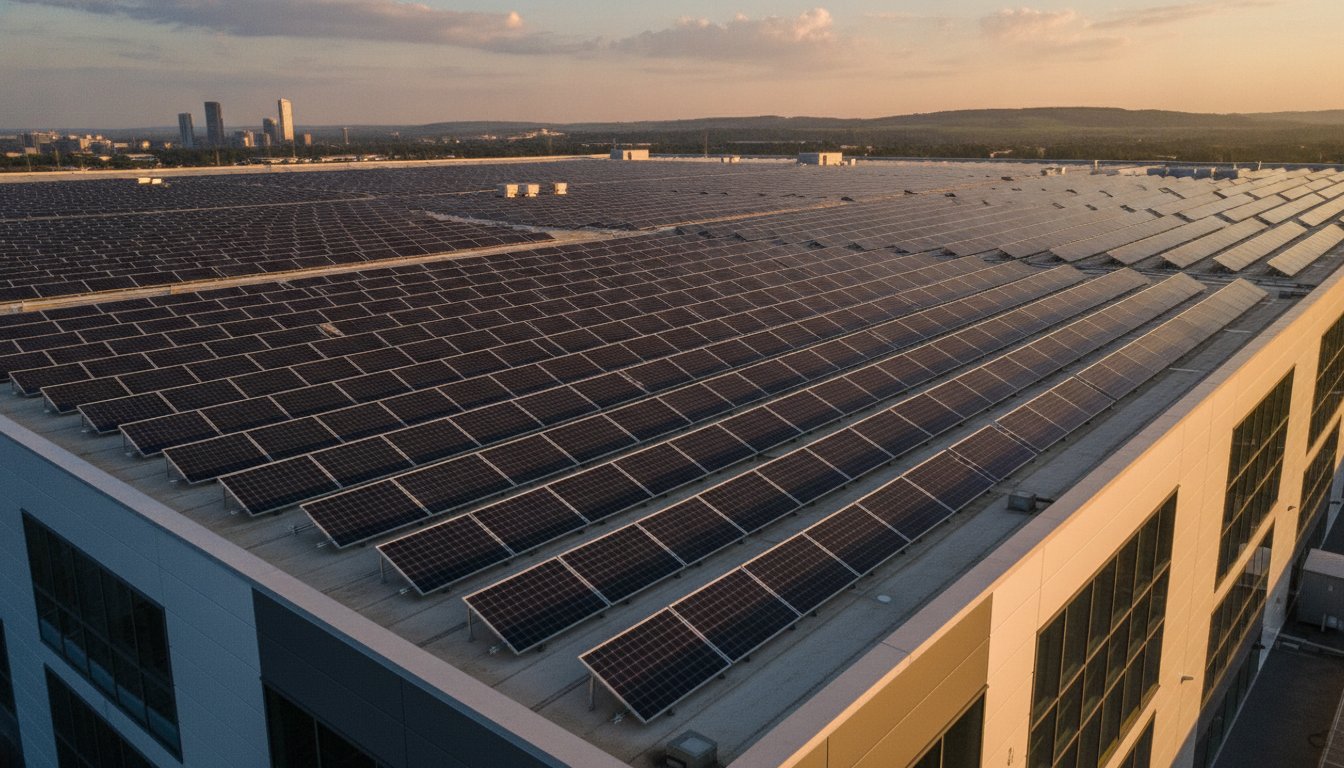
By 2026, an expansive industrial roof left empty will be viewed as a significant operational liability rather than just a structural necessity. The era of passive property management is ending. You’ve likely experienced the disruption of volatile energy pricing and the increasing complexity of grid connection hurdles whilst researching rooftop solar for commercial buildings. It’s a common challenge for decision-makers who want to stabilise overheads and navigate the pressure of shifting EPC regulations and underutilised assets.
We’re here to show you that on-site generation has evolved into a core infrastructure requirement for any resilient organisation. This strategic guide explores how to transform your roof into a high-yielding energy asset that delivers price stability and a reduced carbon footprint. We’ll preview the essential components of a successful transition, from technical feasibility and battery storage integration to the long-term protection provided by professional operation and maintenance packages.
Key Takeaways
- Understand how rooftop solar for commercial buildings has transitioned from a sustainability initiative to a critical infrastructure requirement for long-term energy price stability.
- Identify the technical variables, such as roof orientation and shading, that dictate the efficiency and yield of a bespoke commercial energy system.
- Analyse the financial advantages of different funding models and learn how to utilise the current UK tax regime to accelerate your return on investment.
- Discover sector-specific applications that allow manufacturing and logistics firms to turn underutilised roof space into high-performing energy assets.
- Navigate the turnkey installation process, including how to overcome complex grid connection hurdles and structural feasibility requirements.
The Strategic Role of Rooftop Solar for Commercial Buildings in 2026
Rooftop solar for commercial buildings is no longer a discretionary “green” addition. By 2026, it has become a high-performance energy generation asset that functions as a core component of industrial infrastructure. For businesses operating large-scale facilities, the roof represents vast, underutilised square footage that can be converted into a predictable revenue-saving tool. This transition reflects a fundamental shift in corporate strategy where energy is managed with the same precision as any other high-value capital asset.
This precision in asset management can be applied to all facility utilities; for example, Garden Watering offers advanced irrigation systems that help businesses maintain their external grounds with the same efficiency they apply to their energy generation.
The UK energy market remains characterised by price volatility and infrastructure constraints. Relying solely on the centralised grid exposes organisations to uncontrollable operational costs that can erode profit margins overnight. Self-generation provides a definitive solution to this instability. It allows businesses to decouple their productivity from the fluctuations of global wholesale gas prices whilst ensuring a reliable supply of clean power.
Meeting UK Net Zero and ESG Mandates
Installing rooftop solar for commercial buildings directly impacts a property’s Energy Performance Certificate (EPC) rating. As regulatory standards tighten, maintaining a high EPC rating is essential for preserving asset value and ensuring compliance with commercial letting requirements. Beyond simple compliance, solar installations are the most effective way to reduce Scope 2 emissions. These are the indirect emissions from purchased electricity that now form a critical part of corporate ESG reporting. Demonstrating a commitment to on-site renewable generation strengthens relationships with stakeholders and supply chain partners who demand transparency in carbon reduction efforts.
Specialist firms like Carbon Saving Group are instrumental in this transition, providing the expertise needed to implement renewable energy solutions that meet these rigorous commercial standards.
Energy Security in a Volatile Market
Energy independence is the strategic ability to fix a significant portion of your electricity costs for 25 years or more. By generating power at the point of use, your organisation creates a robust hedge against future grid price spikes. This security is significantly enhanced through the integration of industrial battery storage. These systems allow you to capture surplus solar energy during peak production and deploy it during high-tariff periods or when the sun isn’t shining. It’s a comprehensive approach that ensures your facility remains operational and cost-effective regardless of external market conditions.
Maximising Efficiency: Technical Design for Commercial Roofs
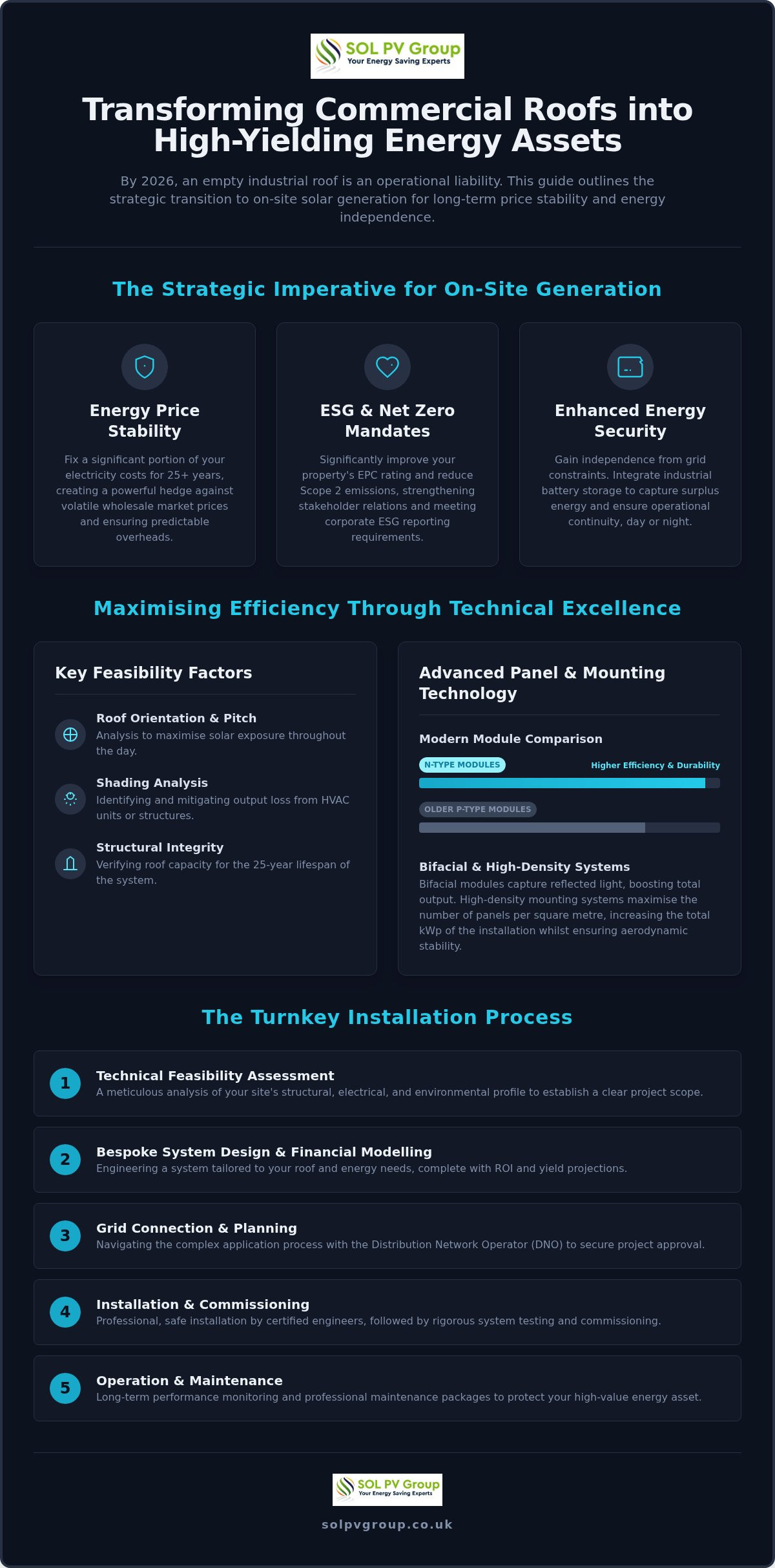
Engineering excellence is the primary driver of performance for rooftop solar for commercial buildings. A standardised, “one-size-fits-all” approach often fails to account for the unique structural and environmental nuances of large-scale industrial sites. By 2026, bespoke system design has become the industry standard for ensuring that every square metre of roof space delivers its maximum potential yield. This process begins with a meticulous analysis of the building’s specific profile, including its orientation, pitch, and any potential shading from HVAC units or adjacent structures.
Modern panel technologies have significantly increased the energy density of commercial arrays. We now utilise N-type modules, which offer superior efficiency and lower degradation rates compared to older P-type cells. In many industrial applications, bifacial modules are deployed to capture reflected light from the roof surface, further enhancing total energy output. However, these technical gains are only viable if the building’s structural integrity is verified. A comprehensive survey must ensure the roof can support the combined load of the modules, mounting hardware, and environmental factors like wind and snow for the next 25 years. Before committing capital, undertaking a thorough commercial solar feasibility study is the most effective way to validate these technical assumptions and confirm your site’s grid connection capacity. If you’re unsure about your building’s capacity, you can request a technical feasibility assessment to clarify your options.
Optimising Space and Layout
High-density mounting systems are essential for maximising the total kWp of an installation. These systems allow for closer module spacing whilst maintaining the necessary aerodynamic properties to resist wind lift. Effective layout design also integrates designated maintenance walkways. These paths ensure that technicians can access all parts of the system safely without casting shadows that would trigger a drop in generation. This level of precision is a hallmark of a professional commercial solar PV installation UK strategy, where longevity and accessibility are prioritised alongside raw power output.
Inverter Technology and System Monitoring
The choice of inverter technology is a critical decision in the design phase. String inverters remain the preferred choice for large, unobstructed roof sections due to their high efficiency and ease of service. Conversely, micro-inverters or power optimisers provide granular control in environments where complex shading is unavoidable. Regardless of the hardware, real-time monitoring is non-negotiable. Digital platforms provide instant alerts for performance deviations, allowing for proactive operation and maintenance. This data-led approach ensures that any technical issues are resolved before they can impact the system’s long-term ROI or your organisation’s energy security.
Financial Analysis: ROI, Business Rates, and PPAs
The financial viability of rooftop solar for commercial buildings has reached a pivotal tipping point. Whilst technical efficiency is vital, the strategic decision often rests on the chosen funding vehicle and the prevailing fiscal landscape. Direct capital expenditure (Capex) remains the most lucrative route for organisations with available liquidity. By owning the asset outright, a business captures the full value of every kilowatt-hour generated; this results in the highest long-term cumulative savings and a significant boost to the company’s balance sheet through asset ownership.
The 2026 fiscal environment is particularly supportive of on-site generation. Under the current “Full Expensing” regime, companies can claim 100% capital allowances on qualifying plant and machinery investments in the year of purchase. This provides a substantial reduction in corporation tax liability. Furthermore, the UK government has confirmed that eligible solar installations will benefit from business rates relief until 2035. This ensures that the increased property value resulting from the installation doesn’t lead to an immediate hike in local taxation, protecting the project’s early-stage profitability. Understanding how to fully leverage these reliefs is explored in detail in our guide to commercial solar capital allowances UK, which outlines how to maximise your business ROI through the Annual Investment Allowance and First-Year Allowance.
The Power Purchase Agreement (PPA) Model
For organisations prioritising capital preservation, the Power Purchase Agreement (PPA) offers a compelling alternative. In this model, a third-party investor funds the entire installation, including the ongoing operation and maintenance. The business simply purchases the generated electricity at a pre-agreed rate, which is typically significantly lower than standard grid tariffs. This provides immediate electricity price certainty and operational resilience with zero upfront cost. PPAs are also an effective solution for tenant-landlord scenarios, as they allow tenants to benefit from cheaper power whilst the landlord sees an improvement in the building’s EPC rating without a major capital outlay; firms like MaddisonV Properties often advise on such structures to ensure they align with broader portfolio management goals.
Calculating Long-Term Yield and ROI
Several variables influence the ultimate return on investment, including annual panel degradation rates and the cost of professional upkeep. Technological advancements in N-type modules have reduced degradation, ensuring that systems maintain high performance well into their second decade of operation. A well-designed system typically pays for itself within 4-6 years, though this can vary based on specific energy consumption patterns and local grid constraints. To understand how these financial variables translate into tangible results for diverse industries, we encourage you to explore our case studies for real-world ROI data and performance metrics.
Sector-Specific Strategies: Manufacturing and Logistics
Manufacturing and logistics represent the most energy-intensive sectors in the UK industrial landscape. For these businesses, rooftop solar for commercial buildings serves as a critical buffer against the rising cost of production and distribution. While the technical principles of solar remain consistent, the strategic application varies significantly between a high-output factory and a high-volume distribution centre. Understanding these sector-specific nuances is essential for achieving the maximum possible self-consumption rate and securing a rapid return on investment.
Solar for the Manufacturing Sector
Industrial facilities often operate with heavy machinery and continuous production lines that create a massive, steady baseline energy demand. This profile is perfectly suited for solar integration because the facility can consume the vast majority of its generated power as it’s produced. For manufacturing clients, this high level of self-consumption is the most direct route to reducing operational overheads. Beyond simple energy replacement, solar arrays enable sophisticated peak-shaving strategies. By using on-site generation to meet demand spikes, manufacturers can lower their agreed capacity with the grid; this reduces fixed demand charges and avoids expensive “red zone” tariff periods during peak hours.
Warehousing and Logistics Optimisation
Logistics hubs and warehouses are characterised by expansive, flat roof structures that offer some of the best square-footage-to-yield ratios in the country. These large surfaces allow for the deployment of high-capacity arrays that can power everything from automated picking systems to massive temperature-controlled storage zones. Cold storage facilities, in particular, benefit from a natural synergy with solar. The energy required for refrigeration peaks during the sunniest parts of the day, which reduces the strain on the grid and ensures that sensitive stock is maintained at lower costs. For guidance on implementing these systems, empireelectricalinnovations.co.uk provides expertise in bespoke commercial solar and battery storage solutions.
The strategic value of these roofs extends to the ground level through the rapid growth of EV charging infrastructure. As logistics firms transition their delivery fleets to electric vehicles, the need for a reliable, low-cost power source becomes paramount. Rooftop solar provides the necessary energy to charge transport fleets during downtime, effectively turning a warehouse into a self-sustaining fuel station. This integrated approach not only supports Net Zero targets but also provides long-term protection against the volatility of the commercial fuel market. To determine the most effective configuration for your site, arrange a comprehensive energy profile analysis with our technical team.
The Turnkey Installation Process: From Feasibility to Commissioning
Implementing rooftop solar for commercial buildings requires a methodical, end-to-end approach that mitigates technical and regulatory risks. A full-turnkey solution ensures that every phase of the project, from the initial site audit to final energisation, is managed with meticulous attention to detail. This structured lifecycle is designed to provide high-level decision-makers with the security that their transition to on-site generation will be handled without disrupting core business operations.
The process begins with a comprehensive feasibility study and structural roof survey. This initial assessment verifies that the building can accommodate the additional load and identifies the most efficient layout for maximum energy yield. A structured commercial solar feasibility study checklist is an invaluable tool at this stage, ensuring that every technical and financial assumption — from G99 application constraints to capital allowance eligibility — is rigorously validated before any capital is committed. Following this, the project moves through several critical stages:
- Grid Management: We handle the complex DNO (Distribution Network Operator) applications to secure your connection.
- System Design: Our engineers create a bespoke system utilising Tier-1 components, ensuring the highest standards of hardware reliability.
- Professional Installation: Our teams execute the build with a focus on safety and minimal site disruption, working around your operational schedule.
- Commissioning: The system undergoes rigorous testing before we provide a full handover of the performance monitoring platform.
Managing Grid Connections
In the 2026 UK energy market, early G99 or G100 applications are critical. Grid capacity is a finite resource; delay in the application process can lead to significant project setbacks or restricted export capabilities. We utilise advanced export limitation devices to help secure connection approvals in areas where the local network is constrained. Sol PV Group handles all DNO negotiations on your behalf, navigating the technical hurdles that often stall commercial projects. This proactive management ensures your system is integrated into the grid as efficiently as possible.
Ensuring Operational Longevity
A solar array is a 25-year asset that requires consistent oversight to maintain its performance. Ongoing operation and maintenance (O&M) contracts are essential for protecting manufacturer warranties and ensuring the system operates at peak efficiency. Our remote monitoring services provide real-time data, allowing us to identify and resolve minor technical faults before they escalate into major outages. This level of ongoing support is what transforms a simple installation into a dependable energy infrastructure asset. If you’re ready to secure your organisation’s energy future, you can enquire about a turnkey rooftop solar solution to begin your feasibility assessment.
Securing Your Organisation’s Energy Future
The transition toward on-site generation is no longer a speculative venture; it’s a fundamental requirement for industrial resilience. By converting underutilised roof space into a high-performance power plant, businesses can effectively decouple their operational costs from the volatility of the national grid. We’ve explored how technical precision, strategic financial planning, and specialised sector knowledge combine to deliver a robust return on investment whilst meeting stringent ESG mandates.
Sol PV Group provides national UK coverage for large-scale projects, offering a full-turnkey service that spans from the first structural survey to ongoing operation and maintenance. As specialists in manufacturing and logistics energy solutions, we understand the technical complexities of high-demand sites and the critical importance of maintaining uptime. Implementing rooftop solar for commercial buildings is a definitive step toward long-term price stability and carbon reduction.
For business leaders who also manage high-end residential portfolios in London and require the same level of structural precision, you can discover Powerpillar Ltd to explore premium renovation and construction options.
Take the first step toward transforming your property into a high-yielding energy asset. Request a Turnkey Commercial Solar Feasibility Study today to receive a bespoke technical and financial analysis for your facility. We look forward to supporting your business growth through engineering excellence and strategic energy management.
Frequently Asked Questions
Do I need planning permission for rooftop solar on a commercial building?
Most installations fall under Permitted Development Rights, meaning formal planning permission isn’t required for the majority of projects. However, exceptions apply if your property is a listed building, situated in a conservation area, or if the system exceeds specific size thresholds. We recommend a preliminary check with your local authority to ensure full compliance before beginning any rooftop solar for commercial buildings project.
How much weight can a typical commercial roof support for solar panels?
A standard commercial solar array typically adds between 10kg and 20kg per square metre to the roof’s load. Most modern industrial buildings are designed with sufficient structural margins to accommodate this weight without issue. However, a professional structural survey is a non-negotiable step in our feasibility process to confirm that your specific roof can safely support the long-term load of the panels and mounting hardware.
Can I install solar if I am a tenant in a commercial building?
Tenants can benefit from solar through various arrangements, though landlord consent is always required. Common methods include a variation in the lease or a Power Purchase Agreement (PPA), where the tenant pays for the generated energy at a lower rate than the grid. These agreements often increase the property’s value and EPC rating, providing a clear incentive for landlords to approve the installation.
In the context of multi-unit residential or mixed-use developments, coordination between management companies and residents is vital; resources like winfieldsblockmanagement.co.uk offer the expertise required to navigate estate management and communal infrastructure improvements.
How long does a commercial rooftop solar installation take to complete?
The physical installation timeline depends heavily on the system’s scale and complexity. A 6.6kw solar panel installation for a small commercial unit might be completed in a single day, whereas a large-scale 500kW project can take several weeks of on-site work. This timeline doesn’t include the initial feasibility, design, and DNO application phases, which should be started several months in advance to ensure a seamless transition to clean energy.
What happens to the solar energy if my business is closed at the weekend?
Any surplus energy generated whilst your facility is closed is either exported back to the national grid or stored for later use. Exported power can generate revenue through the Smart Export Guarantee (SEG) or a negotiated export PPA. Alternatively, integrating battery storage allows you to capture this weekend energy and deploy it on Monday morning, further reducing your reliance on expensive grid power during peak hours.
Will installing solar panels damage my existing roof warranty?
A professional installation should not compromise your existing roof warranty when executed correctly. We work closely with roofing manufacturers and use non-penetrative mounting systems where possible to ensure the structural integrity of the weatherproofing remains intact. It’s vital to notify your roof warranty provider before installation begins; our technical team often manages this communication to ensure all specific warranty conditions are fully met. For residential property owners looking to maintain their building’s envelope, Powersol Solutions specialises in roofing and siding services that ensure long-term structural protection.
What is the lifespan of a commercial rooftop solar system in the UK?
Modern Tier-1 solar panels are designed to last between 25 and 30 years, with performance warranties typically covering this entire duration. Whilst the panels are highly durable, other components like inverters may require replacement or refurbishment after 12 to 15 years. Regular operation and maintenance packages are essential to ensure the entire system reaches its full life expectancy whilst maintaining optimal energy output for your business.
Are there grants available for commercial solar in 2026?
Direct government grants for rooftop solar for commercial buildings are currently limited; however, the financial incentive has shifted toward significant tax-based relief. The “Full Expensing” regime allows companies to deduct the total cost of the installation from their taxable profits in the first year of purchase. Additionally, current relief on business rates for renewable energy assets ensures that your local tax liability doesn’t increase as a result of the installation. For a comprehensive breakdown of how to apply these reliefs effectively, our dedicated guide on commercial solar capital allowances UK provides a definitive roadmap for maximising your tax position in 2026.