
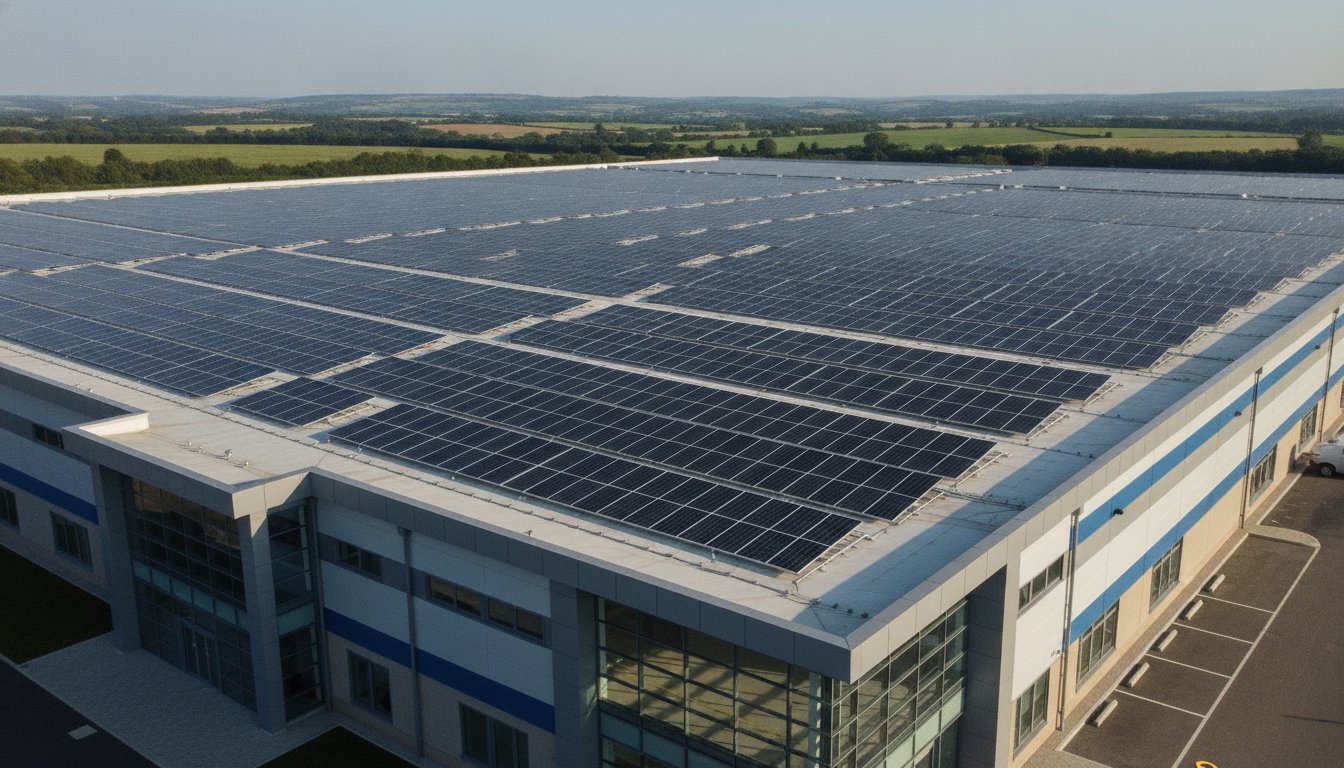
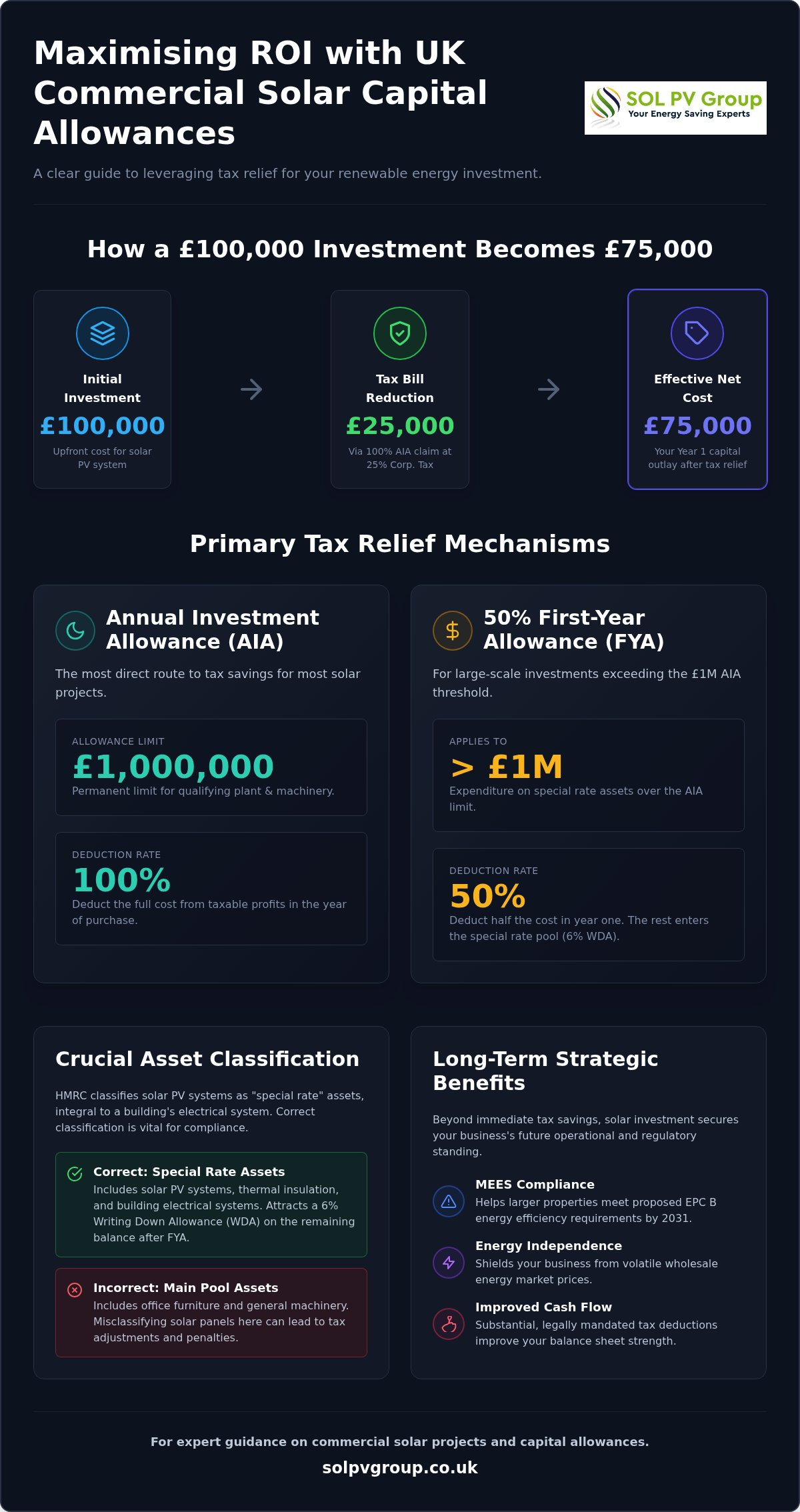
Could a £100,000 investment in your facility’s infrastructure actually cost your business only £75,000 within its first year? For many UK companies, the perceived barrier to renewable transition is the high upfront cost; yet current tax legislation offers a powerful mechanism to offset these expenses almost immediately. As energy prices remain a volatile factor for industrial margins, the ability to reclaim significant capital through commercial solar capital allowances UK has become a critical component of modern fiscal planning.
We understand that navigating the complexities of HMRC’s evolving rules can be daunting, especially with the recent permanence of key reliefs and shifting MEES requirements for larger commercial properties. You likely recognise that energy independence is essential, but you need certainty that your capital is working as hard as possible. This article provides a definitive roadmap for leveraging the £1 million Annual Investment Allowance and the 50% First-Year Allowance to maximise your project’s ROI. We will break down the precise tax savings available for solar and battery storage installations, ensuring your transition to sustainable power is both compliant and highly profitable.
Key Takeaways
- Understand how the permanent £1 million Annual Investment Allowance (AIA) allows your business to deduct the full cost of solar installations from taxable profits in the year of purchase.
- Learn how to strategically apply commercial solar capital allowances UK to reduce the effective net cost of your renewable energy transition by up to 25%.
- Discover the financial advantages of the 50% First-Year Allowance (FYA) for large-scale projects that exceed the standard AIA threshold.
- Identify how solar PV installations help larger commercial properties meet the proposed EPC B requirements by 2031, ensuring long-term MEES compliance.
- Recognise the critical role of professional feasibility studies and grid management in securing technical eligibility for maximum tax relief.
Understanding Commercial Solar Capital Allowances in the UK
Capital allowances serve as a fundamental pillar of UK corporate tax strategy. By Understanding Capital Allowances, finance directors can ensure that the accounting depreciation of physical assets is replaced by a more tax-efficient legislative relief. For businesses investing in renewable infrastructure, HMRC classifies these expenditures under specific categories to determine how quickly the cost can be recovered against annual profits.
Under the Capital Allowances Act 2001 (CAA01/S104A), solar photovoltaic systems are designated as “special rate” expenditure. This classification distinguishes them from main pool assets, such as office equipment or general machinery, which typically attract a different rate of annual relief. Whilst main pool assets qualify for a 14% writing down allowance as of April 2026, solar panels are viewed as integral features of a commercial building’s electrical system. This designation is a deliberate part of the UK’s strategy to reach Net Zero by 2050, incentivising the decarbonisation of manufacturing plants and transport networks.
To better understand how these tax mechanisms apply to your project, watch this helpful video:
The Role of Special Rate Pool Assets
Assets in the special rate pool usually attract a 6% writing down allowance (WDA) on a reducing balance basis. This applies to the residual value of the asset after any initial first-year claims, such as the Annual Investment Allowance, have been utilised. Solar is treated as an integral feature because it’s functionally part of the building’s infrastructure, much like a heating or cooling system. Precise asset categorisation is vital for HMRC compliance; don’t make the mistake of misidentifying solar infrastructure as main pool expenditure, as this can lead to costly tax adjustments and potential penalties during a corporate audit.
Fiscal Incentives for Renewable Energy in 2026
In 2026, the UK tax landscape remains highly favourable for green energy investments. The government has formalised permanent first-year allowances to accelerate the payback period of renewable assets, providing much-needed certainty for long-term capital planning. Beyond the immediate tax relief, these incentives foster genuine energy independence, shielding businesses from the volatility of the wholesale energy market whilst improving overall operational resilience. Utilising commercial solar capital allowances UK ensures that your environmental commitment translates directly into balance sheet strength and improved cash flow. A professional commercial solar PV installation UK effectively reduces the net capital outlay of the project through these substantial and legally mandated tax deductions.
Key Tax Reliefs: Annual Investment Allowance (AIA) and Full Expensing
The UK tax system offers two primary mechanisms for recovering the cost of renewable energy infrastructure: the Annual Investment Allowance (AIA) and the First-Year Allowance (FYA) under full expensing rules. For the 2026/27 tax year, the AIA remains at its permanent limit of £1,000,000. This allowance allows businesses to deduct 100% of the qualifying cost of solar panels and other plant and machinery from their taxable profits in the year of purchase. It’s the most efficient route for most small and medium-sized enterprises to achieve an immediate tax saving.
When capital expenditure exceeds the £1 million AIA limit, limited companies can utilise the 50% First-Year Allowance. Whilst main pool assets qualify for 100% full expensing, solar panels are classified as special rate assets. This means that for any spend above the AIA threshold, you can still deduct 50% of the cost in the first year, with the remaining balance entering the special rate pool for subsequent writing down allowances. You can find detailed technical specifications on qualifying equipment in the official government guidance regarding plant and machinery.
Strategic prioritisation is essential for commercial solar capital allowances UK. Because solar panels typically attract a lower 6% writing down allowance compared to the 14% rate for main pool assets, it’s financially prudent to allocate your AIA to solar projects first. This ensures you receive 100% relief on “slower” assets whilst allowing main pool items to benefit from full expensing. Eligibility for these reliefs varies; limited companies subject to Corporation Tax can access both AIA and FYA, whereas sole traders and partnerships are generally limited to the AIA.
Maximising the £1 Million AIA Limit
For large-scale industrial projects, the £1 million limit requires careful allocation across various project components. If your business operates as part of a group, remember that the AIA is typically shared across the group rather than being available to each individual company. This necessitates a coordinated approach to capital expenditure to ensure that no tax relief is left on the table. For manufacturing facilities with high energy demands, a well-structured claim can significantly shorten the payback period of the installation.
Allowances for Battery Storage and EV Charging
Integrating industrial battery storage into your solar project often follows the same special rate classification as the PV system itself. However, the tax treatment of EV charging infrastructure can differ, as these assets may qualify for main pool treatment or specific 100% first-year allowances depending on their primary use. Capturing the full value of these investments requires a holistic energy asset plan that considers how each component interacts with current tax legislation. To ensure your project is designed for maximum tax efficiency from the outset, you might consider a tailored energy strategy that aligns your technical requirements with available fiscal incentives.
Case Study: How Capital Allowances Accelerate Commercial Solar ROI
To understand the true fiscal impact of renewable investment, one must look beyond the gross installation quote. For a typical manufacturing facility in the UK, energy costs represent a significant portion of operational overheads. By integrating commercial solar capital allowances UK into the project’s financial modelling, the net cost of the asset is fundamentally transformed. Consider a 250kWp warehouse rooftop installation with a capital cost of £210,000. Under current 2026 tax regulations, a company paying the main 25% Corporation Tax rate can achieve a tax saving of £52,500 in the first year alone. This immediate reduction in tax liability effectively lowers the net project cost to £157,500 before a single kilowatt-hour of energy has been generated.
This front-loaded tax relief has a profound effect on the project’s payback period. Whilst a standard commercial solar system might traditionally see a return on investment within five to six years through energy savings alone, the inclusion of capital allowances typically accelerates this by 12 to 24 months. From an accountant’s perspective on capital allowances, this mechanism converts a long-term capital commitment into an immediate cash flow advantage. The liquidity released through these tax savings can be instantly reinvested into other areas of the business, such as production machinery or further energy efficiency measures, creating a compounding benefit for the organisation’s balance sheet.
The “Day One” Tax Benefit
The “Day One” benefit refers to the significant cash flow injection received at the end of the first tax year following the installation. For a larger £250,000 solar investment, the corporation tax saving reaches £62,500, assuming the business has sufficient taxable profits to offset the claim. This immediate relief significantly improves the internal rate of return (IRR), making solar projects much more competitive against other capital expenditure priorities. Applying the 100% AIA to a qualifying solar project reduces the net capital expenditure by exactly the amount of corporation tax the company would have otherwise paid on those profits.
Long-term Yield vs. Initial Tax Relief
Whilst the initial tax saving is substantial, the long-term ROI relies on sustained technical performance. Businesses must balance the immediate writing down allowances with the ongoing yield generated by the system over its 25-year lifespan. To protect the integrity of these long-term returns, it’s vital to factor in solar PV operation and maintenance UK costs to ensure the hardware continues to perform at peak efficiency. When viewed over two decades, the cumulative benefit of avoided energy costs, coupled with the initial tax relief and potential Smart Export Guarantee (SEG) payments, provides a level of financial security that few other facility upgrades can match.
Navigating MEES Compliance and Technical Requirements
The regulatory landscape for commercial property is shifting, making energy efficiency a matter of legal necessity rather than just corporate social responsibility. Whilst the government has moved away from the previously proposed 2027 EPC C milestone, the current focus is on a more rigorous Energy Performance Certificate (EPC) rating of B by 2031 for all leased commercial properties larger than 1,000 m². For owners of large-scale facilities, particularly those operating transport and logistics hubs, failing to meet these standards presents a genuine risk of “stranded assets” that cannot be legally let. Integrating solar PV is one of the most effective methods to boost an EPC rating, ensuring your property remains a viable and valuable asset in the long term.
To secure the maximum benefit from commercial solar capital allowances UK, businesses must adhere to strict HMRC technical criteria. A primary requirement for claiming the 50% First-Year Allowance is that the plant and machinery must be “new and unused”. This means that refurbished or second-hand systems are ineligible for the most accelerated forms of relief. By investing in contemporary, high-efficiency hardware, companies not only ensure tax compliance but also benefit from the superior performance and longevity of modern solar technology. This technical alignment is essential for high-level decision-makers who require certainty that their capital investment is protected by both law and operational excellence.
Technical Feasibility and Tax Eligibility
A professional commercial solar feasibility study for UK businesses is the foundation of any successful tax-planning strategy. This assessment ensures that the proposed installation meets the statutory definition of “plant and machinery” under the Capital Allowances Act. It’s often necessary to implement separate metering for specific system components to provide the granular data required for accurate tax reporting. Meticulous planning at this stage prevents future disputes with HMRC and ensures that every pound spent on mounting structures, inverters, and cabling is correctly categorised for maximum relief.
Sector-Specific Opportunities: Manufacturing and Warehousing
Businesses in the manufacturing sector are exceptionally well-positioned to capitalise on their expansive roof footprints. The vast, unobstructed spaces typical of logistics centres and factories are ideal for large-scale commercial rooftop solar installations. These projects allow companies to mitigate the impact of high energy demand through tax-subsidised infrastructure, effectively turning a passive building element into a revenue-generating power plant. In an era of rising operational costs, the ability to offset 100% of these project costs against taxable profits through the AIA provides a significant competitive advantage. Understanding the full scope of commercial solar PV design and installation — including DNO approvals and grid connection requirements — is essential to ensuring your project qualifies for maximum tax relief from day one.
To ensure your facility remains compliant with future energy standards whilst securing the best possible tax position, you can request a bespoke commercial solar strategy from our expert technical team.
Securing Your 2026 Solar Strategy with Sol PV Group
Executing a large-scale renewable energy project requires more than technical hardware; it demands a partner who understands the intersection of engineering and fiscal strategy. Sol PV Group operates as a seasoned expert in the industrial landscape, providing a full-turnkey service that manages every phase of the transition. We handle everything from the initial technical feasibility and complex grid connection negotiations to final commissioning and long-term Operation and Maintenance (O&M). Our deep integration into the manufacturing and logistics sectors allows us to navigate the unique challenges of high-demand environments with methodical precision.
Our approach is designed to provide high-level decision-makers with the security and stability they need when committing significant capital. We don’t just install panels; we design systems that are optimised for technical compliance and maximum financial yield. By ensuring every component is correctly specified and documented, we help your business confidently claim commercial solar capital allowances UK. This comprehensive oversight ensures that your investment is protected by rigorous technical standards and a commitment to professional integrity.
The Turnkey Advantage for Financial Directors
Financial Directors often face the challenge of managing multi-faceted projects with various points of failure. We eliminate this risk by providing a single point of accountability. Our team ensures that all technical documentation is meticulously prepared to support your capital allowance claims, proving that the infrastructure meets HMRC’s “new and unused” criteria. Beyond the installation phase, our O&M packages provide ongoing performance monitoring. This proactive care ensures that your tax-subsidised investment continues to perform at peak efficiency, protecting the long-term internal rate of return (IRR) we projected during the feasibility stage.
Take the First Step Toward Energy Independence
Strategic timing is essential when planning a solar rollout. Aligning your project’s completion with your business’s financial year-end can be the difference between waiting twelve months or several years to realise the cash flow benefits of the Annual Investment Allowance. We recommend starting with a comprehensive feasibility report that outlines the technical potential of your site and the specific tax reliefs available to your organisation. This data-driven foundation allows you to make informed decisions that balance operational needs with fiscal efficiency. Before committing capital, reviewing a 2026 strategic checklist for a commercial solar feasibility study can help you validate every technical and financial assumption, from grid connection constraints to G99 application requirements. Our experts are ready to guide you through the complexities of the 2026 tax landscape, ensuring your transition to sustainable power is both seamless and highly profitable.
To begin your journey toward energy independence and secure a detailed breakdown of your potential tax savings, you can request your free solar strategy and ROI analysis today.
Strategic Energy Investments for a Decarbonised Future
Strategic energy transition is no longer a discretionary choice but a fiscal imperative for the modern enterprise. By utilising the permanent £1 million Annual Investment Allowance and the 50% First-Year Allowance, your organisation can drastically reduce the net capital outlay of renewable infrastructure. These commercial solar capital allowances UK provide the necessary liquidity to meet the upcoming 2031 MEES requirements whilst shielding your operational margins from energy market volatility.
Sol PV Group serves as an authoritative partner for this transition, specialising in the complex requirements of the manufacturing and logistics sectors. We provide a full-turnkey service encompassing technical design, complex grid management, and detailed tax-efficiency reporting. It’s a methodical approach that ensures your project is not only an engineering success but also a robust financial asset that delivers sustained value.
The path to energy independence begins with a clear understanding of your site’s potential and the associated fiscal benefits. Book your free commercial solar strategy and ROI consultation today to secure your business’s future. We’re ready to help you transform your facility into a high-performing, tax-efficient power plant.
Frequently Asked Questions
Do solar panels qualify for the 100% Annual Investment Allowance (AIA)?
Yes, solar panels qualify for the 100% Annual Investment Allowance (AIA) up to the permanent £1,000,000 limit. This allows businesses to deduct the full cost of the installation from their taxable profits in the first year. It’s the most common route for SMEs to recover capital costs quickly, provided the total annual investment across all plant and machinery stays within the cap.
What is the difference between main pool and special rate pool for solar?
Solar panels are classified as special rate assets because they’re considered integral features of a building. Main pool assets typically attract a 14% writing down allowance as of April 2026, whilst special rate assets like solar PV attract a 6% rate. This distinction is crucial for tax planning once the initial AIA threshold has been exceeded and you’re calculating long-term relief.
Can businesses still claim the 50% First Year Allowance in 2026?
Yes, limited companies can claim the 50% First Year Allowance (FYA) for solar expenditure that exceeds the £1 million AIA cap. This relief was made permanent by the Finance Act 2024. It provides a significant tax-saving mechanism for large-scale industrial projects where the total capital expenditure surpasses the standard allowance, ensuring continued incentive for major renewable investments.
Does battery storage qualify for commercial solar capital allowances?
Battery storage systems generally qualify for commercial solar capital allowances UK when installed as part of a renewable energy system. These assets are typically categorised as special rate expenditure. Including storage in your project allows you to offset the costs of both the generation and storage hardware against your annual corporation tax liability, improving the overall project payback.
How do solar panels affect my building’s EPC rating and MEES compliance?
Solar PV installations significantly improve a building’s Energy Performance Certificate (EPC) rating by reducing reliance on grid-supplied electricity. This is a critical step for meeting Minimum Energy Efficiency Standards (MEES) requirements. For properties over 1,000 m², achieving an EPC B rating by 2031 is the current target to avoid legal restrictions on leasing and protect asset value.
Can I claim capital allowances on a second-hand commercial solar system?
No, you cannot claim the 50% First Year Allowance or Full Expensing on second-hand systems. HMRC rules stipulate that plant and machinery must be “new and unused” to qualify for these specific reliefs. Whilst second-hand assets may still qualify for the standard AIA or basic writing down allowances, they don’t benefit from the accelerated first-year incentives designed for new infrastructure.
What documentation does HMRC require for solar capital allowance claims?
HMRC requires detailed technical documentation, including itemised invoices, proof of commissioning, and evidence that the system is “new and unused”. A professional feasibility study and a grid connection agreement also help substantiate the claim. Maintaining accurate records of all “integral feature” components is vital to ensure compliance and support your position during a technical tax audit.
Is the installation cost of solar PV eligible for tax relief?
Yes, the full cost of a commercial solar capital allowances UK project, including professional installation and mounting hardware, is eligible for relief. HMRC allows for the inclusion of all costs directly related to making the asset functional. This includes grid management fees and structural reinforcements necessary for the rooftop installation, providing a comprehensive deduction against your taxable profits. For a detailed overview of how system design affects both technical performance and tax eligibility, our guide to commercial solar PV design and installation for 2026 outlines the key considerations for UK businesses planning large-scale projects.