
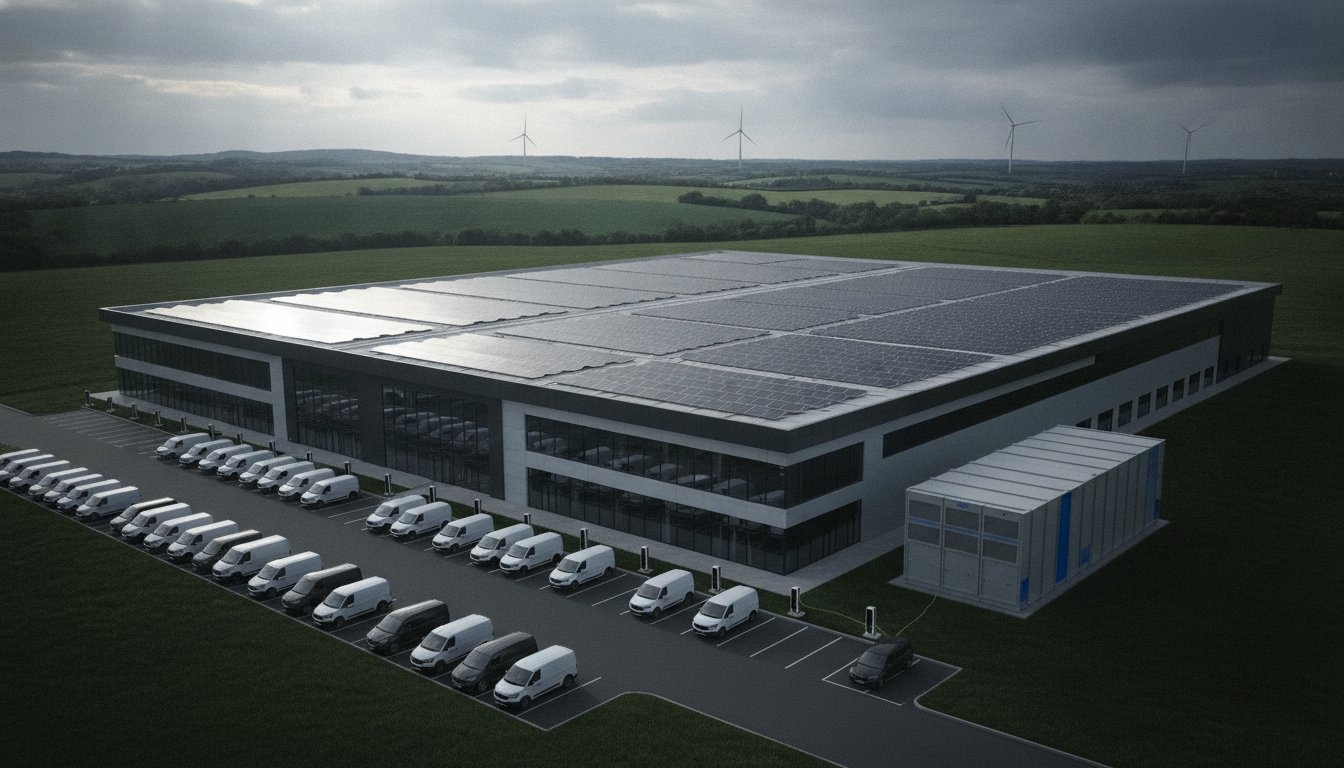
With out-of-contract business electricity rates reaching 40.0p per kWh as of August 2026, the financial penalty for energy inertia has never been more severe. You’re likely feeling the mounting pressure from stakeholders to meet ambitious ESG targets whilst simultaneously protecting your margins from volatile grid pricing. Effectively decarbonising business energy supply is no longer just a corporate social responsibility goal; it’s a fundamental requirement for operational stability. It’s a complex balancing act where the technical starting point often feels obscured by conflicting advice and shifting regulations.
This guide provides a definitive roadmap for transitioning your energy infrastructure in a way that prioritises both environmental integrity and long-term cost reduction. We’ll outline a structured framework that moves from initial feasibility to the deployment of high-performance on-site solar PV and battery storage systems. By following this strategic approach, your organisation can secure lower energy costs and a verified reduction in carbon emissions. We’ll examine how to navigate the technical complexities of grid connections and why an infrastructure-first strategy is now the only reliable path to commercial resilience in the UK’s evolving energy market.
Key Takeaways
- Learn the critical distinctions between Scope 1, 2, and 3 emissions to ensure your environmental reporting meets current UK standards.
- Discover why transitioning from standard monthly billing to granular half-hourly data is essential for identifying and mitigating high-intensity carbon peaks.
- Develop a robust framework for decarbonising business energy supply by prioritising on-site asset ownership and the strategic principle of additionality.
- Understand the essential technical milestones of a successful transition, including commercial solar feasibility studies and grid connection management.
- Explore how integrating industrial battery storage and EV charging infrastructure maximises the financial returns and operational resilience of your low-carbon investment.
Understanding the Urgency of Decarbonising Business Energy Supply
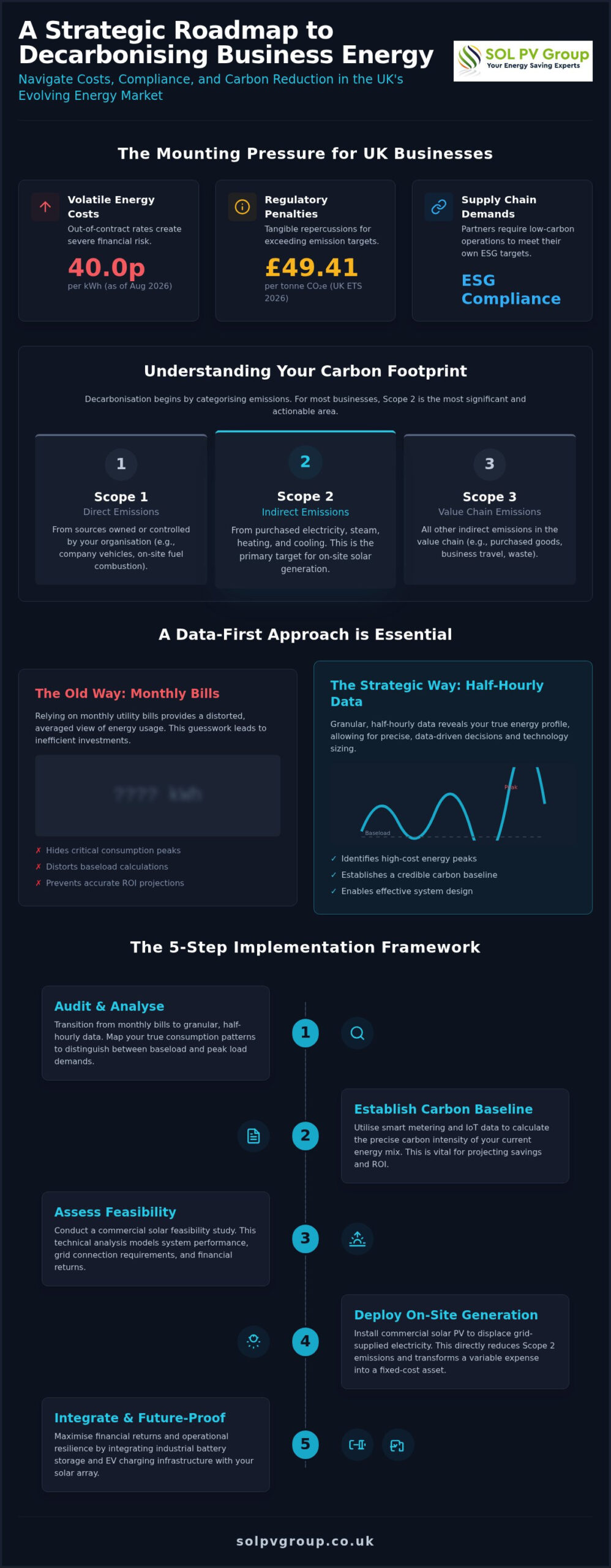
Decarbonising business energy supply represents the systematic reduction of carbon intensity across an organisation’s power procurement and generation processes. It’s no longer a voluntary environmental gesture but a core strategic pillar for UK firms. Transitioning away from carbon-heavy energy sources involves a granular understanding of your carbon footprint, specifically categorised into Scope 1, 2, and 3 emissions. Scope 1 covers direct emissions from owned or controlled sources, whilst Scope 3 encompasses the broader value chain. For most commercial entities, the immediate priority lies within Scope 2: the indirect emissions from purchased electricity.
The 2026 regulatory environment has significantly raised the stakes for ESG reporting. With the UK Emissions Trading Scheme (ETS) civil penalty carbon price set at £49.41 per tonne of CO2 equivalent for the 2026 reporting year, the financial repercussions for exceeding emissions targets are tangible. Relying on volatile fossil fuel markets introduces substantial economic risk. For instance, businesses on out-of-contract rates faced prices reaching 40.0p per kWh in July 2026. A foundational step in mitigating these risks is understanding sustainable energy and how it integrates into a modern industrial framework.
The Role of Scope 2 Emissions in Business Footprints
Purchased electricity often constitutes the largest portion of a business carbon footprint. Whilst the National Grid is gradually incorporating more renewables, your individual reporting remains tied to the grid’s average carbon intensity unless you take direct action. Implementing commercial solar PV installation allows an organisation to generate power on-site. This directly reduces reported Scope 2 figures by displacing grid-supplied electricity with zero-carbon generation. It transforms a variable operational expense into a controlled, fixed-cost asset that provides long-term financial security.
Drivers for Decarbonisation in 2026
Supply chain requirements have become a primary driver for change. Major UK firms in transport and logistics now demand low-carbon operations from their partners to satisfy their own Scope 3 targets. Financial incentives also play a role; for example, the main rate for the Climate Change Levy (CCL) for electricity is £0.00801 per kWh from April 2026. Beyond tax avoidance, decarbonising business energy supply fosters operational resilience. By reducing reliance on external energy providers, businesses insulate themselves from price shocks and grid instability, turning sustainability into a measurable competitive advantage.
Auditing and Mapping Your Current Energy Consumption
A successful roadmap for decarbonising business energy supply begins with data, not hardware. Relying on monthly utility bills provides a distorted view of actual consumption patterns. It’s essential to transition to granular, half-hourly data to understand your organisation’s energy profile. This level of detail allows you to distinguish between your ‘baseload’, the minimum power required for 24/7 operations, and ‘peak load’, the surges caused by industrial machinery or climate control systems. Identifying these peaks is critical because they often coincide with periods of high carbon intensity on the National Grid.
Energy monitoring systems (EMS) provide the necessary visibility to establish a credible baseline. Without this, any investment in low-carbon technology is based on guesswork rather than empirical evidence. By mapping real-time usage, you can identify inefficiencies that don’t require capital expenditure to resolve. This audit serves as the foundation for all subsequent technical decisions, ensuring that your transition to low-carbon alternatives is both cost-effective and operationally sound.
Establishing a Carbon Baseline
Calculating the carbon intensity of your current energy mix requires accurate input data. With the UK’s move towards mandatory half-hourly settlement, businesses must utilise smart metering and IoT devices, especially as new smart meter performance standards came into force on 23 February 2026. This data is vital for projecting the return on investment (ROI) for future projects. It allows for precise carbon saving projections that stand up to stakeholder scrutiny and meet the latest UK Sustainability Reporting Standards (SRS). You can’t manage what you don’t measure; therefore, establishing this baseline is the first non-negotiable step in your journey.
Site Feasibility and Infrastructure Readiness
Once the data is secured, the focus shifts to physical site constraints. A thorough assessment of roof integrity and orientation is required for a successful commercial solar PV installation UK. You must also review existing electrical infrastructure to determine if your distribution boards have the spare capacity for integrated systems like EV chargers or large-scale battery storage. Early grid connection enquiries are equally important. They help identify potential bottlenecks or network reinforcement costs that could impact your project’s timeline. Understanding these variables early prevents costly delays during the commissioning phase.
To ensure your data collection aligns with your long-term goals for decarbonising business energy supply, you might consider an initial review of your energy infrastructure to identify immediate opportunities for carbon reduction.
On-Site Generation vs. Green Procurement: Strategic Comparison
Deciding how to approach decarbonising business energy supply often involves a choice between procurement and generation. Whilst green tariffs are an accessible entry point, they often lack ‘additionality’. This is the principle that your investment directly results in new renewable capacity being added to the grid. In contrast, on-site commercial solar PV installation creates new, clean power exactly where it is consumed. This reduces the burden on the National Grid and provides a far more robust carbon reduction claim for your ESG reporting. Relying solely on the grid, even with a green contract, leaves your organisation exposed to transmission charges and the volatile wholesale market.
The risk profile of grid reliance has become increasingly clear. With out-of-contract rates reaching approximately 40.0p per kWh in mid-2026, businesses that fail to generate their own power remain vulnerable to external price shocks. Solar PV serves as the foundational technology for UK business decarbonisation because it transforms a variable operational expense into a predictable, fixed-cost asset. It provides a level of energy independence that procurement alone cannot offer.
The Benefits of Asset Ownership
Owning your energy assets offers a level of long-term cost certainty that procurement contracts cannot match. By generating your own power, you effectively lock in a significant portion of your energy costs for the 25 to 30 year lifespan of the system. This acts as a powerful hedge against grid price inflation. Furthermore, asset ownership provides direct control over carbon data. You aren’t relying on a third party’s reporting; you have the raw generation data to verify your Scope 2 reductions precisely. From a corporate finance perspective, these installations are high-value tangible assets. They improve the balance sheet and can significantly enhance the overall valuation of industrial and commercial properties, particularly in sectors like manufacturing.
Green Procurement and Corporate PPAs
Green procurement still has a role as a secondary measure for energy needs that on-site generation cannot meet. However, businesses must be wary of ‘greenwashing’ risks associated with low-quality Renewable Energy Guarantees of Origin (REGO) certificates. Some standard green tariffs simply purchase these certificates without supporting new renewable projects. A more sophisticated approach involves corporate Power Purchase Agreements (PPAs), which can provide a direct link to specific renewable sites. The most resilient strategy is a hybrid model. This combines on-site solar and battery storage to cover the majority of your baseload, supplemented by high-quality green procurement contracts for any remaining grid requirements. This approach ensures maximum carbon integrity whilst maintaining operational flexibility.
Five Steps to Implementing a Carbon Reduction Strategy
Transitioning from the audit phase to physical implementation requires a structured framework to ensure technical success and financial viability. The process of decarbonising business energy supply is best managed through a five-step methodology that moves from theoretical potential to operational reality. First, conduct a commercial solar feasibility study to validate the business case. This assessment evaluates site-specific variables such as roof load-bearing capacity and potential solar yield to confirm the project’s ROI. Once the case is proven, the subsequent steps focus on technical design, procurement, commissioning, and long-term asset management.
Navigating Technical Design and Grid Connections
Professional design is critical, particularly for manufacturing sites that often feature high inductive loads from heavy machinery. Inaccurate inverter sizing or poor system design can lead to inefficiencies or equipment failure. Managing G99 grid applications is equally vital. With grid connection lead times remaining a significant variable in 2026, early application is essential to avoid project delays. The design phase must also focus on optimising system size for maximum self-consumption. Using the energy you generate on-site is far more valuable than exporting surplus power to the grid for minimal returns, making integrated battery storage a key consideration at this stage.
Installation and Commissioning Standards
The physical installation phase on an active commercial site requires meticulous planning to maintain safety and operational continuity. High-quality installers prioritising safety standards will ensure minimal disruption to your daily operations. It’s essential that your chosen partner holds MCS and other relevant industry certifications. These benchmarks guarantee that both the hardware and the installation methods meet the rigorous standards required for industrial insurance and long-term reliability.
Following installation, the commissioning phase verifies the system’s performance against the carbon baseline established during your initial audit. This step provides the verified data necessary for transparent ESG reporting. Finally, a comprehensive operation and maintenance (O&M) package protects the performance of your assets over their 25-year lifespan. Regular monitoring and preventative care ensure that your carbon reduction targets are consistently met. To move beyond the planning phase, you can request a bespoke solar strategy to define your path toward energy independence.
Future-Proofing with Integrated Energy Systems
The final stage in decarbonising business energy supply is moving beyond standalone generation to a fully integrated energy ecosystem. Whilst solar PV provides the raw power, its true value is unlocked when paired with intelligent storage and distribution technologies. Smart energy management software acts as the brain of this system, balancing supply from your roof with the demands of your facility in real time. This automated approach ensures that not a single kilowatt-hour of clean energy is wasted, allowing your organisation to scale its strategy as operational needs evolve. It creates a flexible foundation that can adapt to future changes in the UK grid and your own commercial growth.
Solar and Battery Synergy
Implementing industrial battery storage transforms intermittent solar power into a dispatchable asset. This enables load shifting, where solar energy generated during the day is stored and utilised during peak tariff periods when grid prices are highest. For businesses in manufacturing, these systems provide critical Uninterruptible Power Supply (UPS) capabilities, protecting sensitive industrial processes from grid fluctuations. Battery systems also allow for “peak shaving”, which involves discharging stored energy to keep your site’s total demand below specific thresholds. This strategy is particularly effective for avoiding expensive peak demand charges from your Distribution Network Operator (DNO), providing a double benefit of carbon reduction and significant cost avoidance.
Electrifying Transport and Logistics
As corporate fleets transition to electric vehicles, the demand on your site’s electrical infrastructure will inevitably increase. Integrating solar carports offers a dual-purpose solution: providing shaded parking whilst generating clean electricity specifically for employee and fleet charging. This approach is highly effective for the transport and logistics sector, where large vehicle footprints require significant power. A scalable workplace EV charging strategy ensures you don’t over-invest in infrastructure today but remain ready for the full electrification of your fleet tomorrow. By using on-site generation to power your vehicles, you eliminate the carbon footprint of your business travel while insulating your transport costs from the volatile petrol and diesel markets.
Building an integrated system requires technical precision and a deep understanding of UK grid regulations. By consolidating solar, storage, and EV infrastructure into a single managed strategy, your business doesn’t just reduce its carbon footprint; it gains total control over its energy future. A cohesive approach to decarbonising business energy supply ensures long-term viability and operational excellence. If you’re ready to move from planning to implementation, book your free solar strategy session here to explore a bespoke solution for your facility.
Securing Your Energy Future Through Strategic Infrastructure
The transition toward a low-carbon economy is no longer a peripheral concern for UK organisations. Successfully decarbonising business energy supply requires a shift from passive procurement to active on-site generation. By establishing a robust carbon baseline through granular data and prioritising asset ownership over standard green tariffs, you protect your margins from volatile grid pricing while ensuring absolute transparency in your ESG reporting. These strategic investments transform energy from a variable cost into a high-performing corporate asset.
Sol PV Group provides the technical expertise necessary to navigate this complexity with confidence. We specialise in delivering full-turnkey design and installation solutions tailored for high-demand sectors, specifically manufacturing and logistics. Our approach ensures that every system is optimised for maximum self-consumption and long-term reliability, supported by comprehensive O&M packages that protect your investment for decades. It’s time to move beyond the uncertainty of the external energy market and take control of your operational resilience.
Secure your future energy independence with a free solar strategy session and begin your journey toward a sustainable, self-sufficient energy ecosystem today.
Frequently Asked Questions
What is the first step in a carbon reduction strategy for a UK business?
The first step is conducting a comprehensive energy audit to establish a verified carbon baseline. This involves moving beyond monthly utility bills to analyse granular half-hourly consumption data. By identifying baseload and peak demand patterns, you can pinpoint exactly where decarbonising business energy supply will have the most immediate financial and environmental impact. This data-driven foundation ensures that subsequent investments in hardware are sized correctly for your specific operational requirements.
How much can a commercial solar PV system reduce my carbon footprint?
A commercial solar PV system can typically reduce a site’s carbon emissions by 20% to 50% depending on available roof space and energy intensity. For manufacturing facilities with high daytime loads, the reduction is often at the higher end of this scale. The exact saving is verified during the feasibility stage by comparing projected generation against your established baseline. These verified reductions are essential for transparent ESG reporting and avoiding the financial penalties associated with high carbon intensity.
Can my business become 100% energy independent?
Achieving 100% energy independence is technically challenging for most industrial sites, but a high degree of self-sufficiency is entirely possible. Most organisations target 60% to 80% independence by combining solar generation with battery storage. Total independence requires significant oversizing of the array and massive storage capacity to cover winter months. Instead, we recommend a hybrid strategy that balances on-site generation with high-quality green procurement to reach net-zero goals without compromising operational stability.
What are Scope 2 emissions and why do they matter for decarbonisation?
Scope 2 emissions are indirect greenhouse gas emissions associated with the purchase of electricity, steam, heat, or cooling. For UK businesses, these often represent the largest portion of their total carbon footprint. Addressing these emissions is a priority because they’re easier to measure and mitigate than Scope 3 value chain emissions. By generating your own power on-site, you directly displace grid-supplied electricity, which immediately lowers your reported Scope 2 figures and improves your sustainability credentials.
Is battery storage necessary for an effective carbon reduction strategy?
Battery storage isn’t strictly mandatory, but it’s increasingly essential for an effective strategy for decarbonising business energy supply. Without storage, any solar power generated during low-demand periods is exported to the grid for minimal return. Batteries allow you to capture this surplus and use it during peak tariff periods or when solar production is low. This maximises your self-consumption and provides additional benefits like peak shaving and uninterruptible power supply for sensitive industrial equipment.
How long does it take to implement a full-turnkey solar installation?
A full-turnkey solar installation typically takes between four to nine months from the initial feasibility study to final commissioning. The physical installation phase is often the shortest part, usually lasting only a few weeks. Much of the timeline is dedicated to technical design, structural assessments, and managing the G99 grid connection application with your local Distribution Network Operator. Professional project management ensures these stages progress logically without causing disruption to your daily operations.
Are there government grants available for business decarbonisation in 2026?
Direct grants are less common in 2026, but significant financial relief exists through schemes like the British Industrial Competitiveness Scheme (BICS). Applications for BICS, which assists energy-intensive industries with electricity costs, open from 1 October 2026 to 30 November 2026. Additionally, businesses can benefit from the Carbon Price Support (CPS) rate freeze and various capital allowance schemes. These mechanisms often provide a better long-term return than one-off grants by incentivising the ownership of low-carbon assets.
How do I ensure my solar panels continue to deliver carbon savings over 20 years?
Long-term carbon savings are secured through a professional Operation and Maintenance (O&M) package. Solar PV is a low-maintenance technology, but regular cleaning, thermal imaging, and inverter health checks are required to prevent performance degradation. Ongoing monitoring allows for the early detection of inefficiencies that could impact your ROI. By maintaining the system to high standards, you ensure it continues to generate clean power at peak efficiency throughout its expected 25 to 30 year lifespan.