
In 2026, the success of your EV charging infrastructure UK strategy depends less on the hardware you select and more on how you manage the energy behind it. With the ZEV Mandate driving rapid adoption and over 2 million electric vehicles now on our roads, the era of simple installations has ended. You likely recognise the frustration of facing prohibitive grid connection costs or the complexity of DNO applications that threaten to stall your decarbonisation roadmap. These bottlenecks are common; however, they shouldn’t dictate your operational capacity or leave you with stranded assets as technology evolves.
This reference provides the clarity required to deploy a resilient charging network whilst avoiding common capital expenditure pitfalls. You’ll gain a comprehensive understanding of how to integrate commercial solar PV and battery storage to bypass grid limitations effectively. We will examine the specific requirements for ISO 15118-20 compliance and detail the strategic steps needed to ensure your infrastructure remains future-proof against the next decade of regulatory shifts.
Key Takeaways
- Understand how the 2026 ZEV Mandate is accelerating fleet transitions and why infrastructure must encompass sub-stations and cabling rather than just charge points.
- Identify the optimal hardware mix for your site whilst ensuring your EV charging infrastructure UK project remains interoperable through the latest OCPP software standards.
- Learn to navigate complex DNO requirements and why a professional feasibility study is the non-negotiable first step to assessing existing site capacity.
- Compare strategic deployment models, ranging from employee-focused workplace charging to high-capacity depot solutions for 24/7 logistics and distribution.
- Discover how to bypass grid capacity constraints by integrating commercial solar carports and battery storage to create a self-sustaining energy ecosystem.
The Current Landscape of EV Charging Infrastructure in the UK
Effective EV charging infrastructure UK planning now requires a shift in perspective. It’s no longer sufficient to view a charge point as an isolated piece of hardware. Instead, it must be understood as a complex ecosystem involving sub-stations, reinforced cabling, and sophisticated load-management software. As of 2026, the UK EV Charging Landscape has matured, with the Office for Zero Emission Vehicles (OZEV) mandating higher standards for reliability and smart functionality whilst ensuring data transparency. Businesses are pivoting toward private, behind-the-meter solutions to avoid the volatility of the public network and ensure operational continuity.
To better understand the practicalities of the current network and its limitations, watch this helpful video analysis:
UK Legislative Drivers and Compliance
The 2026 ZEV Mandate serves as a firm regulatory hand for UK fleet operators. It dictates that a significant portion of new vehicle sales must be zero-emission, making the transition an immediate procurement priority. This legislation aligns with the broader 2030 and 2035 phase-out dates for internal combustion engines. Beyond simple compliance, firms in transport and logistics must now integrate these assets into their Scope 2 and 3 emissions reporting. Accurate carbon footprint data is a requirement for modern corporate transparency. Private charging infrastructure provides the most reliable data stream for these audits, allowing for precise tracking of energy consumption and carbon intensity.
The Infrastructure Gap: Targets vs. Reality
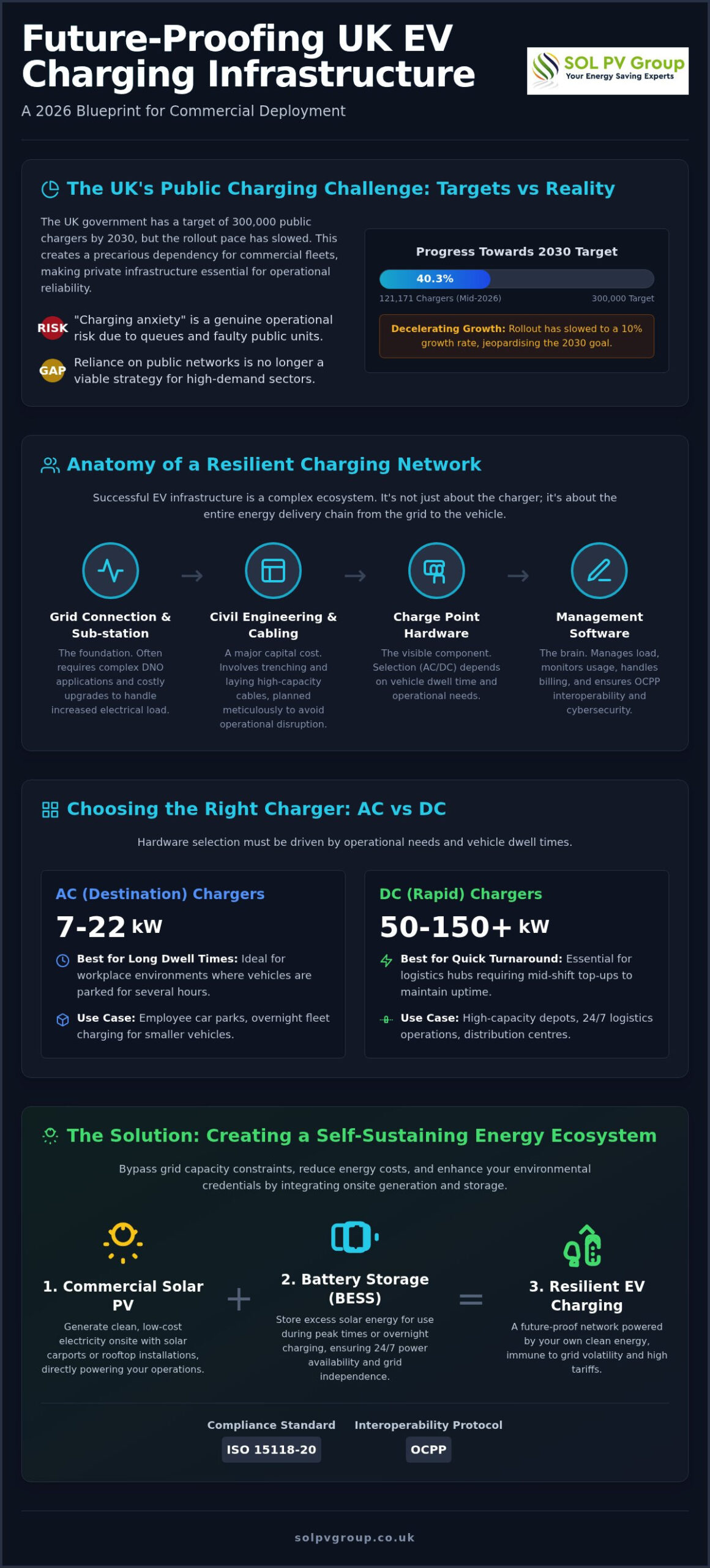
The government target of 300,000 public chargers by 2030 remains a formidable challenge. Although the UK reached 121,171 public chargers by mid-2026, the rollout pace has decelerated to a 10% growth rate. For commercial operators, this creates a precarious dependency. “Charging anxiety” has become a genuine operational risk; drivers often face queues or faulty units at public hubs. Grid capacity constraints, lengthy planning permissions, and the complexities of capital allocation mean that businesses must take control of their own power supply. Relying solely on public EV charging infrastructure UK networks is no longer a viable strategy for high-demand sectors like manufacturing or distribution. Private investment in onsite capacity is now the only way to guarantee fleet readiness.
Technical Components of Commercial EV Infrastructure
Deploying EV charging infrastructure UK assets involves far more than selecting a pedestal and connecting it to a power source. Technical success relies on the seamless integration of hardware, software, and civil engineering. As site requirements grow, the focus shifts from simple connectivity to sophisticated energy management. This ensures that the installation remains a functional asset rather than a liability to the existing electrical supply.
Civil engineering often represents a substantial portion of the initial capital expenditure. This phase includes trenching for high-capacity cabling and the possible installation of new sub-stations to accommodate the increased demand. For businesses in transport and logistics, these physical upgrades must be planned meticulously to avoid disrupting daily operations. Modern installations also require robust cybersecurity measures to meet the Smart Charge Point Regulations, protecting both the hardware and the corporate data network.
Charging Levels and Hardware Selection
Hardware selection should be dictated by vehicle dwell time and operational duty cycles. AC units, typically ranging from 7kW to 22kW, serve as excellent destination chargers for workplace environments where cars remain stationary for several hours. Conversely, DC rapid chargers (50kW to 150kW) are necessary for hubs requiring mid-shift top-ups. In a workplace setting, untethered units offer flexibility for various vehicle types, whilst tethered units are often preferred in dedicated fleet depots for their ease of use and reduced cable wear. Ultra-rapid charging in 2026 refers to DC systems delivering 150kW or more, essential for minimising downtime in heavy-duty logistics cycles.
Software, Connectivity, and Data Management
The intelligence of your network resides in the Charge Point Management System (CPMS). To avoid being locked into a single vendor, it’s vital to specify hardware that supports the Open Charge Point Protocol (OCPP) 2.1. This standard ensures interoperability and allows for advanced features like Plug and Charge. According to the UK government’s EV infrastructure strategy, data transparency is a cornerstone of a reliable national network. In 2026, Vehicle-to-Grid (V2G) technology has also moved beyond pilot schemes, offering commercial sites the ability to use fleet batteries as a flexible energy resource during peak demand periods.
Dynamic load balancing is the final, critical piece of the technical puzzle. This software-driven process monitors the total site load in real-time and adjusts the power delivered to each charger accordingly. It prevents the site from exceeding its agreed supply capacity, which is particularly important when charging coincides with heavy industrial machinery use. Before committing to a specific hardware configuration, it is often beneficial to evaluate your energy profile through a comprehensive site strategy to ensure your grid connection can support your long-term fleet goals. Integrating battery storage can further stabilise these loads, providing a buffer against peak-time tariff spikes.
Strategic Deployment Models for UK Businesses
Selecting the right operational model is as critical as the hardware itself. Whilst Official UK Government EV Statistics highlight the consistent growth of public hubs, businesses must prioritise their specific operational profiles to ensure long-term viability. A well-designed EV charging infrastructure UK strategy balances initial capital expenditure with the ongoing utility of the site, ensuring that the transition to electric transport remains a supportive pillar for business growth rather than a technical burden.
Workplace Charging for Offices and Manufacturing
Implementing charging at an office or factory serves as a powerful employee retention tool whilst decarbonising the daily commute. Access management is typically handled via RFID cards or app-based authentication, allowing for tiered pricing or prioritised access for essential staff. Decision-makers should consider the Benefit-in-Kind (BIK) implications, as providing electricity for private use remains a taxable benefit, though rates for electric vehicles remain highly competitive in 2026. Large-scale manufacturing sites can significantly offset these operational costs by utilising unused roof space for solar-linked charging systems, creating a virtuous circle of zero-carbon transport that reduces reliance on the external grid. This same principle applies across public sector organisations; for example, solar energy for the education sector is delivering substantial savings for UK schools that have adopted integrated solar PV and EV charging solutions.
Depot and Logistics Infrastructure
Optimising a depot for 24/7 logistics requires a focus on high-capacity throughput and vehicle dwell times. Simultaneous charging allows multiple vehicles to charge at once, but sequential charging can be more cost-effective for fleets with staggered departure times. For sites transitioning to electric HGVs, space planning is paramount; turning circles and bay lengths must accommodate larger chassis and the specific requirements of megawatt charging. Integrating these systems requires deep expertise in transport and logistics infrastructure to ensure the grid connection isn’t overwhelmed during peak loading windows, particularly when rapid turnarounds are required for heavy-duty cycles.
Beyond private use, the public-facing commercial model allows businesses to turn car parks into revenue-generating assets. By offering rapid charging to the general public or local residents, organisations can recoup infrastructure costs more quickly through a pay-to-charge model. This approach requires careful consideration of public access, payment interoperability, and the potential for increased wear on site assets. Regardless of the model chosen, the priority remains a composed, results-oriented deployment that handles complex technical transitions with meticulous care.
Navigating Grid Connections and DNO Requirements
The Distribution Network Operator (DNO) acts as the gatekeeper for any large-scale EV charging infrastructure UK project. Every commercial site operates under a specific “Agreed Capacity” with the local network; exceeding this limit without formal authorisation can result in system failures or substantial financial penalties. Consequently, a comprehensive feasibility study is a non-negotiable first step. This technical audit determines whether your current electrical supply can support the additional load of rapid chargers or if a significant grid reinforcement is required.
The DNO Application Process
Securing a connection for high-capacity charging is a methodical process that requires technical precision. It begins with identifying your local DNO and auditing your existing supply capacity to establish a baseline for your energy profile. Following this, you must submit a formal connection application, which often includes G99 or G100 documentation if your project integrates onsite generation assets. Once submitted, the DNO provides a formal offer detailing the necessary works, which are categorised as either contestable or non-contestable.
Managing Connection Costs and Timelines
Lead times for significant grid upgrades in 2026 typically range from six to twelve months, depending on the complexity of the local network. To mitigate these delays, many businesses utilise Automated Load Management (ALM). This software-driven approach monitors site demand in real-time and throttles charger output during peak periods, frequently removing the need for a physical upgrade entirely. It’s also vital to distinguish between work types; contestable works refer to the electrical infrastructure tasks, such as trenching and sub-station installation, that can be handled by an Independent Connection Provider (ICP) rather than the DNO itself.
When a DNO quotes a seven-figure sum for grid reinforcement, it doesn’t necessarily signal the end of a project. Strategic alternatives exist to bypass these constraints and reduce capital expenditure. Integrating battery storage allows you to buffer energy from the grid during off-peak hours, discharging it during high-demand charging windows. This approach is particularly effective for transport and logistics hubs where operational uptime is the primary metric of success. Navigating these technical hurdles requires a seasoned partner who understands the nuances of the UK’s electrical regulatory framework. To ensure your project remains viable, you should request a comprehensive feasibility and grid strategy before committing to hardware procurement.
Future-Proofing with Solar PV and Battery Storage
Designing a robust EV charging infrastructure UK network requires a departure from the traditional grid-first mentality. As discussed in the previous section, DNO constraints often impose significant financial and temporal barriers to fleet electrification. Integrating renewable energy assets on-site provides a definitive solution to these bottlenecks, transforming a passive cost centre into a strategic energy asset. Strategic integration is the key. This synergy ensures that your transport operations remain resilient against fluctuating energy markets whilst meeting the stringent sustainability mandates of 2026.
Integrating Commercial Solar PV
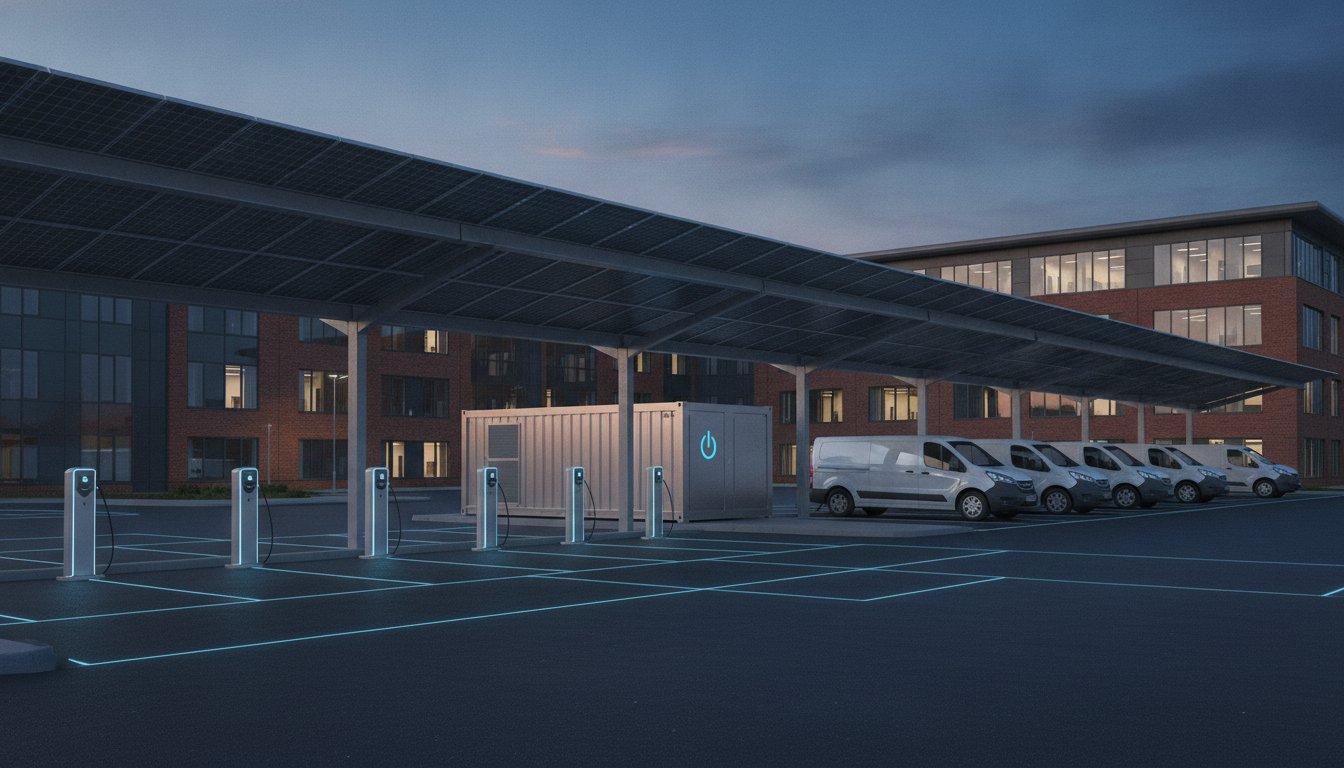
The application of commercial solar carports offers a dual-use advantage for logistics and manufacturing sites. These structures turn existing car parks into productive power stations, shielding vehicles from the elements whilst generating zero-carbon electricity directly above the point of use. For a detailed technical breakdown of these systems, refer to our Solar battery EV charging for business: 2026 strategic guide. Calculating the percentage of fleet demand met by solar is a critical feasibility step. Many sites find that a well-optimised array can cover a significant portion of daytime charging requirements, particularly for employee commutes or delivery vans with midday dwell times. This reduces the burden on your main incoming supply and improves your overall ESG score.
The Role of Battery Energy Storage Systems (BESS)
Battery Energy Storage Systems (BESS) are the operational glue that holds a renewable-integrated site together. By deploying battery storage solutions, businesses can capture excess solar energy generated during the day for use during overnight fleet charging windows. This process, known as peak shaving, allows vehicles to charge at high speeds without exceeding the site’s agreed grid capacity. It’s a method that effectively bypasses the need for costly sub-station upgrades.
Beyond operational support, BESS enables revenue stacking through grid balancing services amongst other Frequency Response schemes. This allows the business to receive payments for supporting the national grid during periods of instability, providing a secondary income stream that offsets the initial capital expenditure. Modern battery systems are now sophisticated enough to manage these transitions automatically, ensuring that fleet readiness is never compromised for the sake of grid support.
The ultimate goal of this integration is the reduction of the Levelised Cost of Energy (LCOE) for your fleet. By generating and storing your own power, you decouple your transport costs from the volatility of the wholesale electricity market. This provides long-term price certainty, which is essential for accurate corporate budgeting and operational forecasting. In a landscape where energy costs are a primary overhead, taking control of your generation is the most effective way to future-proof your commercial infrastructure.
Securing Your Operational Advantage
Transitioning to a zero-emission fleet is a multifaceted industrial project that requires precision at every stage. We’ve explored how a successful EV charging infrastructure UK strategy must integrate advanced power management with robust hardware. The most resilient sites in 2026 are those that prioritise early DNO engagement and leverage on-site renewable generation to bypass grid constraints. By combining commercial solar PV with industrial battery storage, you protect your logistics or manufacturing operations from energy market volatility whilst ensuring compliance with the ZEV Mandate.
Sol PV Group provides the technical expertise needed to handle these complex transitions with meticulous care. As specialists in the manufacturing and logistics sectors, we manage the entire lifecycle of your project, including the full DNO application process and the integration of solar and battery assets. Our approach ensures your infrastructure remains a long-term strategic asset rather than a technical burden. We’re committed to delivering operational excellence that supports your business growth through every stage of the energy transition.
Take the first step toward a self-sustaining energy ecosystem. Request a Turnkey EV Infrastructure Feasibility Study from Sol PV Group today to secure your site’s future capacity.
Frequently Asked Questions
How much does EV charging infrastructure cost for a UK business in 2026?
Costs for EV charging infrastructure UK projects vary significantly based on hardware specifications and civil requirements. Whilst we cannot provide specific pricing here, businesses typically categorise expenditure into hardware procurement, installation labour, and potential grid reinforcement fees. AC units for workplaces are the most accessible option, whilst high-capacity DC rapid chargers for logistics hubs require a larger capital commitment. Factors like trenching distances and sub-station upgrades will also influence the total investment.
What is the difference between a DNO and an ICP for EV installations?
A Distribution Network Operator (DNO) owns and manages the electrical grid in your specific region. An Independent Connection Provider (ICP) is an accredited company that can perform contestable works, such as installing sub-stations or cabling, which were traditionally only handled by the DNO. Using an ICP often provides greater flexibility in project timelines and competitive tension on pricing for the infrastructure components of your installation. It allows for a more streamlined deployment process.
Can I install EV chargers if my site has limited grid capacity?
You can certainly deploy charging assets on sites with restricted supply by utilising smart energy management. Automated Load Management (ALM) software dynamically distributes power to chargers based on real-time site demand, preventing fuse failure. Alternatively, integrating battery storage allows you to buffer energy during low-demand periods, whilst solar carports provide a supplementary zero-carbon power source that reduces your reliance on the primary grid connection. These solutions bypass the need for costly upgrades.
What grants are available for commercial EV charging in the UK for 2026?
As of April 2026, the Workplace Charging Scheme (WCS) provides vouchers worth £500 per socket for eligible organisations. This grant covers up to 75% of purchase and installation costs for a maximum of 40 sockets across all sites. This scheme remains available until 31 March 2027. Additionally, a 0% VAT rate applies to the installation of solar and battery storage systems, which can significantly lower the cost of integrated charging projects and improve your return on investment.
How long does it take to get a grid connection for a large EV hub?
Securing a grid connection for a high-capacity hub typically takes between six and twelve months. This duration includes the initial DNO application period, the technical design phase, and the physical installation of sub-stations or reinforced cabling. Early engagement with a specialist provider is essential to ensure your procurement cycles align with these utility lead times. Smaller AC installations may be completed much faster if sufficient spare capacity exists on-site to handle the additional load.
Is planning permission required for commercial EV charging points?
Most commercial charging installations fall under Permitted Development Rights, meaning formal planning permission is often unnecessary. However, restrictions apply regarding the height of the units and their proximity to the highway. If your site is a listed building or located within a conservation area, you must consult your local planning authority. Solar carports and large sub-station enclosures almost always require a full planning application due to their structural scale and potential impact on the local environment.
What is the ZEV Mandate and how does it affect my business infrastructure?
The Zero Emission Vehicle (ZEV) Mandate requires manufacturers to ensure a rising percentage of their sales are electric, reaching significant thresholds in 2026. For businesses, this impacts vehicle availability and residual values, effectively forcing a transition in fleet procurement. You must prepare your EV charging infrastructure UK assets now to accommodate these vehicles. Delaying installation risks operational disruption as internal combustion engine options become increasingly scarce and more expensive to maintain over the coming years.
Can solar panels provide enough power for a commercial electric fleet?
Solar panels can provide a substantial portion of the energy needed for a commercial fleet, though total self-sufficiency depends on your available roof or car park space. For a typical logistics hub, on-site generation might offset 20% to 40% of daytime demand. To maximise this, you should pair the array with a Battery Energy Storage System (BESS). This allows you to store solar energy generated during the day for use during overnight charging cycles, further reducing grid dependency.